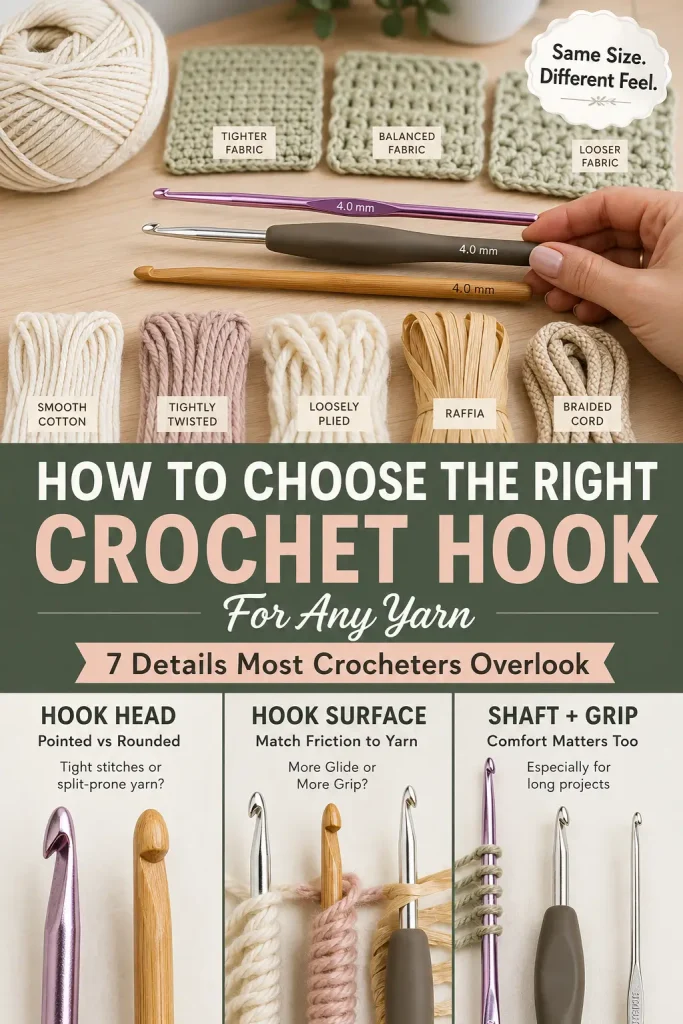
Most crocheters already own several hooks. The harder question is not whether you need another crochet hook. It is knowing which hook will actually work best with the yarn and project already sitting in your basket.
Two hooks marked 4 mm can produce surprisingly different results. The head shape, throat, shaft length, surface material, grip, and even the type of yarn can change how easily the hook enters a stitch and how consistent your tension feels.
That is why experienced crocheters often choose a hook by more than the number printed on the handle.
This guide explains how to choose a crochet hook using the details that become increasingly important as your projects get more complex.
The Hook Size on the Yarn Label Is Only a Starting Point
A yarn label may recommend a range such as 4–5 mm.
That does not mean every project made with that yarn should use the same hook.
A smaller hook generally creates:
- denser fabric
- smaller stitches
- greater structure
- less drape
A larger hook generally creates:
- looser stitches
- more drape
- larger openings
- softer fabric
The project determines which result you actually want.
For example, the same cotton yarn might work well with:
- 3.5 mm for amigurumi
- 4 mm for a structured crochet bag
- 4.5 mm for granny squares
- 5 mm for a soft summer top
- 5.5 mm for open mesh
The yarn has not changed.
The desired fabric has.
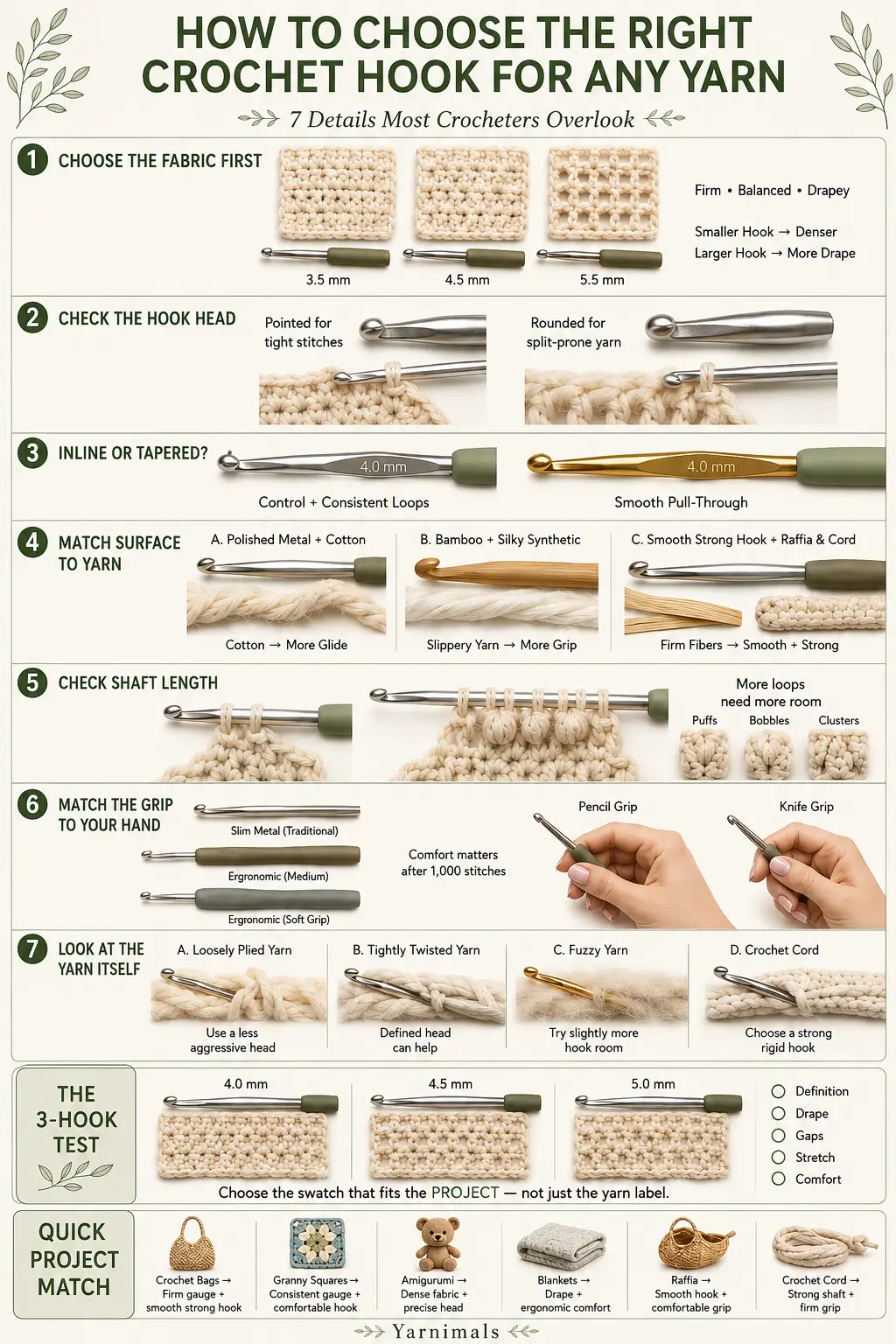
1. Choose the Hook for the Fabric You Want
Before thinking about brands or handle styles, ask one question:
What should the finished crochet fabric feel like?
For Firm Projects
Examples include:
- crochet bags
- baskets
- amigurumi
- storage containers
- straps
Choose a hook toward the smaller end of the yarn’s usable range.
You want stitches that sit closely together without becoming painfully tight.
For Soft Projects
Examples include:
- blankets
- scarves
- shawls
- garments
A slightly larger hook usually creates more comfortable drape.
For Lace and Mesh
Projects such as market bags, open summer tops, and lace shawls may intentionally use a larger hook to open the stitch pattern.
This is why buying yarn and automatically using the first hook size on the label can give disappointing results.
2. Look at the Hook Head, Not Just the Size
One of the most overlooked differences between crochet hooks is the shape of the head.
Two hooks can both be 4 mm but enter stitches very differently.
Sharper Hook Head
A more pointed head can be useful for:
- dense single crochet
- amigurumi
- tight cotton stitches
- inserting into small spaces
- working through several loops
However, an extremely sharp hook can split loosely twisted yarn.
Rounded Hook Head
A rounder head can be comfortable for:
- soft acrylic
- loosely worked stitches
- bulky yarn
- relaxed blankets
But it may be harder to push through very tight stitches.
If you constantly struggle to insert your hook, the issue may not be the hook size.
It may be the shape of the head.
3. Inline vs Tapered Hooks Can Change Your Crochet
Crochet hooks are often described as either inline or tapered.
This difference becomes more noticeable once you start paying attention to tension.
Inline Crochet Hooks
An inline hook generally has:
- a more defined throat
- a head that stays closer to the shaft width
- a deeper hook opening
Some crocheters find that inline hooks help them maintain more consistent loop sizes.
They can be especially useful for:
- granny squares
- repetitive motifs
- controlled tension
- tight crochet
Tapered Crochet Hooks
A tapered hook gradually changes width between the throat and shaft.
They often feel smooth when pulling yarn through loops.
They can be comfortable for:
- double crochet
- half double crochet
- cluster stitches
- blankets
- flowing stitch patterns
Neither style is automatically better.
The important thing is recognizing that the shape may be responsible when one hook feels easier than another even though both are technically the same size.
4. Match the Hook Surface to the Yarn
This is one of the most useful advanced crochet habits.
Do not only match hook size to yarn.
Match hook friction to yarn.
Some yarns slide very easily.
Others grip the hook.
Smooth Metal + Cotton
A smooth metal hook is often excellent for cotton because cotton can create noticeable friction.
The polished surface helps the yarn move more easily.
Useful for:
- granny square bags
- cotton blankets
- dishcloths
- market bags
- summer accessories
Bamboo or Wood + Slippery Yarn
Bamboo and some wooden hooks offer more surface grip.
That can be useful with yarn that constantly slips away from you.
Potential examples include:
- smooth synthetic yarn
- silky blends
- some mercerized fibers
Smooth Hook + Raffia
Raffia is already firm and relatively resistant.
Adding a rough hook surface can make it much harder to crochet.
A smooth hook with a comfortable grip is usually easier.
Strong Hook + Crochet Cord
Cord places more resistance on the hook than ordinary yarn.
Choose a hook that feels rigid and strong rather than one that flexes noticeably.
This matters especially for dense bag and basket projects.
5. Check the Usable Shaft Length
This detail is easy to ignore when buying crochet hooks.
Look at how much straight shaft exists before the handle begins.
Why does it matter?
Because some stitches need several loops to sit on the hook at the same time.
A very short shaft can feel cramped during:
- puff stitches
- bobbles
- cluster stitches
- tall stitches
- foundation stitches
- some Tunisian-style techniques
For ordinary single crochet, shaft length may barely matter.
For heavily textured crochet, it can make a large difference.
This is also why a beautifully shaped ergonomic hook is not automatically suitable for every technique.
6. Grip Shape Matters More on Long Projects
A small flower motif may only take a few minutes.
A blanket, tote, cardigan, or large granny square project can involve thousands of stitches.
That is when handle shape becomes much more important.
Look for an ergonomic grip that allows your hand to remain relatively relaxed.
Useful features may include:
- wider handle
- soft grip area
- smooth transition into the shaft
- enough room for your natural grip
- clearly marked size
But do not assume the thickest handle is the most comfortable.
Some crocheters prefer a narrow hook.
Others prefer a larger grip.
How you hold the hook matters.
Knife Grip vs Pencil Grip
Most crocheters naturally use a variation of one of these two grips.
Knife Grip
The hook is held somewhat like a table knife.
A wider ergonomic handle may feel particularly comfortable.
Pencil Grip
The hook is held more like a pencil.
Some oversized handles may interfere with this position.
Before buying an expensive full hook set, test one hook in the style you are considering.
A premium set is not useful if the handles do not suit the way you naturally crochet.
7. Yarn Construction Can Change Which Hook Works Best
Fiber content is not the only thing that matters.
Look at how the yarn itself is constructed.
Loosely Twisted Yarn
This yarn may split easily.
A very sharp hook can separate the strands instead of catching the whole yarn.
A slightly rounder hook may work better.
Tightly Twisted Yarn
A more defined hook head can make it easier to enter compact stitches.
Chainette Yarn
Chainette yarn has a knitted tube-like construction.
It can behave differently from conventional plied yarn and may work better with a smooth hook that does not catch the tiny loops.
Fuzzy Yarn
With fuzzy yarn, you may not be able to see every stitch clearly.
A slightly larger hook and simple head shape can make it easier to work by feel.
Chenille Yarn
Chenille requires special care because repeatedly dragging a tight hook through the yarn can damage the surface.
Do not automatically size down just because you want tighter stitches.
The Advanced Test: Crochet the Same Swatch With Three Hooks
This is one of the easiest ways to understand your hooks.
Take the yarn you plan to use.
Suppose the label recommends 4–5 mm.
Make three small swatches:
- 4 mm
- 4.5 mm
- 5 mm
Use the same stitch for each.
Then compare them.
Do not only measure gauge.
Check:
Stitch Definition
Which hook makes the pattern easiest to see?
Flexibility
Which fabric bends naturally?
Gaps
Can you see more space between stitches than you want?
Structure
Does the fabric hold its shape?
Stretch
Pull the swatch gently.
Does it recover?
Comfort
Which hook could you realistically use for 1,000 stitches?
The correct hook is often obvious once all three swatches are placed beside one another.
When You Should Ignore the Recommended Hook Size
There are several situations where changing hook size makes sense.
Amigurumi
You often need dense stitches so stuffing does not show.
A smaller hook may be appropriate.
Crochet Bags
Structure matters, so a slightly smaller hook can help reduce excessive stretch.
Lace
A larger hook can help open decorative stitches.
Garments
Drape may be more important than firmness.
Crochet Cord
The physical resistance of the cord often determines what is comfortable.
Granny Squares
Your final motif measurement may require adjusting the hook even if your yarn technically works with another size.
How to Choose a Hook for Granny Squares
For granny squares, consistency is usually more important than firmness.
Choose a hook that allows the square to:
- lie flat
- maintain clear corners
- avoid curling
- reach the required measurement
- retain visible stitch definition
Once you find that hook, use the same one for every square in the project.
Even switching between two different 4 mm hooks can occasionally change your tension because the shaft and head shapes may differ.
How to Choose a Hook for Crochet Bags
Bag fabric should generally be firmer than blanket fabric.
Use a hook that creates:
- compact stitches
- limited gaps
- good structure
- manageable hand tension
For smooth cotton, a polished aluminum or ergonomic metal hook is a strong starting choice.
For cord, focus on:
- hook strength
- comfortable grip
- smooth surface
- appropriate head shape
Do not force extremely tight stitches simply to make the bag rigid.
A lining, reinforced base, or proper yarn choice can add structure without making the crochet uncomfortable.
How to Choose a Hook for Amigurumi
The goal is usually a dense fabric that hides stuffing.
A slightly smaller hook is often used compared with ordinary crochet.
But watch the yarn.
If the hook is so small that:
- fibers split
- your hand hurts
- stitches become difficult to enter
- chenille starts shedding
go up a size.
Good amigurumi fabric should be dense, not impossible to work.
How to Choose a Hook for Blankets
Blankets usually benefit from comfort and drape.
A hook that is too small can make a large blanket:
- stiff
- heavy
- slow to crochet
For repetitive blanket projects, ergonomic comfort becomes especially important.
Also check the usable shaft if the pattern contains:
- puff stitches
- clusters
- bobbles
How to Choose a Hook for Summer Crochet
Cotton, bamboo blends, linen blends, and raffia are common in warm-weather crochet.
These fibers often have less elasticity than wool or acrylic.
A smooth hook can make them more comfortable to work.
For summer garments, avoid automatically using a small hook just because the stitches look neat.
The finished fabric still needs enough drape to move comfortably.
When Is It Worth Buying Another Crochet Hook?
You probably do not need another hook simply because it looks different.
A new hook becomes useful when it solves a specific problem.
Consider adding another hook if:
- your current hook constantly splits a favorite yarn
- dense cotton feels difficult to pull through
- your hands tire during large projects
- your handle interferes with textured stitches
- you need a stronger hook for cord
- you regularly use a size missing from your collection
- your existing hooks jump too far between sizes
- you want a different surface for slippery or high-friction yarn
This approach is more useful than collecting random sets with many sizes you rarely use.
Which Crochet Hook Sizes Are Most Useful to Own?
For someone who crochets a broad variety of projects, a practical core collection might include:
3 mm
3.5 mm
4 mm
4.5 mm
5 mm
5.5 mm
6 mm
That closely spaced range is useful because a difference of only 0.5 mm can noticeably change gauge and fabric.
Crocheters who use thick yarn or cord may also want:
6.5 mm
7 mm
8 mm
9 mm
10 mm
You do not necessarily need every size immediately.
Buy according to the materials and projects you actually use.
Do Expensive Crochet Hooks Make Better Crochet?
Not automatically.
A more expensive hook may offer:
- smoother finishing
- better handle construction
- clearer size markings
- more comfortable ergonomics
- consistent manufacturing
But price does not guarantee that the hook suits your hand or yarn.
An inexpensive smooth aluminum hook can work beautifully.
A premium ergonomic hook can feel uncomfortable if the grip shape does not match how you crochet.
Fit matters more than branding.
What to Check Before Buying a Crochet Hook
Before buying an individual hook or full set, check:
Size range: Does it include the sizes you actually use?
Head shape: Is it appropriate for the yarns you crochet most often?
Surface: Do you need more glide or more grip?
Shaft length: Is there enough room for textured stitches?
Handle: Does it work with your grip style?
Strength: Will it handle cotton cord or dense crochet?
Markings: Can you easily identify the size?
Weight: Will it remain comfortable during long sessions?
These details can be more important than the number of accessories included in the package.
The Crochet Hook Pairing Guide
A useful starting point is:
| Project or Yarn | Hook Feature to Prioritize |
|---|---|
| Cotton Bags | Smooth surface + firm gauge |
| Granny Squares | Consistent shaft + comfortable grip |
| Amigurumi | Precise head + smaller gauge |
| Raffia Bags | Smooth hook + ergonomic grip |
| Crochet Cord | Strong shaft + comfortable handle |
| Slippery Yarn | Slightly grippier surface |
| Fuzzy Yarn | Simple head + slightly larger size |
| Puff/Cluster Stitches | Longer usable shaft |
| Large Blankets | Ergonomic comfort |
| Summer Garments | Smooth hook + enough size for drape |
A Better Way to Build Your Crochet Hook Collection
Instead of buying every crochet hook you see, build your collection around problems you want to solve.
Start with the sizes you already use.
Then add:
- a smoother hook for cotton
- a comfortable ergonomic hook for long projects
- a strong larger hook for cord
- a grippier hook for slippery yarn
- closely spaced half-millimeter sizes for gauge adjustment
Over time, you end up with a smaller collection of hooks that actually perform different jobs.
That is much more useful than owning several nearly identical sets.
FAQ
Why do two crochet hooks of the same size feel different?
The diameter may be the same, but the hook head, throat, shaft, material, surface friction, and handle can all differ. Those differences affect how the hook enters stitches and how the yarn moves.
Should I always use the hook size on the yarn label?
No. Treat it as a starting range. The correct hook depends on the project, stitch pattern, gauge, and fabric you want.
Is a smaller crochet hook always better for bags?
No. A slightly smaller hook can improve structure, but going too small makes stitches difficult and can cause hand fatigue. Yarn choice, stitch pattern, and lining also affect bag structure.
Which crochet hook material is best?
There is no single best material. Smooth metal works particularly well for many cotton projects, while bamboo or wood can provide additional control for slippery yarn. The ideal surface depends on the yarn.
Do I need an ergonomic crochet hook?
Not necessarily, but ergonomic handles can be useful for large repetitive projects or dense yarn. Try one hook before investing in an entire ergonomic set.
Conclusion
Choosing the right crochet hook is about much more than matching a millimeter number to a yarn label.
The project determines the fabric you need. The yarn determines how much friction and control feels comfortable. The hook head affects stitch entry, the shaft affects loop size and textured stitches, and the handle affects how comfortable the project feels after hundreds of repetitions.
Once you start choosing hooks this way, your existing hook collection becomes much more useful. You also become better at recognizing when a new hook would genuinely solve a problem rather than simply adding another tool to your crochet drawer.