Small crochet projects are often some of the easiest products to add to a handmade business. They use very little yarn, work up quickly, and can be displayed near checkout areas where customers are more likely to make an impulse purchase.
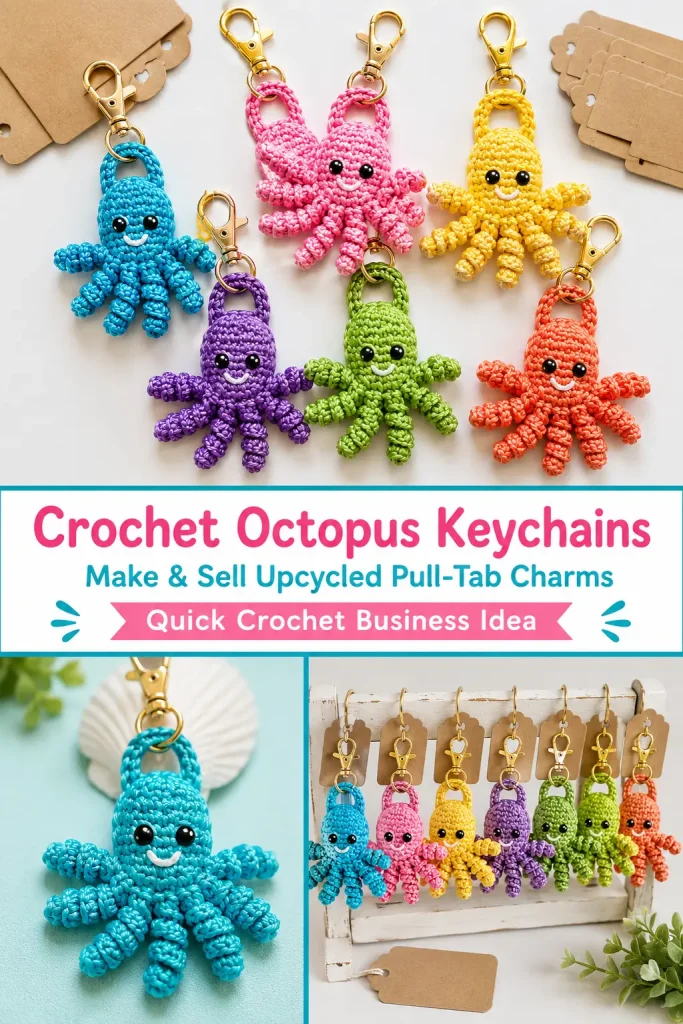
This colorful crochet octopus keychain turns a clean aluminum pull tab into a sturdy hanging loop. The finished charm has a round face, eight curly tentacles, and a playful expression that works well for backpacks, handbags, pencil cases, keys, party favors, and small gifts.
Because each octopus can be customized with different colors and expressions, this is a practical crochet pattern to make in batches for craft fairs, online shops, school events, and local gift markets.
Description
The finished octopus keychain is made directly around a recycled beverage-can pull tab. The larger opening becomes a firm hanging loop, while the smaller section supports the crocheted head. Eight spiral tentacles are worked from the lower edge, and two eyes with a tiny embroidered mouth complete the face.
Approximate finished size:
- Width: 5–6 cm
- Length including tentacles: 7–9 cm
- Covered hanging loop: approximately 2.5–3 cm
The exact measurements depend on the pull tab, yarn thickness, hook size, and tentacle length.
Why This Is a Good Crochet Product to Sell
This project works well for a small crochet business because it offers several useful advantages:
- It uses only a small amount of yarn.
- Several pieces can be made from leftover thread.
- The design is easy to customize.
- The finished item is lightweight and simple to package.
- Customers can use it as a keychain, zipper pull, or bag charm.
- Colorful displays can attract attention at craft fairs.
- Sets can be created for parties, classrooms, and small gifts.
- The recycled pull-tab detail gives the product an interesting handmade story.
The finished keychains can be sold individually, grouped into color collections, or added to gift sets with matching accessories.
Materials
- One clean aluminum beverage-can pull tab
- Fingering-weight cotton, size 3 crochet thread, or thin mercerized cotton
- 1.5 mm to 2 mm crochet hook
- Two small googly eyes, sew-on eyes, or black embroidery thread
- Small amount of white or black embroidery thread for the mouth
- Yarn needle
- Scissors
- Strong craft glue, when using glue-on eyes
- Small jump ring
- Split keyring, swivel clasp, or lobster clasp
- Small pliers
- Fine metal file, if needed
- Product card or small packaging bag for selling, optional
Abbreviations
- ch – chain
- inc – work 2 single crochet in the same stitch
- sc – single crochet
- sl st – slip stitch
- st – stitch
- sts – stitches
Pattern Notes
- This pattern uses US crochet terminology.
- The larger pull-tab opening becomes the hanging loop.
- The smaller opening supports the head.
- Work closely spaced stitches around the metal so no sharp edge remains exposed.
- Pull tabs vary in size, so the number of covering stitches may need adjustment.
- The head is increased to 24 stitches.
- Eight tentacles are distributed around the 24-stitch head.
- Each tentacle curls because multiple stitches are worked into every chain.
- Mercerized cotton gives the finished keychain a smooth and slightly shiny appearance.
- Use embroidered or securely sewn eyes when making products intended for frequent handling.
- This accessory contains metal and small parts. It should not be marketed as a baby toy.
Step-by-Step Instructions
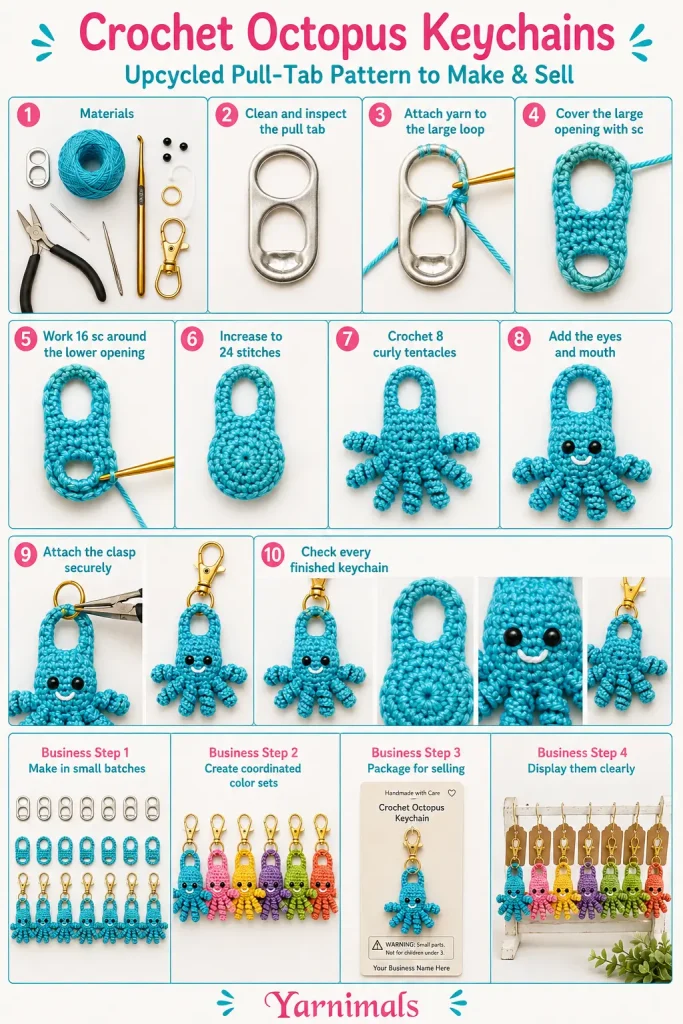
Prepare the Pull Tab
Wash the pull tab with warm soapy water and dry it completely.
Inspect the tab carefully. Do not use a tab that is cracked, bent, rusty, or sharp.
Run a finger gently around every edge. Flatten raised areas with pliers and smooth rough metal with a fine file.
Position the tab vertically:
- Larger oval opening at the top
- Smaller opening at the bottom
The larger opening becomes the hanging loop.
Attach the Yarn
Make a slip knot.
Insert the hook through the larger oval opening near the narrow bridge between the two openings.
Place the working yarn behind the pull tab.
Pull the yarn around the metal and through the loop on the hook.
Ch 1 to secure the yarn.
This beginning chain does not count as a stitch.
Cover the Large Hanging Loop
Work closely spaced sc stitches around the complete metal edge of the larger opening.
For each stitch:
- Insert the hook through the opening.
- Pass the hook beneath the metal edge.
- Yarn over behind the tab.
- Pull the loop around the metal.
- Yarn over and pull through both loops.
Continue until the metal is fully covered.
Most standard pull tabs require approximately 30–36 sc when worked with fine cotton thread.
Push the stitches closely together as you work. Keep the center of the opening clear so it can still hold a keyring or clasp.
Join with a sl st in the first sc.
Do not fasten off.
Move to the Lower Opening
Work 1 or 2 sl sts across the narrow bridge until the hook reaches the smaller opening.
Insert the hook through the lower opening.
Ch 1.
Head Round 1
Work 16 sc closely around the edge of the smaller opening.
Push the stitches together so the metal is hidden.
Join with a sl st in the first sc.
You should have 16 sts.
Head Round 2
Ch 1.
Repeat around:
- Sc in the next st.
- Work 2 sc in the next st.
Join with a sl st in the first sc.
You should have 24 sts.
The lower section should now look like a small round or slightly oval head.
Crochet the Eight Curly Tentacles
Each tentacle is made from a chain worked away from the head and crocheted back toward the body.
Repeat the following sequence eight times.
Tentacle Sequence
Sl st in the next st.
Ch 16.
Starting in the second ch from the hook, work 2 sc in every ch back toward the head.
The extra stitches will force the chain into a spiral.
Sl st in each of the next 2 sts around the head.
One tentacle is complete.
Repeat until eight tentacles have been made.
After the final tentacle, join neatly with a sl st if necessary.
Fasten off, leaving a long tail for finishing.
Optional Mixed-Length Tentacles
For a more playful shape, use different chain lengths:
- Tentacle 1: ch 14
- Tentacle 2: ch 17
- Tentacle 3: ch 15
- Tentacle 4: ch 18
- Tentacle 5: ch 16
- Tentacle 6: ch 14
- Tentacle 7: ch 17
- Tentacle 8: ch 15
Work 2 sc in every chain.
Place the longer tentacles near the lower center and the shorter tentacles closer to the sides.
Close the Center Opening
If the smaller pull-tab opening remains visible, thread the long yarn tail onto a yarn needle.
Pass the needle beneath the stitches surrounding the opening.
Pull gently to bring the stitches closer together.
Pass the yarn across the opening several times if additional coverage is needed.
Secure the yarn firmly on the back and weave in the tail.
Do not pull too tightly or the face may become puckered.
Add the Face
Eye Placement
Position two small eyes below the hanging loop and above the tentacles.
Keep the eyes close together for a playful expression.
Embroidered Eyes
Use black embroidery thread to make two small round eyes.
Pass the needle through each eye several times until they are even.
Secure the thread on the back.
Sew-On Eyes
Stitch each eye firmly through several crochet stitches.
Knot the thread securely and hide the ends inside the head.
Glue-On Eyes
Apply a small amount of strong craft glue to each eye.
Press the eyes onto the crochet and allow the glue to cure fully.
For products intended for sale, embroidered or sew-on eyes generally provide a more durable finish than lightly glued decorations.
Add the Mouth
Using white or black embroidery thread, make a small mouth directly below the eyes.
Choose one simple expression:
- Short horizontal mouth
- Tiny curved smile
- Small round surprised mouth
- Two or three compact white stitches
Secure the thread on the back and weave in the ends.
Add the Keychain Hardware
Insert a small jump ring through the covered top loop.
Attach a split keyring, swivel clasp, or lobster clasp.
Use pliers to close the jump ring completely.
Check that there is no opening where the hardware could separate.
The covered pull-tab opening may also be used directly without additional hardware, but adding a clasp often creates a more polished product for selling.
Final Finishing
Arrange the eight tentacles evenly.
Wrap each spiral gently around a finger to strengthen its curl.
Check the entire piece carefully:
- No metal is exposed.
- No sharp edges can be felt.
- All yarn tails are hidden.
- The eyes are secure.
- The mouth is centered.
- The tentacles are firmly attached.
- The jump ring is fully closed.
- The clasp opens and closes properly.
How to Make the Keychains Efficiently in Batches
Batch production can reduce the time needed for each finished keychain.
Stage 1 – Prepare the Pull Tabs
Clean, dry, inspect, and smooth several pull tabs at the same time.
Discard any damaged tabs.
Stage 2 – Cover the Hanging Loops
Crochet around the large opening of every prepared tab before moving to the next construction stage.
This helps keep your stitch tension and speed consistent.
Stage 3 – Complete the Heads
Work the lower opening and head rounds on the full batch.
Count every head carefully so each one reaches 24 stitches.
Stage 4 – Add All Tentacles
Crochet the eight spirals on each piece.
Use the same tentacle lengths for a uniform collection or create a deliberate mixed-length version for every octopus.
Stage 5 – Add Faces
Lay the finished bodies in a row before attaching eyes.
Use a ruler or small placement guide if you want the faces to look consistent.
Stage 6 – Add Hardware and Inspect
Attach all jump rings and clasps together.
Inspect every finished item before packaging.
This method makes it easier to identify which stage takes the most time and helps you calculate a more accurate selling price.
How to Price Crochet Octopus Keychains
Do not price the keychain based only on the small amount of yarn used.
Include:
- Yarn and embroidery thread
- Eyes
- Jump ring and clasp
- Packaging
- Time spent cleaning and preparing pull tabs
- Crochet time
- Assembly and finishing time
- Selling fees
- Market or event fees
- Business overhead
- Profit
A simple pricing formula is:
Materials + labor + overhead + profit = selling price
For labor, record how long it takes to make several keychains and calculate an average time per piece.
For example, if a batch of five takes two hours, the average labor time is approximately 24 minutes per keychain before packaging and selling expenses are added.
Avoid choosing a price only because similar items appear inexpensive. Your product includes design work, preparation, crochet, assembly, inspection, and finishing.
Product Ideas to Test
Individual Keychains
Sell each octopus separately in one bright color.
Allow customers to choose their favorite shade.
Two-Piece Friend Sets
Create two coordinating octopus keychains as friendship gifts.
Use matching colors or contrasting pairs.
Rainbow Collections
Make several octopuses in a complete rainbow palette.
Display them together to attract attention at markets.
School and Backpack Charms
Use bright colors and secure embroidered faces.
Market them as zipper pulls or backpack decorations rather than toys.
Party Favor Sets
Offer custom quantities for birthdays, school celebrations, or small events.
Keep the colors coordinated with the event theme.
Mystery Color Bags
Package one randomly selected octopus in an opaque or partially covered bag.
Clearly show examples of the possible colors.
Personalized Color Orders
Allow buyers to choose:
- Body color
- Eye style
- Mouth expression
- Clasp color
- Tentacle length
Limit the number of options so custom orders remain efficient.
Craft-Fair Display Tips
Use a simple vertical display board, small hooks, or a rotating keychain stand.
Group the octopuses by color.
Place one sample on a backpack, zipper pouch, or keyring so customers immediately understand how it can be used.
Keep the price clearly visible.
A small sign can highlight the product features:
- Handmade crochet
- Upcycled pull-tab center
- Lightweight bag charm
- Available in multiple colors
Do not present the keychains in a crowded pile. The tentacles and faces are more noticeable when each piece can hang freely.
Packaging Ideas
Attach each keychain to a small cardstock display card.
Include:
- Product name
- Handmade care note
- Small-parts warning
- Your business name
- Contact or social information, when appropriate
Keep the packaging lightweight so shipping costs remain low.
Use a clear protective bag only when necessary. A simple card may be enough for local craft fairs.
Product Photography Tips
Photograph several colorful octopuses together for the main listing image.
Use a clean white, cream, pale blue, or light wood background.
Include close-up images showing:
- Covered pull-tab loop
- Crochet stitch texture
- Face details
- Tentacle curls
- Keychain clasp
- Size beside a hand or ruler
Use bright natural light and avoid heavy shadows.
Photograph at least one keychain attached to a bag or zipper so customers can see its practical size.
Suggested Product Listing Title
Crochet Octopus Keychain, Colorful Upcycled Pull-Tab Bag Charm, Handmade Curly Tentacle Zipper Accessory
Suggested Product Description
This colorful crochet octopus keychain is handmade around a carefully cleaned aluminum pull tab, creating a sturdy covered hanging loop. Each charm has eight curly crochet tentacles, a playful face, and a secure keychain clasp.
Use it as a backpack charm, zipper pull, handbag decoration, keyring accessory, or small handmade gift. Because every piece is made by hand, slight variations in stitch placement and expression make each octopus unique.
This item contains metal and small parts and is intended as a decorative accessory rather than a toy for babies or young children.
Tips and Variations
Use mercerized cotton to create a smooth, shiny surface that photographs well.
Keep the yarn, hook size, eye size, and tentacle pattern consistent when producing a coordinated collection.
Work 3 sc in each tentacle chain for tight spirals.
Alternate 1 sc and 2 sc in each chain for softer curls.
Use embroidered eyes for a fully textile finish.
Create seasonal collections using:
- Orange, black, and purple
- Red, green, and white
- Pastel spring shades
- Ocean blues and greens
- Bright summer colors
- School or team colors
A small bow or flower can be added to selected designs, but additional details increase production time and should be included in the selling price.
Frequently Asked Questions
Is this a good beginner product to make and sell?
Yes. The stitches are simple, the materials are inexpensive, and the project is small. Practice several pieces before selling so the metal coverage, faces, and hardware remain consistent.
How many keychains should I make for a first test?
A small batch of 8–12 pieces is enough to test different colors without creating too much inventory. Track which colors receive the most attention before making a larger batch.
Can I sell the keychains as toys?
The design contains a metal pull tab, hardware, and potentially small eyes. It is safer to describe it as a keychain, bag charm, or decorative accessory rather than a toy for young children.
How can I make the product look more valuable?
Use smooth yarn, consistent stitches, secure hardware, neat packaging, bright photography, and carefully matched color collections. Clean finishing often matters more than adding many decorations.
Should every octopus look exactly the same?
The construction and quality should remain consistent, but small differences in expression are part of the handmade character. Buyers may enjoy choosing the face they like best.
Conclusion
These upcycled crochet octopus keychains are colorful, practical, and suitable for testing a make-and-sell crochet business angle. They require little yarn, can be produced in small batches, and offer plenty of opportunities for color collections, custom orders, party sets, and craft-fair displays. Start with a limited batch, track your true material and labor costs, and use customer interest to decide which colors and versions to make next.