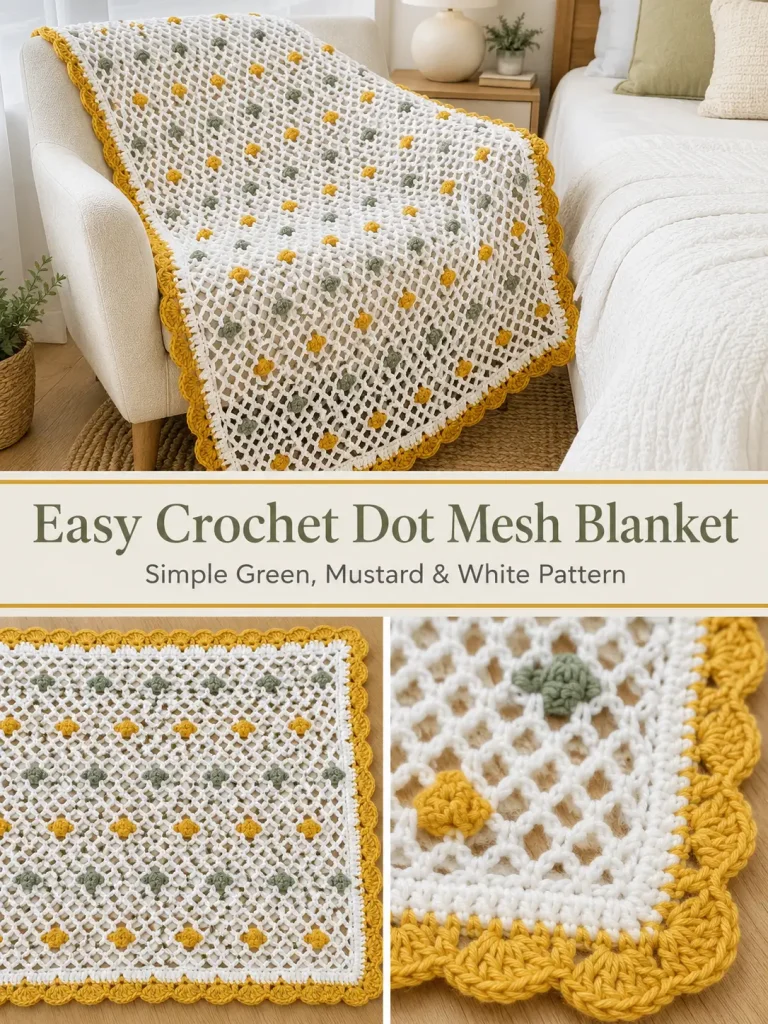
This crochet blanket has a beautiful openwork look made from small raised color clusters connected with a simple white mesh. The alternating sage green and mustard dots give the fabric a fresh retro feel, while the white chain spaces keep the blanket light and airy.
The border is one of the prettiest details: a row of mustard shell stitches runs around the outside, matching the mustard clusters inside the blanket. Although the finished texture looks intricate, the construction can be kept quite simple by repeating the same mesh-and-cluster sequence across every row.
Description
The finished crochet blanket is a lightweight rectangular throw featuring:
- white open chain-space mesh
- small raised sage-green clusters
- small raised mustard-yellow clusters
- alternating color placement from row to row
- airy diamond-shaped openings
- mustard shell edging around the outside
- no separate motifs or sewing
The whole blanket is worked as one continuous piece, making this easier than a granny-square blanket while still giving it plenty of visual interest.
Materials
- DK or light worsted yarn in white
- DK or light worsted yarn in sage green
- DK or light worsted yarn in mustard yellow
- 4 mm crochet hook
- Yarn needle
- Scissors
- Stitch markers, optional
For a baby blanket, use approximately:
- 500–600 yards white
- 250–300 yards sage green
- 250–300 yards mustard yellow
Abbreviations
- ch – chain
- sc – single crochet
- dc – double crochet
- sl st – slip stitch
- st – stitch
- sts – stitches
- sp – space
- cl – cluster
Pattern Notes
US crochet terminology is used.
The main fabric uses a simple repeat of:
colored cluster, white chain space, colored cluster
The colored clusters alternate between sage green and mustard.
The white yarn forms the connecting mesh between the raised dots.
For the cleanest result, carry only the white yarn across the mesh rows and fasten off the colored yarn after each cluster row.
Approximate finished baby blanket size:
32 x 38 in / 81 x 97 cm
The foundation can easily be adjusted.
Cluster Stitch
The colored dots are made with a compact 3-dc cluster.
To make one cluster:
Yarn over.
Insert hook into indicated space.
Pull up a loop.
Yarn over and pull through 2 loops.
Repeat this twice more into the same space.
You should have 4 loops on the hook.
Yarn over and pull through all 4 loops.
The cluster should look small, plump, and slightly raised.
Step-by-Step Instructions
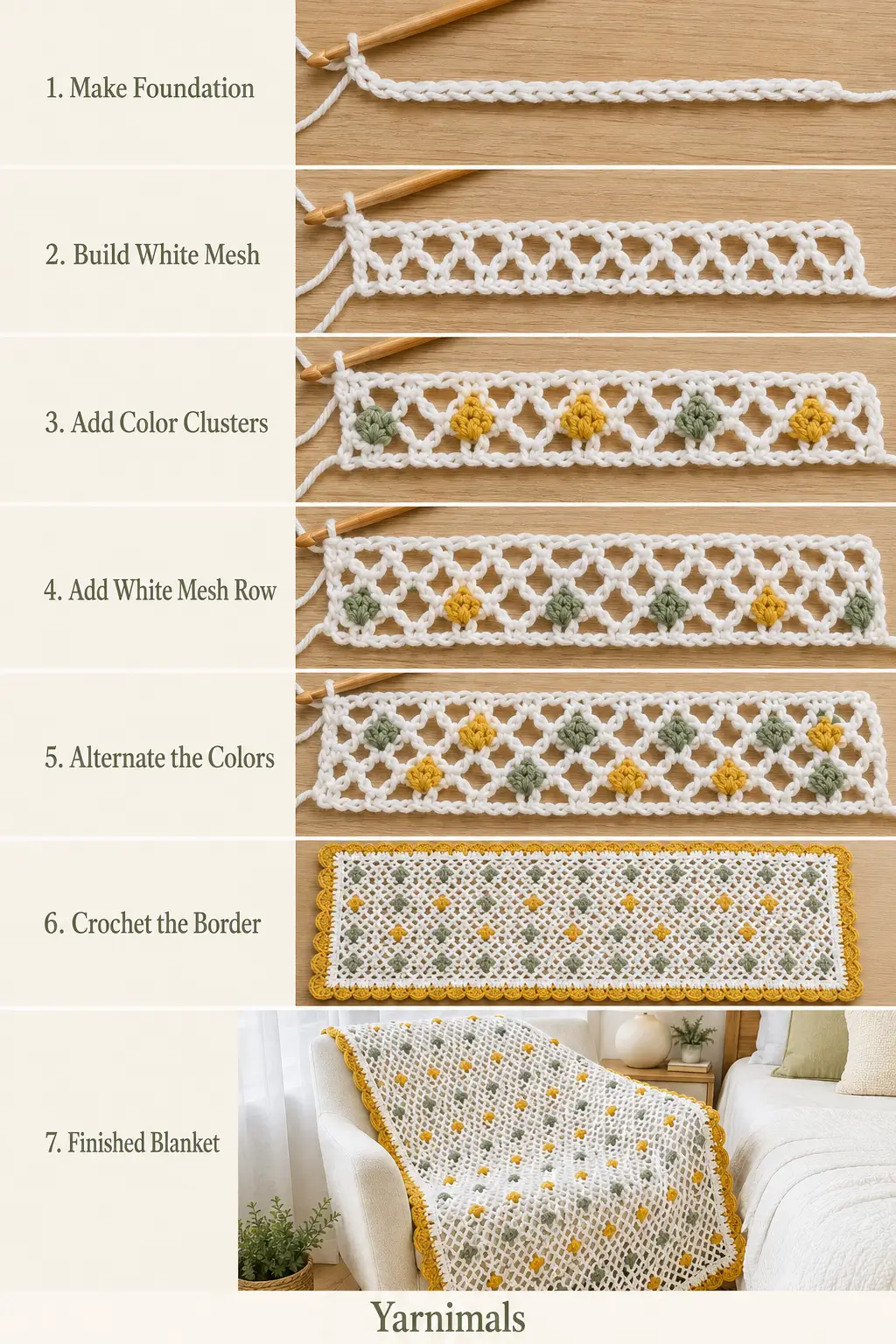
Foundation
Using white yarn:
Ch a multiple of 4 + 1 until the chain reaches your desired blanket width.
For a baby blanket, try:
Ch 121
Row 1 – White Mesh Foundation
Sc in the second ch from hook.
Ch 3.
Skip 3 ch.
Sc in next ch.
Repeat:
ch 3, skip 3 ch, sc in next ch
across.
Turn.
You now have a row of evenly spaced ch-3 arches.
Row 2 – First Colored Cluster Row
Join sage green into the first ch-3 sp.
Work 1 cluster into that space.
Ch 3 with white.
Work 1 mustard cluster into the next ch-3 sp.
Ch 3 with white.
Continue alternating:
- sage cluster
- white ch 3
- mustard cluster
- white ch 3
across.
End with the appropriate colored cluster.
Turn.
Row 3 – White Connecting Mesh
Using white yarn:
Ch 3.
Sc into the top of the first colored cluster.
Ch 3.
Sc into the top of the next cluster.
Repeat across.
Turn.
The white chain spaces should create an open zigzag mesh between the colored dots.
Row 4 – Second Cluster Row
Begin with the opposite color from Row 2.
If Row 2 started with sage, begin this row with mustard.
Work:
Mustard cluster in first ch-3 sp.
Ch 3 with white.
Sage cluster in next ch-3 sp.
Ch 3.
Continue alternating across.
Turn.
Row 5
Repeat the white connecting mesh row:
Ch 3.
Sc into each cluster top with ch 3 between.
Turn.
Continue the Pattern
Repeat Rows 2–5, alternating the colored cluster placement each time.
This creates the offset pattern visible in the finished fabric.
Continue until the blanket reaches approximately:
36–38 in / 91–97 cm long
or your preferred size.
Keeping the Color Pattern Correct
The easiest way to maintain the design is:
Colored Row A
Sage – Mustard – Sage – Mustard
Colored Row B
Mustard – Sage – Mustard – Sage
Continue alternating A and B.
This prevents the colors from forming straight vertical stripes and gives the blanket its scattered geometric look.
Side Edging Preparation
Once the main rectangle is complete, fasten off all colors except white.
Join white yarn in any corner.
White Border Round 1
Ch 1.
Sc evenly around the entire blanket.
Along the sides, work approximately:
3 sc for every 2 mesh rows
At each corner work:
3 sc
Join with sl st.
White Border Round 2
Ch 1.
Sc in every st around.
Work 3 sc in each corner center stitch.
Join.
Fasten off white.
This creates a stable foundation for the shell border.
Mustard Shell Border
Join mustard yarn in any corner.
Shell Repeat
Sc in first st.
Skip 2 sts.
Work 5 dc in next st.
Skip 2 sts.
Sc in next st.
Repeat:
skip 2, 5 dc in next st, skip 2, sc in next st
around the entire blanket.
At each corner, work a shell into the corner stitch or space so the edging turns smoothly.
Join with sl st.
Fasten off.
The mustard shells should create the rounded fan-shaped edge visible around the blanket.
Optional Smaller Shell Border
If 5-dc shells look too large with your yarn, use:
4 dc in each shell
instead.
Keep the same skip-and-sc spacing.
Finishing
Weave in all yarn ends securely.
Lay the blanket flat.
Gently stretch the white mesh openings into even shapes.
Shape each mustard border shell with your fingers.
Lightly block if necessary.
Do not stretch aggressively because the open mesh can become distorted.
Design Consistency Lock
Keep the finished blanket exactly as:
- white open mesh background
- small sage-green raised clusters
- small mustard-yellow raised clusters
- alternating green and mustard placement
- open diamond-shaped spaces
- one continuous rectangular blanket
- white stabilizing border
- mustard shell edging
- no granny squares
- no flower appliqués
- no fringe
- no tassels
- no extra colors
The colored clusters should remain small and compact rather than becoming large puff flowers.
Tips & Variations
A smooth acrylic, cotton-acrylic, or baby yarn works best because it keeps the little colored clusters clearly defined.
If the white chains feel too tight, use a hook 0.5 mm larger for the mesh sections.
Keep the colored clusters slightly snug so they stay rounded and do not spread across the openings.
For a larger throw, simply begin with a longer foundation chain while keeping the multiple of 4 + 1 formula.
You can also use this stitch for scarves, lightweight throws, table runners, or summer baby blankets.
FAQ
Is this blanket made from separate motifs?
No. The entire blanket is worked continuously in rows, so there is no motif joining or sewing.
What creates the raised colored dots?
Each colored dot is a compact crochet cluster worked into one white chain space.
Can I use only two colors?
Yes. You could use white mesh with one accent color, but alternating sage and mustard creates the distinctive look of this design.
Conclusion
This green, mustard, and white crochet mesh blanket is a lovely project when you want something colorful without using complicated motifs. The raised clusters create texture, the white mesh keeps the fabric light, and the mustard shell border ties everything together beautifully. Once the short repeat becomes familiar, it is an easy crochet pattern to continue to almost any blanket size.