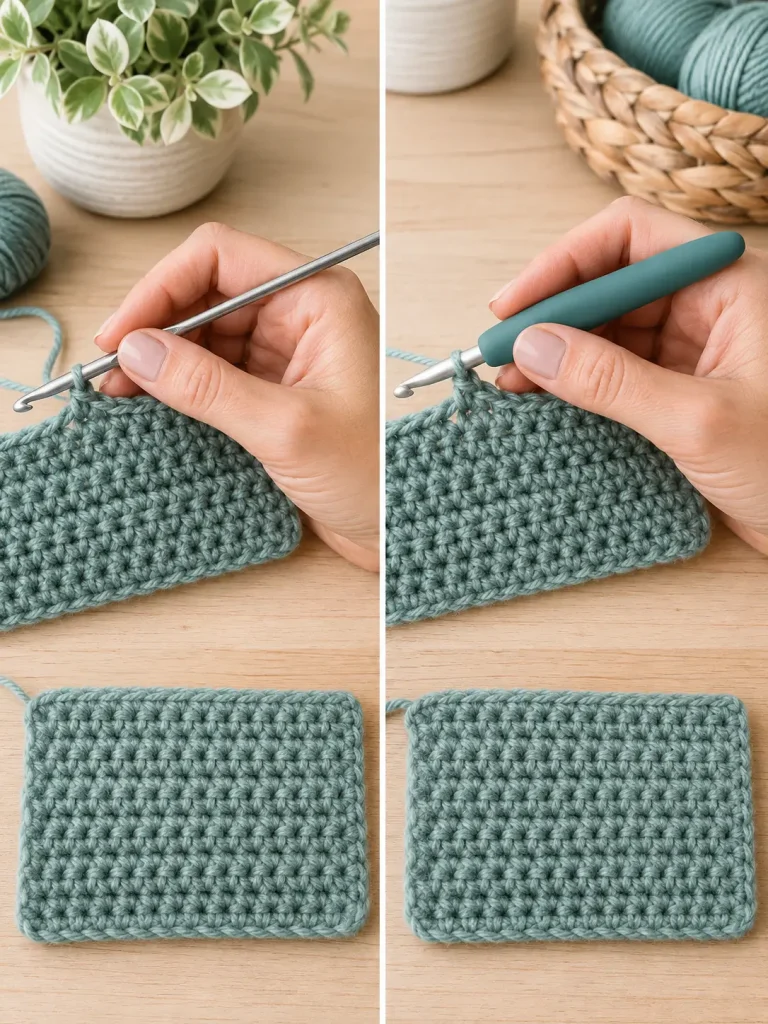
If you have ever looked at an ergonomic crochet hook next to a basic aluminum hook, the difference seems almost too simple.
One has a skinny handle.
The other has a thick, shaped or cushioned grip.
But does that bigger handle actually change anything when you crochet?
The answer is: it can—but not necessarily in the way people expect.
An ergonomic hook does not magically improve your stitches, fix your tension, or make you crochet faster. What it changes most is how the hook feels and sits in your hand.
And for some crocheters, that difference is surprisingly noticeable.
Here is what actually separates ergonomic crochet hooks from regular hooks, what stays exactly the same, and how to decide whether changing hooks is worth trying.
What Is a Regular Crochet Hook?
When I say “regular crochet hook,” I mean the classic straight hook many of us first learned with.
These are often made from:
- aluminum
- steel
- plastic
- bamboo
- wood
A basic aluminum hook, for example, usually has a relatively narrow shaft and a small flattened thumb-rest area.
There is nothing wrong with this design.
Regular hooks are:
- inexpensive
- lightweight
- easy to find
- available in many sizes
- simple to store
- perfectly comfortable for many crocheters
Plenty of experienced crocheters use basic hooks for years and have no desire to change.
So an ergonomic hook should not automatically be considered an “upgrade.”
It is really a different handle design.
What Is an Ergonomic Crochet Hook?
An ergonomic crochet hook typically has a handle that is wider than the hook shaft.
Depending on the design, that handle might be:
- rubberized
- silicone
- plastic
- resin
- wood
- cushioned
- contoured to fit the fingers
Some have a fairly subtle grip.
Others have a dramatically thick handle that fills much more of your hand.
The idea is to provide a larger surface to hold instead of gripping a very thin shaft.
For some people, that feels much more natural.
For others, it can feel bulky or strange.
That is why “ergonomic” does not automatically mean “more comfortable for everyone.”
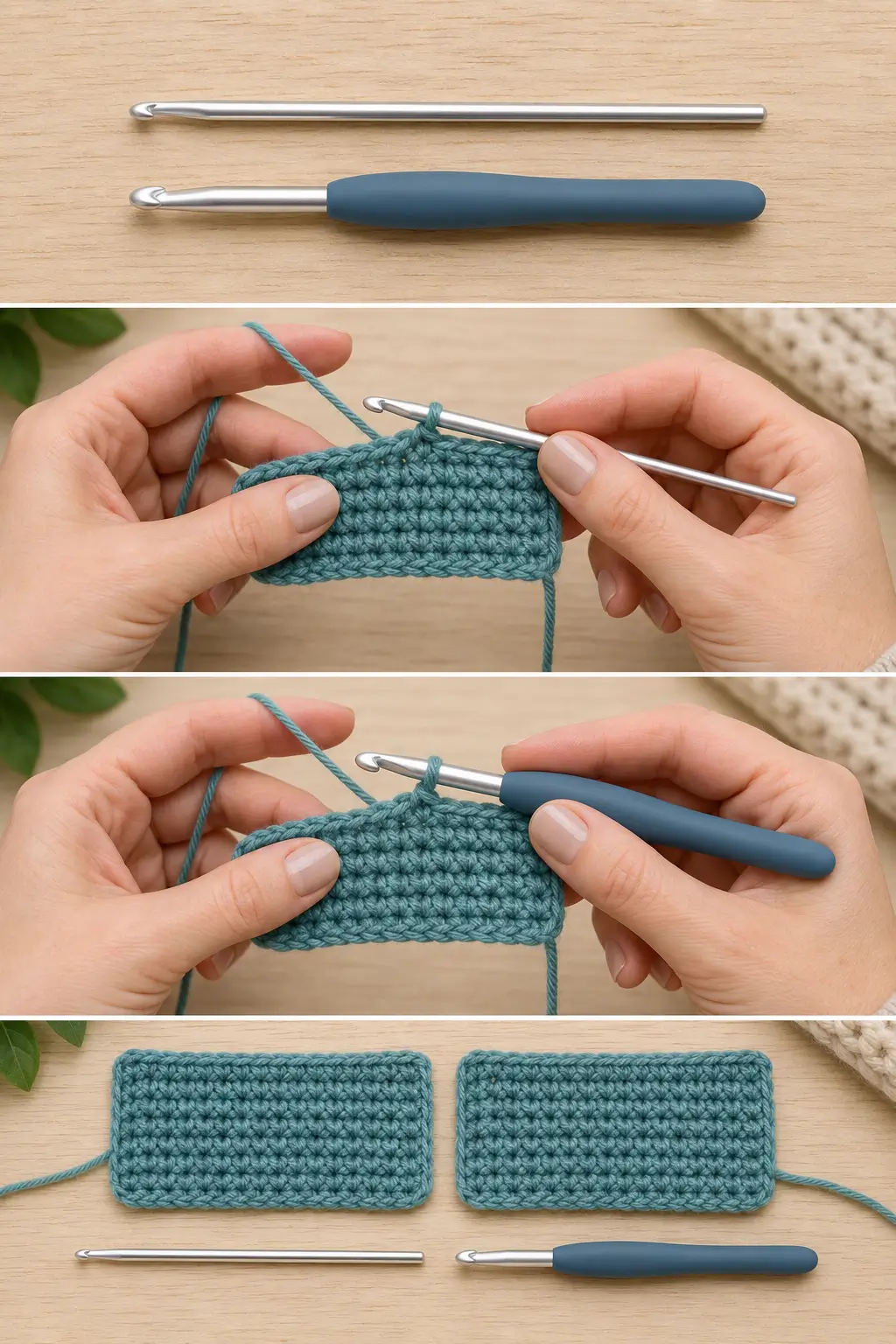
Ergonomic vs Regular Crochet Hooks at a Glance
| Feature | Ergonomic Hook | Regular Hook |
|---|---|---|
| Handle | Wider, shaped or cushioned | Usually narrow and straight |
| Grip | Often textured or non-slip | Usually smooth |
| Weight | Depends heavily on design | Often very lightweight |
| Price | Usually more expensive | Usually inexpensive |
| Hand position | May allow a less tightly closed grip | Requires holding a narrower surface |
| Portability | Bulkier | Very compact |
| Available materials | Rubber, silicone, resin, wood, plastic, metal combinations | Aluminum, steel, plastic, wood, bamboo |
| Best choice | Depends on individual comfort | Depends on individual comfort |
The important word in that table is individual.
Hands are different.
Crochet styles are different.
And the hook that feels amazing to one crocheter can feel completely wrong to another.
The Biggest Difference: The Handle
This is what I would pay attention to first.
Imagine holding a thin pencil.
Now imagine holding a thick marker.
Your fingers have to close farther around the pencil than they do around the marker.
A thicker crochet handle can create a similar difference.
Instead of pinching a narrow metal shaft, you are holding a larger surface.
Some crocheters find that this makes it easier to keep a relaxed grip during longer crochet sessions.
But there is a catch.
A handle can also be too thick for your hand.
If you have smaller hands or prefer very precise finger movements, an oversized ergonomic hook may feel clumsy.
So bigger does not automatically mean better.
Does an Ergonomic Hook Change the Crochet Stitch?
Not directly.
If two hooks are both genuinely 5 mm, the hook-size measurement is still 5 mm even if:
- one has a skinny aluminum handle
- one has a thick silicone grip
The ergonomic handle does not turn a 5 mm hook into a larger crochet hook.
However, switching hook designs can indirectly affect your crochet.
Why?
Because you may hold the new hook differently.
That can change:
- your tension
- your hand position
- how tightly you pull loops
- how quickly you crochet
So even when two hooks are labeled the same size, it is worth checking your gauge after changing hook styles—especially when making a garment or anything where finished dimensions matter.
Don’t Rely Only on the Letter Printed on the Hook
Crochet hooks sold in the United States often use letters and numbers, but those designations can vary slightly between manufacturers.
The millimeter measurement is the most useful number to compare.
So instead of thinking only:
H hook
look for:
5.0 mm
That makes comparing different brands much easier.
If you switch from a regular hook to an ergonomic one, check the millimeter size rather than assuming hooks with similar letters are identical.
What About Pencil Grip vs Knife Grip?
This can make a huge difference in whether you like a particular hook.
Most crocheters use some variation of two common holding styles.
Pencil Grip
The hook is held somewhat like a pencil.
Your fingers tend to control more of the movement.
Some ergonomic handles feel wonderful with this grip.
Others may feel too thick near the fingers.
Knife Grip
The hook is held more like you would hold a dinner knife.
More of the handle may rest against the palm.
Crocheters who use this style sometimes appreciate a thicker handle because there is more surface area resting in the hand.
Neither grip is the “correct” one.
The right ergonomic hook needs to work with the way you already crochet.
You should not have to completely reinvent your natural hand position just because the package says ergonomic.
The Shape of the Hook Still Matters
The handle gets most of the attention, but it is not the only thing that affects how a crochet hook feels.
Look at the actual working end.
Different hooks can have differences in:
- hook head shape
- throat depth
- shaft length
- point sharpness
- surface finish
Some crocheters prefer a more tapered hook.
Others prefer a more inline shape.
And this preference does not disappear when you buy an ergonomic handle.
You can love the grip of a hook and dislike the head.
Or love the way the hook catches yarn and hate the handle.
That is why I would test one hook before buying an entire expensive set whenever possible.
Ergonomic Hooks Can Feel Very Different From Each Other
This surprised me more than the simple ergonomic-versus-regular comparison.
There is no single ergonomic crochet hook shape.
One might have:
- a soft rubber grip
Another might have:
- a hard sculpted handle
Another:
- a thick wooden body
And another might simply be a traditional metal hook with a removable foam or silicone grip added to it.
So if you try one ergonomic hook and hate it, that does not necessarily mean you dislike ergonomic hooks.
You may simply dislike that particular handle.
Soft Grip vs Hard Grip
This is another useful comparison.
Soft or Rubberized Handles
These can feel:
- cushioned
- slightly grippy
- less slippery
- comfortable against the fingers
But some crocheters dislike the feeling of soft rubber or find that their fingers catch against it.
Hard Ergonomic Handles
Wood, resin, or rigid plastic handles can still be thick and shaped without being soft.
They may provide:
- a solid feel
- less flex
- a smooth surface
- more substantial weight
Neither type is automatically superior.
This is mostly about what your hand prefers.
Don’t Forget About Weight
A hook can have the most comfortable grip in the world and still feel wrong if you dislike its weight.
Basic aluminum crochet hooks are usually extremely light.
An ergonomic hook with a large resin, wood, or sculpted handle may weigh noticeably more.
Some crocheters like that substantial feeling.
Others notice the extra weight during longer sessions.
So when comparing hooks, consider:
handle thickness + shape + weight
rather than focusing only on cushioning.
Do Ergonomic Crochet Hooks Help With Hand Fatigue?
They may feel more comfortable for some crocheters, especially if a wider handle allows them to hold the hook without squeezing as tightly.
But I would be cautious about any claim that an ergonomic crochet hook will eliminate pain, cure arthritis, prevent repetitive-strain injuries, or allow everyone to crochet comfortably for unlimited periods.
There is too much variation between:
- individual hands
- grip styles
- existing health conditions
- crochet technique
- session length
- hook design
Think of an ergonomic hook as a comfort option, not a medical treatment.
If crocheting causes persistent pain, numbness, tingling, weakness, or other concerning symptoms, changing hooks should not replace appropriate medical advice.
Can You Turn a Regular Hook Into an Ergonomic Hook?
Sort of.
You do not necessarily have to replace an entire collection of crochet hooks.
Removable grips are available that fit around the handle of some regular hooks.
People also use purpose-made foam or silicone crochet-hook grips.
This can be an inexpensive way to discover whether you enjoy holding a thicker handle before investing in a complete ergonomic set.
Just make sure the added grip:
- fits securely
- does not rotate constantly
- leaves enough usable shaft length
- does not interfere with your normal crochet movements
Which Hook Is Better for Beginners?
I don’t think every beginner automatically needs an ergonomic crochet hook.
A basic hook is inexpensive and perfectly capable of teaching:
- chaining
- single crochet
- double crochet
- working in rows
- working in rounds
- basic tension control
But beginners sometimes grip their hooks extremely tightly while concentrating.
In that case, trying a thicker handle may make it easier to notice just how tightly they are holding the tool.
The best beginner hook is ultimately one that:
- feels controllable
- moves smoothly through the yarn
- is easy to identify by size
- doesn’t distract from learning the stitches
Which Hook Is Better for Amigurumi?
This depends heavily on the crocheter.
Amigurumi usually involves fairly dense fabric and a lot of repetitive single crochet.
Some people enjoy having a larger ergonomic grip for this kind of project.
Others prefer the precision and lightness of a traditional hook.
What matters technically is achieving the fabric and gauge the pattern requires.
Your handle shape does not determine whether a hook can make amigurumi.
Which Is Better for Blankets?
Again, either works.
Blankets often involve many repeated stitches, which makes them a useful project for noticing whether your hook feels comfortable over a longer crochet session.
If your regular hook feels perfectly comfortable, there is no reason you must replace it.
If you constantly find yourself clenching the narrow handle, a wider hook may be worth testing.
What About Crochet Speed?
Do not buy an ergonomic hook expecting it to automatically make you faster.
Speed depends on much more than the handle:
- experience
- stitch familiarity
- yarn
- tension
- hook surface
- project complexity
- hand movement
A comfortable hook may help your motions feel more natural.
But another crocheter may actually work faster with a plain aluminum hook because that is what they have used for years.
Comfort matters more than winning a speed contest.
Will My Gauge Change If I Switch Hooks?
It can.
Even when the millimeter size stays the same, a new handle or hook geometry can subtly change how you work.
That is why I would never switch hook brands halfway through a fitted garment without checking the fabric.
For projects where gauge matters:
- Crochet a swatch with the original hook.
- Crochet another with the new hook.
- Use the same yarn and stitch.
- Measure both after treating them consistently.
- Compare stitch and row gauge.
If they match closely, great.
If they do not, you know before finishing half a sweater.
The Test I Think Every Crocheter Should Try
Instead of immediately buying a full ergonomic hook set, compare two hooks in the same millimeter size.
Use:
- the same yarn
- the same stitch
- the same number of stitches
- roughly the same crochet time
Make two small swatches.
Then compare more than the finished crochet.
Ask yourself:
While crocheting:
- Which hook feels easier to control?
- Am I squeezing one more tightly?
- Does one rotate awkwardly?
- Does the handle feel too large?
- Does one feel too slippery?
- Do I like the weight?
After crocheting:
- Is my gauge different?
- Are my stitches equally even?
- Which fabric do I prefer?
- Which hook would I choose for another 50 rows?
That answer is far more useful than somebody on the internet declaring one style “the best.”
Regular Crochet Hooks Still Have Some Big Advantages
Ergonomic hooks get plenty of attention, but traditional hooks deserve some credit.
They are often:
Cheaper
If you need many sizes, a basic hook collection can be very affordable.
Lighter
Especially simple aluminum hooks.
Smaller
A full set takes almost no room in a crochet bag.
Familiar
If you have crocheted with one style for 20 years, familiarity matters.
Easy to Replace
If you lose a common basic hook, another one is usually easy to find.
So do not throw away your regular crochet hooks simply because ergonomic versions exist.
Where Ergonomic Hooks Have the Advantage
An ergonomic hook becomes especially interesting when you dislike the feeling of gripping a narrow tool.
The larger handle may offer:
- more surface area to hold
- a different resting position in the hand
- added texture or cushioning
- less slipping for some users
And sometimes the biggest advantage is simply this:
It feels nicer.
For something you may hold for hours while making a blanket, that is a perfectly valid reason to prefer one tool over another.
Before Buying a Full Ergonomic Crochet Hook Set
Here are the things I would check.
1. Handle thickness
Does it suit the size of your hand?
2. Handle shape
Round, flattened, tapered, sculpted—there are many designs.
3. Grip material
Do you prefer rubber, silicone, wood, resin, or hard plastic?
4. Weight
Very light or slightly substantial?
5. Hook head
Does it catch the yarn smoothly?
6. Shaft length
Make sure there is enough working space for the crochet techniques you use.
7. Millimeter sizing
Check the actual size rather than relying only on U.S. letters or numbers.
8. Your usual grip
Will the handle work naturally with your pencil or knife-style grip?
And if possible:
buy one hook in your most-used size before buying the entire set.
Who Might Prefer an Ergonomic Crochet Hook?
You might enjoy one if:
- you dislike gripping very thin hooks
- your fingers tend to squeeze the hook tightly
- you want a non-slip grip
- you enjoy thicker writing or crafting tools
- you crochet for long stretches and simply prefer a larger handle
- your current hook feels awkward even though the hook size is correct
Who Might Prefer a Regular Crochet Hook?
A traditional hook may still be perfect if:
- you already crochet comfortably
- you prefer very lightweight tools
- you like precise finger control
- thick handles feel bulky
- you want inexpensive hooks
- you carry many hook sizes with you
- you simply love the hooks you already own
There is no prize for using the most expensive hook.
If a $2 basic hook feels wonderful in your hand, use it.
So, Are Ergonomic Crochet Hooks Worth It?
For the right crocheter, absolutely.
But I would not say everyone needs them.
The real question is not:
“Are ergonomic hooks better?”
It is:
“Which handle lets me crochet comfortably and naturally?”
For one person, that might be a chunky silicone ergonomic hook.
For another, it might be the same basic aluminum hook they have used for years.
The smartest approach is to compare them yourself.
Use the same yarn.
Use the same hook size.
Crochet the same stitch.
And pay attention to both the fabric and your hand.
You might discover that the difference is much bigger than you expected.
Or you might decide your inexpensive regular hook was perfect all along.
Either result is useful.
Frequently Asked Questions
Are ergonomic crochet hooks actually different from regular hooks?
Yes. The main difference is typically the handle. Ergonomic hooks generally have a wider, shaped, cushioned, or textured grip, while traditional hooks often have a relatively narrow handle.
Does an ergonomic handle change the crochet hook size?
No. A larger handle does not change the working diameter of the hook.
Always compare the hook’s millimeter size.
Are ergonomic crochet hooks better for beginners?
Not necessarily.
Some beginners prefer the larger handle, while others find a simple traditional hook easier to control.
Trying both is the best way to find out.
Are expensive crochet hooks automatically better?
No.
Price can reflect different materials, manufacturing, finishing, handle design, or branding, but the hook still needs to work well with your individual hand and crochet style.
Can I add a grip to the crochet hooks I already own?
Yes. Removable crochet-hook grips can provide a thicker holding surface on compatible traditional hooks and can be a relatively inexpensive way to test the idea.
Should I use the hook size recommended on the yarn label?
A yarn-label recommendation is a useful starting point, but the hook you ultimately use depends on the project and the gauge or fabric you need.
When following a pattern where size matters, make a gauge swatch and adjust the hook size if necessary.
Why are millimeters important when buying crochet hooks?
U.S. hook letters and numbers are not completely uniform across every manufacturer.
The millimeter measurement gives you a clearer way to compare actual hook sizes between brands.
Final Verdict
If your regular crochet hook already feels great, there is no urgent reason to replace it.
But if you have ever looked down during a project and realized you are clenching that tiny hook like your life depends on it, an ergonomic version is worth experimenting with.
Just don’t start by buying 15 of them.
Try one.
Same millimeter size.
Same yarn.
Same stitch.
Then let your own hand decide.