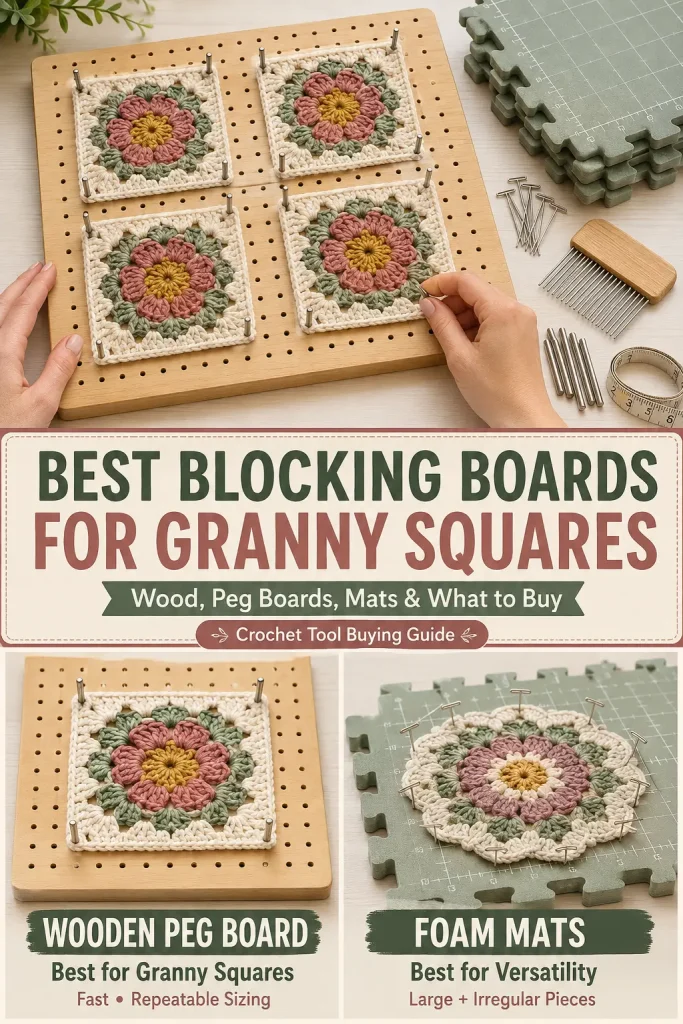
Blocking can make the difference between a pile of slightly uneven crochet motifs and a stack of granny squares that are crisp, consistent, and much easier to join.
If you regularly make granny square bags, blankets, cardigans, cushion covers, or motif-based projects, a dedicated blocking board can save a surprising amount of time. Instead of measuring every square individually, you can place several motifs over correctly spaced pegs and let them dry to the same dimensions.
But blocking boards are not all the same. Some are designed specifically for small granny squares, while others are better for large motifs, multiple sizes, or complete crochet panels.
This guide explains the main types of crochet blocking boards, what features actually matter, and what to check before buying one.
What Is the Best Blocking Board for Granny Squares?
For most granny square projects, the most useful option is a reusable peg-style blocking board with adjustable rust-resistant pins or rods.
A good board should have:
- evenly spaced holes
- removable pegs
- several possible square sizes
- enough working area for your usual motifs
- a flat, sturdy surface
- moisture-resistant construction
- pegs that will not easily bend or rust
Wooden peg boards are popular because they are sturdy and attractive, but foam blocking mats can be better when you work with larger or irregularly shaped crochet pieces.
The best choice depends on what you crochet most often.
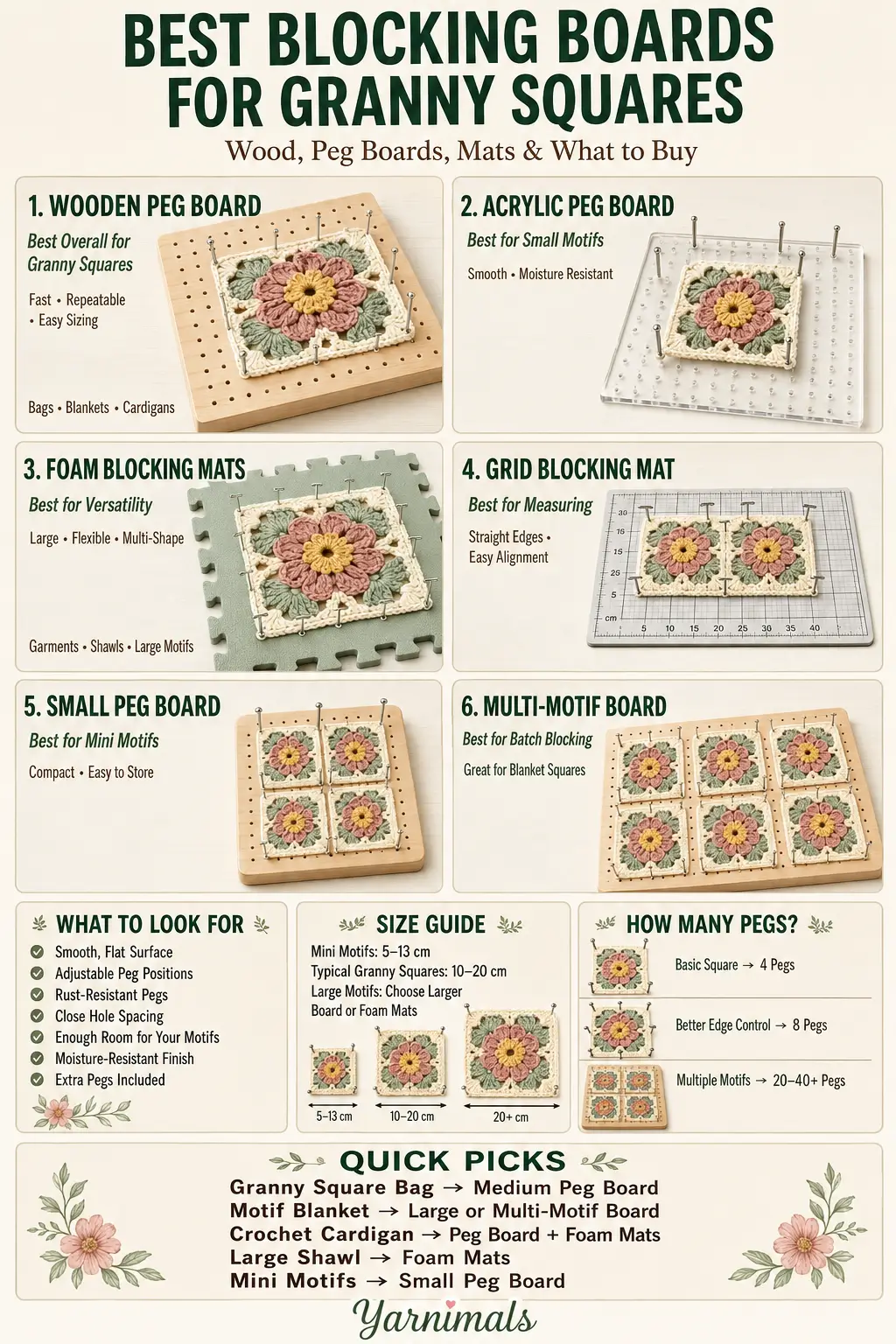
Quick Blocking Board Comparison
| Blocking Type | Best For | Main Advantage | Main Limitation |
|---|---|---|---|
| Wooden Peg Board | Granny squares | Fast consistent sizing | Limited by board dimensions |
| Acrylic Peg Board | Small motifs | Smooth and moisture-resistant | Can be more rigid and slippery |
| Foam Blocking Mats | Large crochet pieces | Flexible sizing | Requires separate pins |
| Grid Blocking Mats | Blankets and garments | Easy measurement | Less convenient for stacking motifs |
| Small Portable Board | Mini motifs | Compact and easy to store | Too small for larger squares |
| Multi-Motif Peg Board | Batch blocking | Blocks several motifs together | Requires more space |
1. Wooden Blocking Boards: Best Overall for Granny Squares
A wooden crochet blocking board is one of the most practical tools for anyone who makes granny squares regularly.
The board contains a grid of holes. Removable pegs are inserted into the positions corresponding to the desired square dimensions.
A damp crochet square is then placed over the pegs and gently stretched into shape.
This is particularly useful for:
- traditional granny squares
- flower granny squares
- solid granny squares
- crochet bag motifs
- blanket squares
- cardigan motifs
Why Wooden Boards Work So Well
A rigid board keeps the corners in fixed positions.
That makes it easier to block several squares to exactly the same size.
For example, if a bag requires 13 identical granny squares, you can set the pegs once and use the same dimensions for every motif.
That consistency makes joining much easier later.
2. What Kind of Wood Is Best?
The specific wood species matters less than the construction and finish.
Look for a board that is:
- smooth
- flat
- reasonably thick
- properly sealed or finished
- free from rough edges
- resistant to moisture
An unfinished thin wood board may absorb water from wet crochet pieces and eventually warp.
A properly finished board is more suitable for repeated wet blocking.
The surface should also be smooth enough that yarn cannot snag on splinters.
3. Rust-Resistant Pegs Matter
Pay close attention to the included pegs.
Blocking often involves damp yarn, so ordinary untreated metal rods can eventually develop corrosion.
Look for pegs described as:
- stainless steel
- rust-resistant metal
- corrosion-resistant rods
The pegs should also fit firmly into the holes without wobbling excessively.
Loose pegs make it difficult to keep the crochet square properly aligned.
4. Best Blocking Board Size for Granny Squares
There is no ideal board size for every crocheter.
Choose based on the motifs you normally make.
Small Board
Useful for squares approximately:
2–5 inches / 5–13 cm
Good for:
- mini granny squares
- small floral motifs
- jewelry motifs
- small bag panels
Medium Board
Useful for squares approximately:
4–8 inches / 10–20 cm
This is probably the most versatile size for typical granny square projects.
It works well for:
- tote bags
- blankets
- cardigans
- cushions
- decorative motifs
Large Board
Useful when you regularly make:
- oversized granny squares
- large blanket motifs
- crochet garment panels
- cushion fronts
Before buying, check the actual usable peg area, not only the outside dimensions of the board.
5. Peg Spacing Is More Important Than It Looks
The distance between holes determines how precisely you can size your motifs.
Closer hole spacing gives you more sizing options.
For example, a board with many evenly spaced holes allows you to block:
- a 10 cm square
- a 10.5 cm square
- an 11 cm square
- a larger motif
depending on where the pegs are placed.
A board with widely spaced holes gives you fewer choices.
If you make many different granny square patterns, a dense peg grid is usually more useful.
6. Best Blocking Board for Multiple Granny Squares
If you frequently make motif blankets or large granny square bags, consider a board designed to block several squares at once.
There are two common systems.
Stacking Squares on the Same Pegs
Several identical motifs can be placed over the same four or more pegs.
This saves space.
However, do not stack a large number of soaking-wet squares tightly together.
Air still needs to circulate so the motifs can dry properly.
Multiple Blocking Sections
Some larger boards allow several individual squares to sit beside one another.
This takes more space but improves airflow.
It is especially useful when the motifs contain:
- raised flowers
- textured stitches
- puff stitches
- dimensional petals
These designs are better blocked individually rather than compressed into a thick stack.
7. Foam Blocking Mats: Best for Versatility
A peg board is excellent for squares, but foam mats are more versatile.
Interlocking blocking mats can be arranged into different shapes and sizes.
They are useful for:
- shawls
- scarves
- garments
- blankets
- triangular crochet
- rectangular panels
- large granny squares
You secure the crochet with T-pins or blocking pins rather than fixed pegs.
Why Foam Mats Are Useful
You are not limited to a fixed hole pattern.
You can block almost any shape.
The downside is that every piece needs to be measured and pinned manually.
For 30 identical granny squares, a peg board is usually faster.
8. Grid Blocking Mats: Best for Measuring Large Pieces
Some blocking mats include printed measurement grids.
These are convenient when blocking:
- garment panels
- scarves
- rectangles
- large motifs
The grid helps you keep edges straight and compare dimensions.
For repetitive granny squares, however, movable pegs are still more convenient because the corners automatically return to the same position.
9. Acrylic Blocking Boards
Acrylic blocking boards provide another option for small crochet motifs.
They usually have:
- a rigid flat surface
- precisely positioned holes
- removable pegs
- good resistance to moisture
They are easy to wipe clean.
However, make sure the board is thick enough to remain rigid and that the peg holes are well made.
Acrylic can also scratch, so store the board carefully.
10. Best Blocking Board for Flower Granny Squares
Flower granny squares need slightly different handling because the central motif may be dimensional.
For designs containing:
- daisies
- sunflowers
- puff flowers
- raised petals
- layered flowers
use the pegs to shape the square border, not the flower itself.
Place the square over the corner pegs and gently arrange the central flower by hand.
Do not flatten dimensional petals unnecessarily.
The goal is to square the motif while preserving the flower texture.
11. Best Blocking Board for Granny Square Bags
A blocking board is especially valuable when making crochet bags.
A granny square tote may use 10, 12, 13, 16, or more motifs depending on construction.
If some squares are even slightly larger than others, the finished bag can develop:
- uneven seams
- puckered joins
- crooked side panels
- mismatched top edges
Blocking every square to the same dimensions before assembly makes the construction much cleaner.
For bag making, a medium peg board that accommodates your most common motif sizes is usually the most practical choice.
12. Do Granny Squares Really Need Blocking?
Not every crochet square absolutely requires blocking.
But blocking is particularly useful when:
- motifs finish at slightly different sizes
- corners curl
- borders look uneven
- stitches need opening
- lace needs shaping
- many motifs will be joined
A simple acrylic granny square may already lie flat.
A cotton lace square can change significantly after blocking.
The fiber and stitch pattern both matter.
13. Wet Blocking vs Spray Blocking
There are several ways to prepare crochet motifs for a blocking board.
Wet Blocking
Soak the piece according to the yarn’s care instructions.
Gently remove excess water without twisting.
Place it on the board and shape it.
This works particularly well for many natural fibers.
Spray Blocking
Place the dry square on the board first.
Shape it correctly.
Mist it evenly with clean water.
Allow it to dry completely.
This is convenient for cotton granny squares and projects that only need light shaping.
Always follow the yarn manufacturer’s care recommendations.
14. Can You Steam Block on a Peg Board?
This depends on both the yarn and the blocking-board material.
Steam can be useful, but it requires more care than ordinary wet blocking.
Never press a hot iron directly onto crochet.
For acrylic yarn, excessive heat can permanently change the fibers and flatten or soften the stitches.
If using steam:
- keep the heat source above the crochet
- do not touch the yarn directly
- use minimal heat
- test a swatch first
- confirm that the blocking board itself can tolerate the heat and moisture
For many granny square projects, wet or spray blocking is simpler.
15. Best Blocking Method for Cotton Granny Squares
Cotton responds very well to wet or spray blocking.
For a typical cotton square:
- Lightly wet or mist the square.
- Gently remove excess moisture.
- Insert the blocking pegs at the required dimensions.
- Place the four corners over the pegs.
- Add additional pegs along the sides if necessary.
- Adjust the stitches.
- Leave the square until completely dry.
Do not stretch aggressively.
Blocking should correct the shape, not permanently distort the crochet.
16. Use More Than Four Pegs for Large Squares
Four corner pegs may be enough for a small solid granny square.
Large or lace motifs often benefit from additional pegs.
Place pegs along:
- top edge
- bottom edge
- left edge
- right edge
This prevents the sides from bowing inward while the corners are stretched outward.
A large square may use:
- 4 corner pegs
- 4 side-center pegs
for a total of 8.
More complex motifs may need additional support.
17. Measure Before You Block
Do not assume every square should be stretched to the largest size it can reach.
Measure several unblocked squares first.
Suppose your motifs naturally measure:
- 14.4 cm
- 14.7 cm
- 14.5 cm
- 14.6 cm
Blocking all of them to approximately:
14.5–14.7 cm
makes sense.
Stretching all of them to 17 cm simply because the board allows it could distort the fabric.
Blocking should improve consistency rather than radically change the gauge.
18. What to Look for Before Buying a Crochet Blocking Board
Board Size
Make sure your usual motifs fit comfortably.
Hole Spacing
Closer spacing provides more sizing choices.
Number of Pegs
You need enough for the number of squares and edges you plan to block.
Peg Material
Rust-resistant metal is preferable for damp blocking.
Board Thickness
A very thin board can flex or warp.
Surface Finish
Choose smooth surfaces without rough edges.
Measurement Markings
Useful but not essential.
Storage
Removable pegs and a storage pouch or compartment make the board easier to organize.
19. How Many Blocking Pins or Pegs Do You Need?
For a basic granny square:
4 pegs
may be enough.
For better edge control:
8 pegs
is useful.
If you block several squares simultaneously, you may want:
20–40+ pegs
depending on the board.
Having extra pegs also lets you block:
- rectangles
- hexagons
- triangles
- irregular motifs
20. Blocking Combs vs Individual Pins
Blocking combs contain several pins attached to one plastic or metal bar.
They are particularly useful for maintaining straight edges.
They work well for:
- scarves
- garment panels
- blankets
- large square motifs
For small granny squares, individual pegs are often easier because you only need to establish precise corner and side positions.
Many crocheters eventually find both systems useful.
21. Should You Buy a Blocking Board or Make One?
A homemade blocking board can work well.
You can make one from:
- smooth sealed wood
- a measured grid
- removable rust-resistant rods or pegs
The advantage is customization.
You can build it specifically for the square sizes you make most frequently.
A purchased board is more convenient if you want:
- evenly drilled holes
- included pegs
- compact storage
- measurement markings
- no construction work
If you crochet granny squares frequently, a reusable commercial board can save enough measuring time to justify having one.
22. Best Blocking Setup by Crochet Project
Granny Square Bag
Choose:
Medium adjustable peg board
Why:
Many identical motifs need consistent dimensions.
Granny Square Blanket
Choose:
Large peg board or multi-square board
Why:
You may need to block dozens of motifs.
Crochet Cardigan
Choose:
Peg board for motifs + foam mats for finished panels
Why:
Squares need consistency, while assembled garment sections may need larger blocking space.
Large Lace Shawl
Choose:
Interlocking foam mats
Why:
The project is too large and irregular for a small peg board.
Mini Crochet Motifs
Choose:
Small portable peg board
Why:
A large board is unnecessary.
23. Common Blocking Board Mistakes
Stretching Too Hard
If your square is being forced dramatically beyond its natural dimensions, the problem may be gauge rather than blocking.
Removing the Piece Too Early
The crochet should be completely dry before removing it from the board.
Otherwise, it may relax back toward its original shape.
Using Rusting Pins
Moisture plus untreated metal can potentially leave marks on light-colored yarn.
Use rust-resistant hardware.
Blocking Different Squares to Different Measurements
If the motifs will be joined into one project, choose one target measurement and use it consistently.
Flattening Raised Flowers
Shape the square border while preserving dimensional petals and textured centers.
24. Is a Blocking Board Worth Buying?
If you mainly crochet amigurumi or simple one-piece projects, probably not.
If you frequently make:
- granny squares
- motif bags
- motif blankets
- crochet cardigans
- lace squares
- geometric crochet
a blocking board can be extremely useful.
It does not make the stitches for you.
What it does is make consistency much easier.
That can save significant time when assembling a project with many repeated motifs.
Quick Buying Recommendation
If you are choosing your first granny square blocking board, look for:
- medium-size reusable board
- dense adjustable hole grid
- approximately 20 or more removable pegs
- rust-resistant peg material
- smooth sealed surface
- enough room for approximately 15–20 cm motifs
That combination handles a large percentage of common granny square projects without requiring an oversized setup.
FAQ
What size blocking board should I buy for granny squares?
Choose a board that is comfortably larger than the biggest motifs you normally crochet. A board capable of blocking squares up to approximately 15–20 cm is versatile for many bag, blanket, and garment motifs.
Are wooden blocking boards better than foam mats?
For repeated granny squares, a peg-style wooden board is usually faster because the size can remain fixed for every motif. Foam mats are more versatile for large or irregular crochet pieces.
Can I stack granny squares while blocking?
Yes, especially if they are identical and relatively flat. Avoid creating an excessively thick stack, and make sure moisture can escape so all layers dry completely.
Do I need to block acrylic granny squares?
Not always. If the motifs already lie flat and measure consistently, blocking may not add much. Light blocking can still help even out the shape, but avoid excessive heat with acrylic yarn.
Can I block flower granny squares?
Yes. Block the outer square while arranging the flower gently by hand. Avoid crushing raised petals or textured centers.
Conclusion
A good blocking board is a simple tool, but it can make motif-based crochet projects look much more consistent.
For most granny square makers, a medium adjustable peg board with a smooth moisture-resistant surface and rust-resistant pegs is the most useful place to start. It gives you repeatable measurements for bags, blankets, cardigans, cushions, and other motif projects without having to measure every square from scratch.
Choose the board according to the motifs you actually make, pay attention to peg spacing and usable dimensions, and remember that good blocking should refine your crochet—not force it into a completely different size.