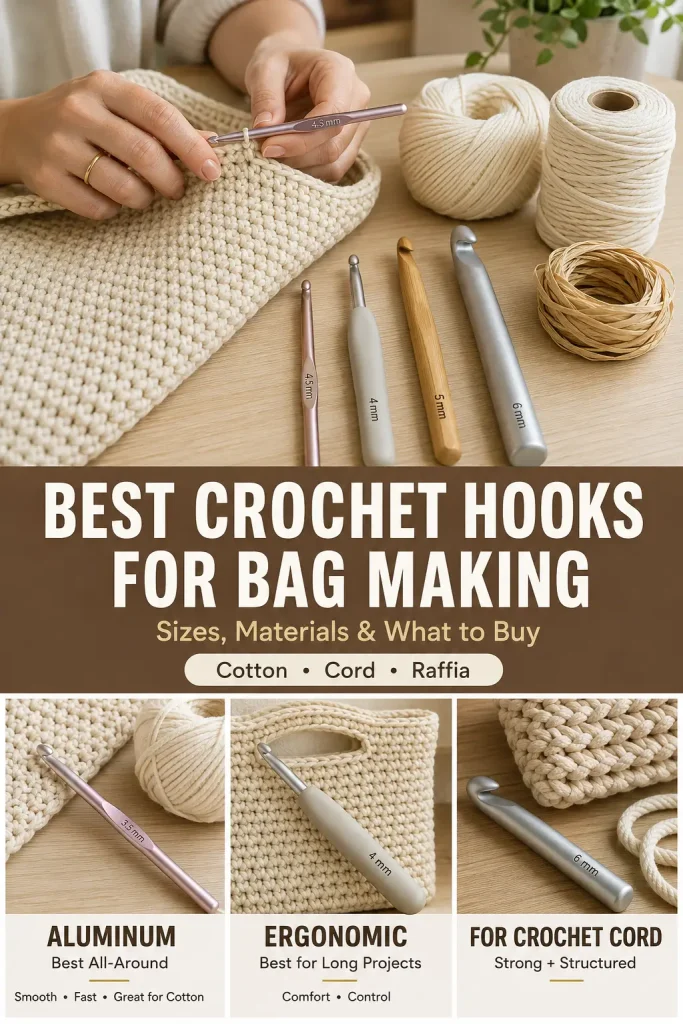
Choosing the right crochet hook for a bag matters more than it does for many soft crochet projects. A hook that feels perfect for a blanket can produce a bag that is too loose, too stretchy, difficult to control, or uncomfortable to crochet for long periods.
Crochet bags usually need a firmer fabric, strong stitches, controlled tension, and enough structure to support everyday use. The hook you choose affects all of those things.
If you are planning a granny square tote, structured handbag, market bag, raffia purse, crochet cord bag, or summer shoulder bag, this guide will help you decide which crochet hook size and material makes the most sense before you buy your supplies.
What Is the Best Crochet Hook for Making Bags?
There is no single hook that is best for every crochet bag.
For most everyday cotton crochet bags, a smooth aluminum or ergonomic crochet hook in the 3.5–5 mm range is a practical starting point.
For thicker cotton or polyester cord, you may need a larger and stronger hook.
For raffia, a smooth hook with a comfortable handle can make the material much easier to work with.
The best hook depends on four things:
- yarn thickness
- desired fabric density
- crochet stitch
- how much structure the finished bag needs
The most important rule is simple:
Do not choose a hook size only because it appears on the yarn label.
For crochet bags, you often want a slightly firmer gauge than you would use for a garment or blanket.
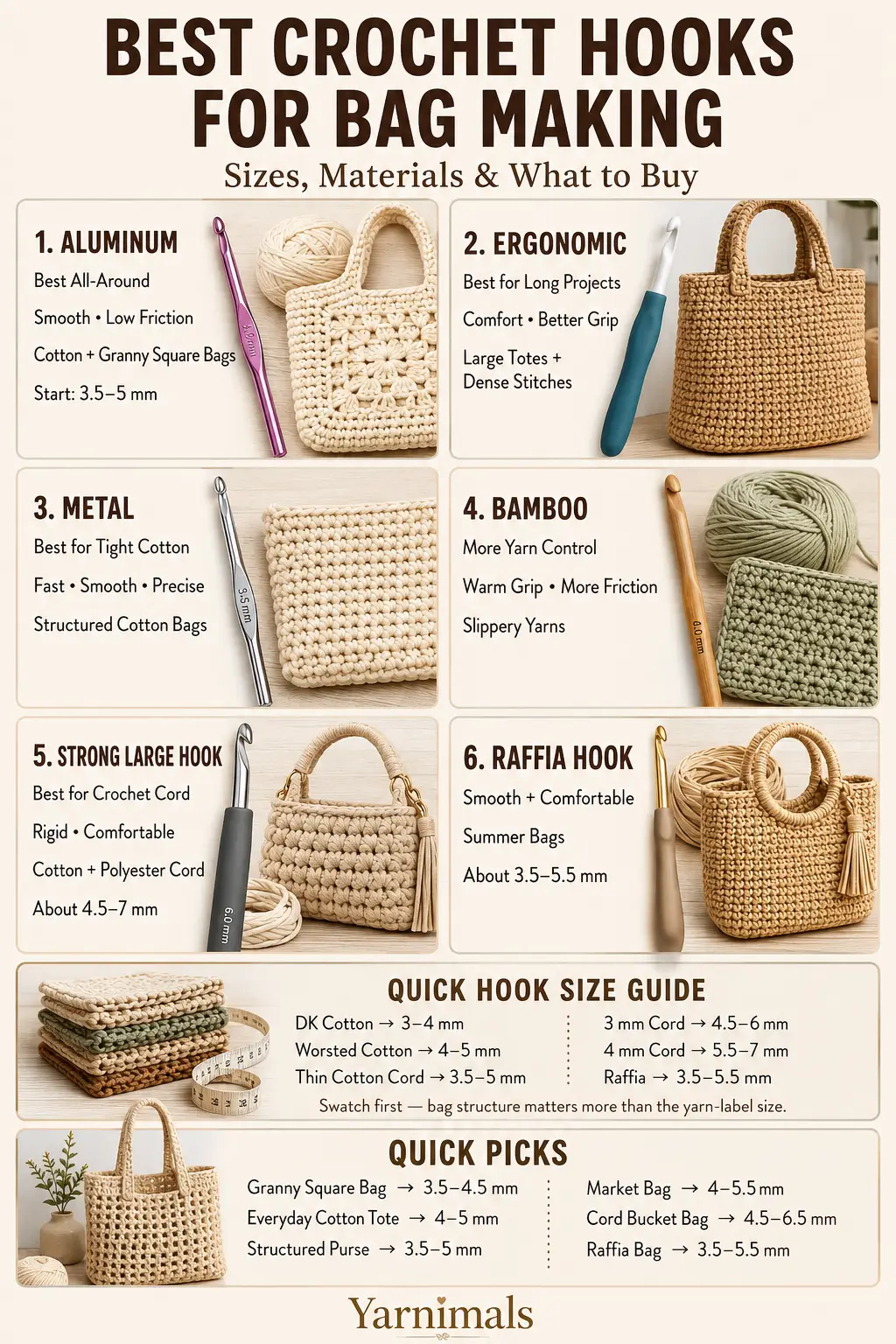
Quick Crochet Hook Guide for Bags
| Bag Material | Useful Starting Hook Range | Best For |
|---|---|---|
| DK Cotton | 3–4 mm | Granny squares, small bags, detailed motifs |
| Worsted Cotton | 4–5 mm | Totes, market bags, shoulder bags |
| Mercerized Cotton | 3–4.5 mm | Detailed handbags, floral bags |
| Thin Cotton Cord | 3.5–5 mm | Firm purses and structured bags |
| 3–4 mm Crochet Cord | 5–7 mm | Bucket bags, baskets, structured totes |
| Raffia | 3.5–5.5 mm | Summer handbags and beach bags |
| Polyester Cord | 4–7 mm | Modern structured bags |
These are starting ranges rather than fixed rules. Always make a small swatch before committing to the full bag.
1. Aluminum Crochet Hooks: Best All-Around Choice
A smooth aluminum hook is one of the safest choices for everyday crochet bag projects.
It works especially well with:
- cotton
- mercerized cotton
- cotton blends
- smooth synthetic yarn
- lightweight cord
Aluminum allows the yarn to move across the hook without excessive resistance. That is useful when making hundreds of dense stitches for a bag.
Why Aluminum Works Well for Bags
Crochet bags frequently use tight single crochet, half double crochet, or dense motif borders.
When the fabric is intentionally firm, a hook with too much friction can make every stitch harder.
A smooth aluminum surface reduces some of that resistance.
It is particularly useful for:
- granny square bags
- cotton totes
- market bags
- floral crochet bags
- mesh bags with solid borders
2. Ergonomic Crochet Hooks: Best for Long Bag Projects
A medium or large crochet bag can require thousands of stitches.
If your hand starts hurting before you finish the first panel, the cheapest hook is not necessarily the best value.
An ergonomic hook usually has a thicker grip around the shaft.
This can help reduce how tightly you need to pinch the hook while crocheting.
They are worth considering for:
- large totes
- multiple granny square projects
- thick cotton
- cord
- repetitive single crochet
- long crochet sessions
What to Look for in an Ergonomic Hook
Look for:
- a comfortable grip thickness
- a smooth transition between handle and shaft
- enough exposed shaft for your stitch style
- clearly marked hook size
- a tip that is neither excessively blunt nor painfully sharp
The shape that feels best is personal, so buying one hook in your most frequently used size can make more sense than immediately purchasing a large set.
3. Metal Hooks: Best for Cotton and Tight Stitches
Metal hooks are especially useful when working with cotton because cotton can create more resistance than some softer synthetic yarns.
A polished metal surface helps the stitch slide.
This makes metal particularly good for:
- tight single crochet
- structured bag panels
- crochet straps
- compact granny square borders
- small flower motifs
- dense bag bases
If your hook constantly feels stuck inside a tight cotton stitch, switching to a smoother metal hook can make a noticeable difference.
4. Wooden Crochet Hooks: Comfortable but Not Always Ideal for Bags
Wooden hooks can feel warm and pleasant in the hand, but they generally create more friction than polished metal.
That is not automatically bad.
A little friction can help control slippery yarn.
However, for a very dense cotton bag, a wooden hook may make tight stitches slower to work.
Wooden hooks can be a good choice for:
- softer cotton blends
- slippery synthetic yarn
- relaxed market bags
- crocheters who prefer a warmer grip
They may be less convenient for very stiff cord.
5. Bamboo Crochet Hooks: Good for Slippery Yarn
Bamboo provides more grip than aluminum.
That makes it useful when your yarn slides too quickly off the hook.
Consider bamboo for:
- slippery synthetic yarn
- loosely twisted yarn
- some lightweight cotton blends
For dense bag stitches, though, too much friction can become tiring.
If you plan to crochet a large bag with tight cotton stitches, test a bamboo hook before committing to the entire project.
6. Plastic Crochet Hooks: Useful for Larger Sizes
Plastic hooks are common in larger sizes and can be useful when working with thick cord.
They are often lighter than a similarly sized metal hook.
This can be helpful for:
- chunky crochet bags
- thick yarn
- soft rope-style yarn
- larger crochet cord
The main thing to check is rigidity.
A hook that flexes significantly under tension can be frustrating when working dense cord stitches.
7. Best Crochet Hook for Cotton Bags
For ordinary cotton crochet bags, my first choice would usually be a:
smooth aluminum or ergonomic metal hook.
For DK cotton:
3–4 mm is a useful starting range.
For worsted cotton:
4–5 mm is often practical.
For a structured handbag, you may go slightly smaller.
For an open market bag, you may prefer a larger hook.
The difference of only 0.5 mm can noticeably change the fabric.
8. Best Crochet Hook for Granny Square Bags
Granny square bags need two things from the hook:
- comfortable motif-making
- consistent square dimensions
For DK or light worsted cotton, hooks around:
3.5–4.5 mm
are commonly useful.
The exact size should produce a square that lies flat without becoming floppy.
If your granny square corners curl inward, your hook may be too small or your tension too tight.
If the square looks loose and stretches easily, try going down a hook size.
Consistency matters more than using a particular number.
Once you find the hook that produces the correct motif size, use that same hook for every square in the bag.
9. Best Crochet Hook for Structured Bags
Structured crochet handbags require a denser fabric than ordinary totes.
For these projects, use a hook that creates firm stitches without making the fabric painfully stiff.
A useful approach is:
- Check the recommended range for the yarn.
- Make a swatch using the middle of that range.
- If the swatch is too floppy, reduce the hook by 0.5 mm.
- Test again.
Cotton cord and polyester cord are especially sensitive to hook size.
Too large a hook can leave visible gaps.
Too small a hook can make the material extremely difficult to work.
10. Best Hook for Crochet Cord Bags
Crochet cord behaves differently from conventional yarn.
It is thicker, firmer, and often less elastic.
The correct hook depends heavily on the actual cord diameter.
Thin Cord
For approximately 2 mm cord, try around:
3.5–5 mm
Medium Cord
For approximately 3 mm cord, try around:
4.5–6 mm
Thicker Cord
For approximately 4 mm cord, try around:
5.5–7 mm
These are starting points only.
Cord construction varies considerably.
A tightly braided 3 mm cord may behave very differently from a softer tubular cord with the same nominal diameter.
11. Best Crochet Hook for Raffia Bags
Raffia can be beautiful for summer bags, but it is less forgiving than soft yarn.
A smooth hook is especially helpful.
Start around:
3.5–5.5 mm
depending on the raffia thickness.
Look for a hook with:
- smooth shaft
- comfortable handle
- rounded edges
- enough strength for firm stitches
Avoid gripping raffia too tightly.
The goal is structured fabric, not hand fatigue.
12. Inline vs Tapered Crochet Hooks for Bags
Crochet hooks generally fall into two broad shapes.
Inline Hook
The hook head and shaft are more closely aligned.
Some crocheters find inline hooks helpful for maintaining consistent stitch size.
They can work particularly well for:
- granny squares
- repetitive bag panels
- controlled tension
Tapered Hook
A tapered hook gradually narrows toward the hook head.
Some crocheters find this easier for pulling through several loops.
That can be useful for:
- half double crochet
- double crochet
- cluster stitches
- textured bag patterns
Neither shape is universally better.
For bag making, comfort and stitch consistency matter more than choosing one category.
13. Why Hook Size Changes Crochet Bag Structure
Imagine making the same cotton bag with three hooks:
- 3.5 mm
- 4.5 mm
- 5.5 mm
Even with identical yarn, the results can look very different.
Smaller Hook
Usually creates:
- denser stitches
- firmer fabric
- smaller finished dimensions
- less visible space between stitches
Larger Hook
Usually creates:
- softer fabric
- more drape
- larger finished dimensions
- more open stitches
For a bag, you usually want to avoid an unnecessarily loose fabric because it can stretch under weight.
14. Do You Need a Smaller Hook for Crochet Bags?
Often, yes—but only slightly.
If your yarn label recommends 4–5 mm, a crochet bag might work beautifully at:
4 mm
rather than automatically choosing 5 mm.
But there is a limit.
Going too small can cause:
- wrist fatigue
- difficult hook insertion
- distorted stitches
- excessively stiff fabric
- slower crocheting
A good bag fabric should feel firm but still flexible.
15. Best Hook Size for Crochet Bag Straps
Bag straps are especially prone to stretching.
You can sometimes make them stronger by using a slightly smaller hook than you used for the body.
For example:
Bag body:
4.5 mm
Strap:
4 mm
This creates a denser strap without forcing you to crochet the entire bag at an uncomfortable gauge.
Dense stitches also help.
Good strap stitches include:
- single crochet
- thermal stitch
- slip stitch ribbing
- Romanian cord
- tightly worked half double crochet
16. Should You Buy a Crochet Hook Set or Individual Hooks?
If you are new to crochet bag making, you may not need a huge hook collection.
For common cotton bags, a useful small group is:
- 3.5 mm
- 4 mm
- 4.5 mm
- 5 mm
- 5.5 mm
These closely spaced sizes let you fine-tune the structure of the finished fabric.
Individual Hook Makes Sense When:
- you already know your preferred size
- you want a better ergonomic hook
- you work mostly with one yarn type
- you want to test a premium hook before buying more
A Set Makes Sense When:
- you use many yarn weights
- you frequently test gauge
- you crochet bags, blankets, wearables, and amigurumi
- you are building your first crochet toolkit
For bag making specifically, closely spaced sizes are more useful than a set that jumps dramatically between sizes.
17. What Makes a Good Crochet Hook Set for Bag Makers?
If you are shopping for a hook set, look for:
Useful Size Range
Approximately 3–7 mm covers many common bag materials.
Clear Size Markings
The size should remain readable after repeated use.
Comfortable Handles
Especially useful for long projects.
Smooth Hook Heads
The hook should not snag yarn fibers.
Strong Shafts
Important for dense cotton and crochet cord.
Storage Case
Useful when you switch hook sizes while testing yarn.
You do not need dozens of accessories for the set to be useful.
The hook quality matters more.
18. Hook Size Guide by Crochet Bag Type
Granny Square Tote
Try:
3.5–4.5 mm
with DK or light worsted cotton.
Everyday Cotton Tote
Try:
4–5 mm
with worsted cotton.
Structured Purse
Try:
3.5–5 mm
depending on yarn or cord thickness.
Market Bag
Try:
4–5.5 mm
depending on how open you want the fabric.
Raffia Summer Bag
Try:
3.5–5.5 mm
depending on raffia thickness.
Cotton Cord Bucket Bag
Try:
4.5–6.5 mm
depending on cord diameter.
Polyester Cord Bag
Try:
4.5–7 mm
depending on cord construction.
19. Make a Swatch Before Buying More Yarn
A crochet bag swatch does more than check gauge.
It helps you test:
- stitch density
- stretch
- yarn-hook friction
- hand comfort
- stitch definition
- finished structure
Make a swatch at least:
10 × 10 cm
Then pull it gently in different directions.
Ask:
- Does it stretch excessively?
- Can I see large holes?
- Does it recover?
- Does it feel too stiff?
- Can I comfortably crochet several hundred stitches at this tension?
If the answer is not right, change the hook before beginning the bag.
20. Best Hook Choice by Yarn Type
If you are standing in front of your yarn stash trying to decide where to start, use this simple guide.
Smooth Cotton
Choose a smooth aluminum or ergonomic metal hook.
Mercerized Cotton
Choose a polished metal hook for clean stitch definition.
Cotton Cord
Choose a strong ergonomic metal or sturdy plastic hook.
Polyester Cord
Choose a strong hook with a comfortable handle.
Raffia
Choose a smooth hook with a comfortable grip.
Slippery Synthetic Yarn
Try bamboo or another slightly grippier surface if metal feels too fast.
Common Crochet Hook Mistakes When Making Bags
Using a Hook That Is Too Large
The bag can become:
- floppy
- overly stretchy
- full of visible gaps
Using a Hook That Is Too Small
You may get:
- hand pain
- stiff fabric
- difficult stitches
- damaged yarn fibers
Ignoring the Strap Gauge
A beautiful bag can still become frustrating if the handles stretch dramatically.
Test the strap separately.
Changing Hooks Mid-Project
Unless the pattern requires it, changing hook size can alter:
- motif dimensions
- seam lengths
- bag width
- top opening size
Label your hook or keep it with the work until the project is finished.
FAQ
What size crochet hook is best for a bag?
For many cotton bags, approximately 3.5–5 mm is a useful starting range. The correct size ultimately depends on yarn thickness and how firm you want the finished fabric.
Should I use a smaller hook for a crochet bag?
Sometimes. Using a hook approximately 0.5 mm smaller than you might use for a soft project can produce a firmer bag fabric. Always make a swatch rather than automatically sizing down.
Is metal or plastic better for crochet bags?
Metal is excellent for smooth cotton and tight stitches because it creates relatively low friction. Strong plastic can work well for larger hook sizes and thick cord. The better option depends on the yarn and what feels comfortable in your hand.
What is the best hook for crochet cord?
Use a strong hook that matches the cord diameter. For common 2–4 mm cords, hooks in roughly the 3.5–7 mm range are useful starting points, with thicker cord generally requiring a larger hook.
Are ergonomic crochet hooks worth it?
For large bags or dense cotton and cord projects, they can be very useful. A thicker grip may make long crochet sessions more comfortable, particularly if you tend to grip thin hooks tightly.
Conclusion
The best crochet hook for bag making is the one that gives your yarn enough structure without making the fabric uncomfortable to crochet.
For everyday cotton bags, smooth aluminum or ergonomic hooks around 3.5–5 mm cover many common projects. Structured cord bags usually need stronger, larger hooks, while raffia benefits from a smooth hook and comfortable grip.
Instead of choosing your hook from the number on the yarn label alone, crochet a small test swatch first. Check the density, stretch, stitch definition, and how your hand feels.
That small test can help you choose better supplies before investing hours—and several skeins of yarn—into your next crochet bag.