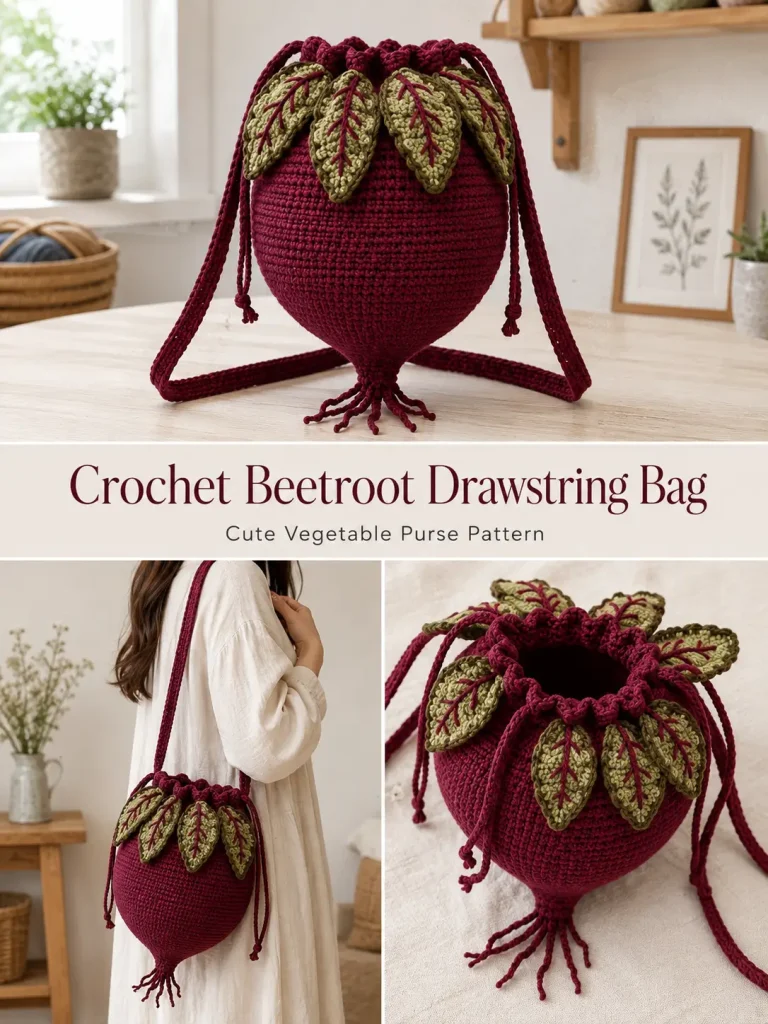
This crochet beetroot bag is a playful handmade accessory shaped like a plump beet, complete with a deep berry-red body, pointed root tip, green leaves with burgundy veins, long drawstring cords, and shoulder straps.
The design looks detailed, but the construction can be kept very manageable. The bag starts with an oval crochet base, grows outward into a rounded beet-shaped body, then narrows slightly toward the opening. A drawstring round gathers the top, while separate crochet leaves are attached around the opening to create the leafy beet crown.
Description
The finished crochet beetroot purse has a rounded, slightly bulbous body worked in deep beet-red yarn. The bottom narrows into a small pointed root with several short dangling yarn ends.
At the top, the bag has a drawstring opening with multiple decorative green leaves. Each leaf is light olive green with a darker brown-green edging and burgundy embroidered veins that match the bag.
Two long burgundy straps allow the bag to be worn over the shoulder, while a separate drawstring cord cinches the opening closed.
For extra practicality, a simple fabric lining can be added inside.
Materials
- Worsted or aran-weight yarn in deep beetroot burgundy
- Worsted or aran-weight yarn in light olive green
- Small amount of dark olive-brown yarn for leaf edging
- Small amount of burgundy yarn for leaf veins
- 4 mm crochet hook
- Yarn needle
- Scissors
- Stitch markers
- Polyester cord or additional crochet yarn for straps, if desired
- Optional cotton fabric for lining
- Optional magnetic snap
Abbreviations
- ch – chain
- sc – single crochet
- hdc – half double crochet
- sl st – slip stitch
- inc – 2 sc in same st
- dec – single crochet 2 together
- st – stitch
- sts – stitches
- BLO – back loop only
Pattern Notes
US crochet terminology is used.
The bag is made from:
- one oval base
- one rounded beet-shaped body
- one pointed root tip
- drawstring eyelets
- one long drawstring cord
- 5 crochet leaves
- embroidered leaf veins
- 2 long shoulder straps
- optional lining
The bag body is worked in continuous rounds.
Use a stitch marker to mark the first stitch.
Approximate finished size:
- width: 9–10 in / 23–25 cm
- height without leaves: 9–10 in / 23–25 cm
- height including root tip: approximately 11 in / 28 cm
- straps: approximately 28–32 in / 70–80 cm each
Step-by-Step Instructions
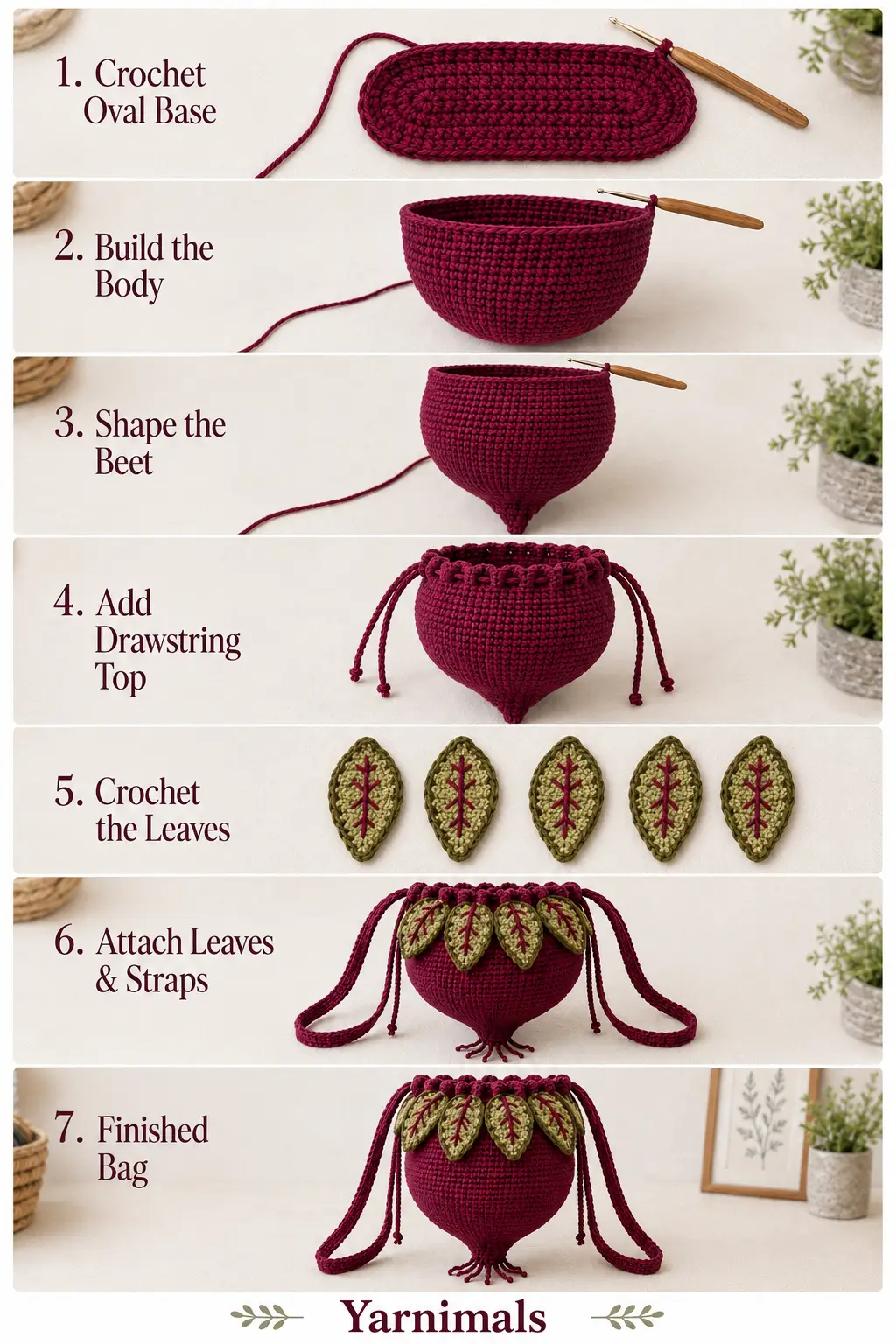
Part 1 – Oval Bag Base
Using deep beetroot burgundy yarn.
Foundation
Ch 21.
Round 1
Sc in second ch from hook.
Sc in next 18 ch.
Work 3 sc in final ch.
Continue along the opposite side of the foundation chain.
Sc in next 18 ch.
Work 2 sc into the same foundation chain where the first sc was made.
You should have:
42 sts
Round 2
Inc in first st.
Sc in next 18 sts.
Inc in each of next 3 sts.
Sc in next 18 sts.
Inc in each of final 2 sts.
48 sts
Round 3
Repeat:
- sc in first st, inc in next
- sc across the long side
- work evenly spaced increases around the curved end
- sc along second long side
- work evenly spaced increases around final end
Aim for:
56 sts
The exact placement of the increases is less important than keeping the base flat and oval.
Round 4
Sc around, adding 4–6 evenly spaced increases around the two curved ends if needed.
Aim for approximately:
60 sts
The base should measure approximately 7–8 in / 18–20 cm long.
Part 2 – Turn Up the Bag Sides
Round 5
Working BLO only:
Sc in every st around.
Do not increase.
This creates a clean turning ridge between the base and the bag body.
Rounds 6–9
Sc in every st around.
Keep approximately:
60 sts
The sides will begin rising vertically.
Part 3 – Shape the Rounded Beet Body
To create the plump beet shape, gradually increase the circumference.
Round 10
Repeat:
sc in next 9 sts, inc
around.
Approximately 66 sts
Rounds 11–14
Sc around without increasing.
Round 15
Repeat approximately:
sc in next 10 sts, inc
around.
Aim for approximately:
72 sts
Rounds 16–22
Sc in every st around.
The bag should now have a rounded full middle section.
Part 4 – Narrow the Upper Body
The top of the beet should become slightly narrower before the drawstring opening.
Round 23
Repeat:
sc in next 10 sts, dec
around.
Approximately 66 sts
Rounds 24–26
Sc around.
Round 27
Repeat:
sc in next 9 sts, dec
around.
Approximately 60 sts
Rounds 28–30
Sc around.
The opening should now be slightly narrower than the widest part of the bag.
Part 5 – Drawstring Eyelet Round
Round 31
Ch 1.
Repeat around:
sc in next 2 sts, ch 2, skip 2 sts
Continue around.
Join with sl st.
These ch-2 spaces become the drawstring openings.
Round 32
Sc in every sc and work 2 sc into every ch-2 sp.
Join.
Fasten off.
Part 6 – Beet Root Tip
The pointed root is made separately and attached to the center bottom of the bag.
Using beetroot burgundy yarn.
Round 1
Make a magic ring.
6 sc into ring.
Round 2
Sc around.
6 sts.
Round 3
Repeat:
sc, inc
around.
9 sts.
Rounds 4–5
Sc around.
Round 6
Repeat:
sc, dec
around.
6 sts.
Fasten off, leaving a long sewing tail.
Do not stuff heavily. A tiny amount of stuffing can be added if desired.
Sew the wide end securely to the exact center of the bag base.
Root Fibers
Cut 4–5 burgundy yarn strands approximately 4–5 in / 10–12 cm long.
Fold them in half.
Attach them through the tip using a lark’s-head knot.
Trim unevenly so the ends resemble small beet roots.
Part 7 – Crochet Leaves
Make 5 leaves.
The leaves should be broad, rounded, slightly scalloped, and pointed at the base.
Use light olive-green yarn.
Foundation
Ch 13.
Side 1
Beginning in second ch from hook:
- sl st in next ch
- sc in next ch
- hdc in next 2 ch
- dc in next 5 ch
- hdc in next 2 ch
- sc in final ch
Work 3 sc into the end chain.
Now work along the opposite side of the foundation.
Side 2
- sc in next ch
- hdc in next 2 ch
- dc in next 5 ch
- hdc in next 2 ch
- sc in next ch
- sl st at beginning
Do not fasten off.
Leaf Scalloped Edge
Continue around the leaf.
Repeat approximately:
sc in next st, 3 hdc in next st, sc in next st
around both outer sides.
Keep the base relatively narrow.
Fasten off.
The finished leaf should have a soft scalloped outline.
Part 8 – Dark Leaf Border
Using dark olive-brown yarn.
Join at the base of one leaf.
Sc evenly around the entire outer edge.
At each scalloped bump, work slightly loosely so the leaf remains flat.
Fasten off.
Repeat for all five leaves.
Part 9 – Burgundy Leaf Veins
Using beetroot burgundy yarn and a yarn needle.
Embroider one long central vein from the leaf base toward the upper tip.
Then add 3–4 smaller diagonal veins on each side.
The side veins should branch outward from the center.
Do not pull the embroidery too tightly.
Repeat on every leaf.
This burgundy veining visually connects the green leaves with the beet body.
Part 10 – Leaf Stems
Using burgundy yarn.
For each leaf:
Ch 12–16.
Sl st back through every chain.
Fasten off.
Sew one end of the cord firmly to the base of the leaf.
Make five stems.
Part 11 – Attach the Leaves
Arrange the five leaves around the top opening.
Use this layout:
- one centered front leaf
- one front-left leaf
- one front-right leaf
- one back-left leaf
- one back-right leaf
Allow the leaves to overlap slightly.
Sew only the lower leaf base and stem area to the bag.
Leave most of the leaf free so it can stand outward naturally.
Do not sew the leaves flat against the bag.
Part 12 – Drawstring Cord
Using beetroot burgundy yarn.
Ch approximately 140–160.
Sl st back through every chain.
Fasten off.
Thread the cord through the eyelet round:
- into first opening
- out through next
- continue around the entire bag
Bring both ends toward one side.
Tie a secure knot at each end.
The opening should gather smoothly when the cord is pulled.
Part 13 – Shoulder Straps
Make 2.
Using beetroot burgundy yarn.
Foundation
Ch approximately 130–150, or until the strap measures approximately 28–32 in / 70–80 cm.
Row 1
Sl st in second ch from hook and across.
For a thicker strap:
Turn and work a second row of sl st or sc.
Fasten off, leaving a long tail.
Make a second identical strap.
Attach the Straps
Position one strap along the left side of the bag.
Sew one end near the front upper edge and the other end near the back upper edge.
Attach the second strap on the opposite side.
Reinforce each attachment point several times.
Keep the straps clear of the drawstring eyelets.
Part 14 – Optional Lining
Cut cotton fabric approximately 1/2 in / 1.5 cm larger than the inside dimensions of the bag.
Sew the fabric into a simple pouch.
Fold the upper raw edge inward.
Place the lining inside the crochet bag.
Hand stitch it just below the drawstring round.
Do not sew through the eyelets.
A lining is especially useful if the bag will hold keys, makeup, coins, or other small objects.
Finishing
Weave in all ends.
Gently shape the bag with your hands.
Check:
- base sits evenly
- beet body is rounded
- top opening gathers correctly
- root tip is centered
- root fibers hang freely
- five leaves are securely attached
- leaf embroidery is visible
- shoulder straps are equal length
- drawstring works smoothly
Design Consistency Lock
Keep the finished project as:
- deep beetroot burgundy rounded bag
- oval bottom
- slightly narrower upper opening
- pointed root tip
- several short dangling root fibers
- five light olive-green leaves
- dark olive-brown leaf edging
- burgundy leaf veins
- overlapping leafy crown
- burgundy drawstring
- two long burgundy shoulder straps
- no zipper
- no flower decorations
- no granny squares
- no beads
- no extra colors
The bag should immediately resemble a crochet beetroot.
Tips & Variations
Cotton or cotton-blend yarn is ideal because it provides enough structure for the vegetable shape.
If the bag feels too floppy, use a hook 0.5 mm smaller or add a fabric lining.
Keep the leaf embroidery slightly raised rather than pulling it flat into the green crochet.
For the most natural beet shape, keep the widest part below the middle of the bag and gradually narrow the upper section.
Before sewing the leaves permanently, pin all five around the opening and adjust their angles.
The two front leaves can point slightly outward while the back leaves sit more upright.
For a smaller handbag, reduce the foundation chain and stop increasing the body at approximately 54–60 stitches.
For a larger shoulder bag, increase the oval base and continue the body to 78–84 stitches.
FAQ
Is this bag difficult to crochet?
The construction is intermediate-beginner friendly. The body uses mostly single crochet with simple increases and decreases. The leaves are made separately and sewn on afterward.
How does the bag close?
A crochet cord passes through chain-space eyelets near the top. Pulling the cord gathers the opening like a drawstring pouch.
Are the leaves part of the drawstring?
No. The leaves are decorative pieces sewn around the upper edge. The burgundy drawstring runs independently through the eyelet round beneath them.
Conclusion
This crochet beetroot drawstring bag turns a simple rounded crochet pouch into a playful vegetable-inspired accessory. The deep burgundy body, tapered root, olive-green scalloped leaves, contrasting veins, and long matching straps give the finished bag its recognizable beet shape without requiring complicated construction. Make it as a whimsical everyday purse, market bag, handmade gift, or fun crochet accessory in the rich botanical colors of the original concept.