Beautiful Star Lace Crochet Blanket – Easy Openwork Throw in Soft Cream
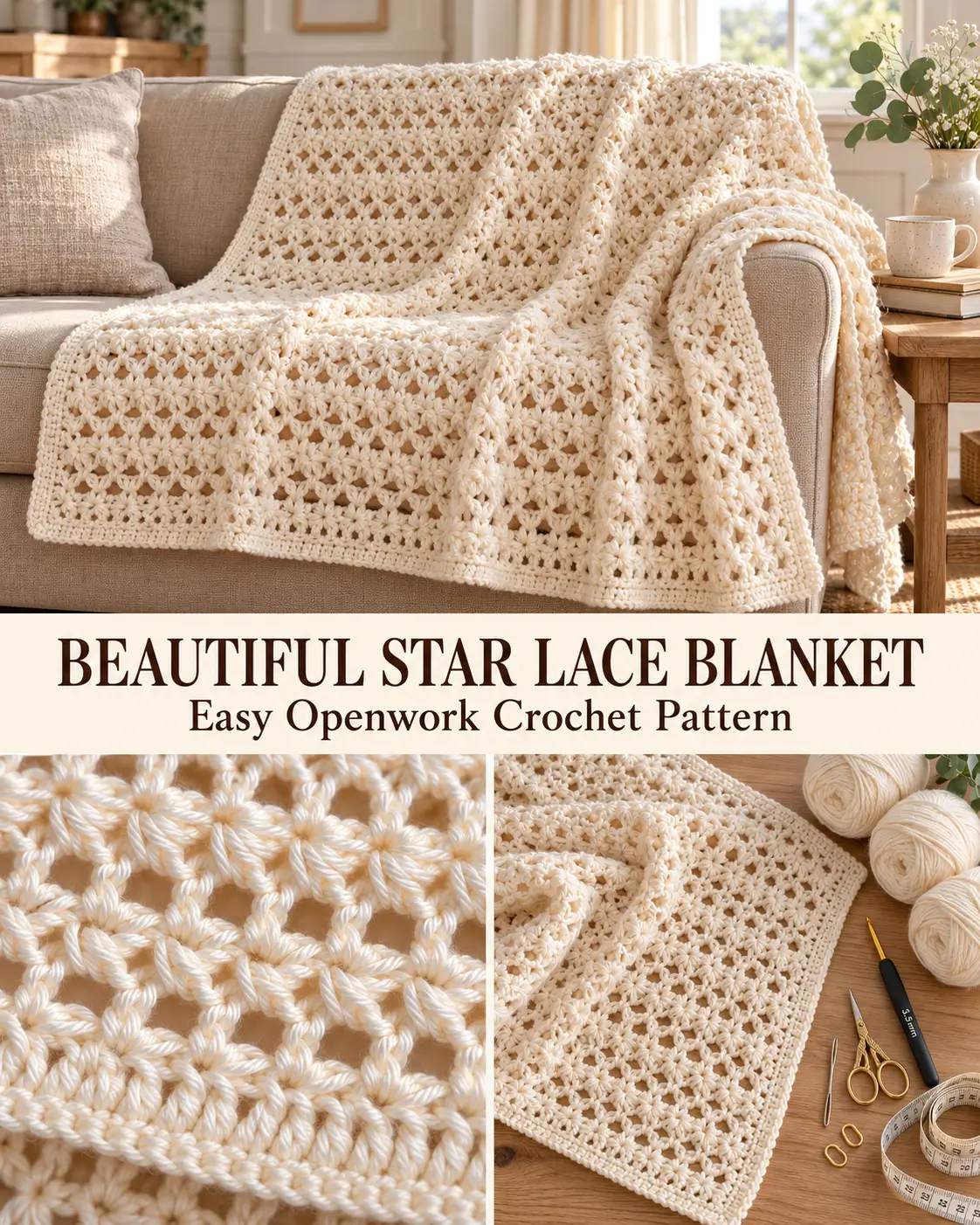
Some crochet stitches are so beautiful that they deserve an entire blanket of their own.
This gorgeous star-inspired lace crochet blanket combines delicate open spaces, tiny raised clusters, and soft ivory yarn to create an elegant handmade throw.
At first glance, the fabric looks incredibly intricate. Small decorative clusters appear to form tiny stars across the surface, while evenly spaced chain openings create a light, airy texture.
But the real appeal is how the fabric develops from a repeating sequence of familiar crochet techniques.
Instead of sewing individual motifs together, you’ll work the entire blanket back and forth in rows, allowing the star-like pattern to grow naturally with every repeat.
The soft cream color makes this project especially attractive for neutral living rooms, cozy bedrooms, modern farmhouse interiors, and vintage-inspired spaces.
Whether you’re exploring lace crochet for the first time or searching for an elegant new blanket design, this project is a lovely opportunity to create something special.
Why You’ll Love This Crochet Blanket
- Beautiful raised clusters resembling tiny stars.
- Delicate openwork spaces between the motifs.
- Soft, flexible fabric with attractive drape.
- A classic creamy-ivory color.
- Worked in one piece without joining squares.
- Easy to customize for different blanket sizes.
- A repeating two-row pattern after the foundation.
- Lovely for decorative throws and handmade gifts.
- Looks beautiful in photographs because of the distinctive texture.
This star-inspired variation is best for confident beginners who already know double crochet and are ready to learn closed crochet clusters.
Crochet Blanket Pattern Overview
Pattern name: Cream Star-Cluster Lace Throw
Skill level: Intermediate
Crochet terminology: US terms
Construction: Worked flat in turned rows
Stitch pattern: Star-inspired paired cluster lace
Pattern repeat: Two rows after setup
Foundation multiple: 4n + 4 chains, where n is the number of motif repeats
Suggested starting chain: 244 chains for 60 repeats
Yarn weight: DK / light (#3)
Crochet hook: 3.5 mm (E/4), or size needed for desired fabric
Color: Warm creamy ivory
Desired finished dimensions: Approximately 48 × 60 inches, adjustable after swatching
Border: Optional simple single crochet edging
This is an original star-cluster lace variation inspired by the visual appearance of openwork star crochet. It has a defined repeat, but the finished blanket size and yarn requirements have not been sample-tested.
Materials You’ll Need
- DK-weight yarn in warm creamy ivory
- 3.5 mm crochet hook
- Scissors
- Yarn needle
- Measuring tape
- Stitch markers
- Optional blocking mats and rustproof pins
Choosing the Right Yarn
The yarn you choose can completely transform the appearance of this blanket.
A smooth DK-weight yarn works particularly well because it makes the decorative stitch clusters easy to see.
For a blanket similar to the inspiration photograph, choose an ivory yarn with a slight sheen and a softly twisted strand.
Cotton: Produces crisp stitch definition and a beautiful drape, but a large cotton blanket can be heavy.
Cotton-bamboo blend: Creates a soft, flexible fabric with elegant drape.
Soft acrylic: Often practical for larger blankets because it is lightweight and easier to care for.
Wool blend: Creates a warmer blanket, although it may have more elasticity and a softer stitch definition.
Avoid extremely fuzzy yarn if you want the openwork pattern to remain clearly visible.
The Beautiful Cream Color
One of the most appealing details of the original stitch photograph is its single soft cream color.
Using one solid shade allows the delicate stitch structure to become the main visual feature.
Choose a warm ivory rather than a very bright white if you want a soft, timeless appearance.
The same pattern would also look beautiful in oatmeal, pale sage, dusty rose, soft beige, or powder blue.
However, for this version, we’ll keep the entire blanket one elegant creamy-ivory shade.
How Much Yarn Do You Need?
Yarn consumption depends on the finished dimensions, yarn weight, hook size, and the density of your crochet clusters.
The best way to estimate is to make a sample.
- Crochet a sample containing at least six complete motif repeats and several pattern rows.
- Measure its finished width and height after blocking.
- Weigh the sample.
- Calculate the area of your desired blanket and divide it by the sample area.
- Multiply the result by the sample weight.
- Add extra yarn for the border and a reasonable safety margin.
This gives you a more dependable yarn estimate than purchasing a fixed number of skeins without checking gauge.
Crochet Abbreviations
All instructions use US terminology.
- Ch: Chain
- Sc: Single crochet
- Dc: Double crochet
- Sl st: Slip stitch
- St: Stitch
- Sp: Space
- Sk: Skip
- Rep: Repeat
- CL: Three-double-crochet closed cluster
- RS: Right side
- WS: Wrong side
Understanding the Star-Cluster Lace Stitch
The openwork fabric is built from alternating rows of V-shaped stitches and paired closed clusters.
The V-shaped rows create the airy openings.
The cluster rows create the raised star-like texture.
Each cluster is worked into a chain space rather than into several different foundation stitches.
This makes the repeat easier to count and gives the pattern a clear structure.
Special Stitch – Three-Double-Crochet Closed Cluster (CL)
A closed cluster combines three partially completed double crochet stitches into one shared top.
To make one:
- Yarn over.
- Insert your hook into the indicated chain space.
- Yarn over and pull up a loop.
- Yarn over and pull through two loops.
- Leave the remaining loops on the hook.
- Yarn over and insert your hook into the same space again.
- Pull up a loop, yarn over, and pull through two loops.
- Repeat the partial double crochet one more time.
- You should have four loops remaining on your hook.
- Yarn over and pull through all four loops.
One closed cluster is complete.
Do not add an extra closing chain unless the pattern specifically instructs you to.
Special Stitch – V-Stitch
A V-stitch is made by working:
1 dc, ch 2, 1 dc
into the same indicated stitch or chain space.
The chain-2 opening forms the center of the V.
Special Stitch – Star Pair
For this pattern, a star pair is:
CL, ch 2, CL
worked into the same chain-2 space.
The two closed clusters form raised sides, while the chain-2 opening between them becomes the center of the next motif row.
Blanket Size and Foundation Chain
This pattern uses a starting chain of 4n + 4, where n is the number of complete motifs.
For example:
| Motif Repeats | Starting Chains |
|---|---|
| 20 | 84 |
| 30 | 124 |
| 40 | 164 |
| 50 | 204 |
| 60 | 244 |
| 70 | 284 |
These are mathematically valid starting chains, not guaranteed finished widths.
For a large decorative throw, you can begin by sampling the 60-repeat version.
However, the correct number of repeats for a 48-inch width depends on your actual gauge.
How to Choose the Right Width
Make a six-repeat sample using 28 chains.
Complete several rows and block it gently.
Measure the sample width, then divide by six to estimate the width of one repeat.
Divide your desired blanket width by that result to estimate how many repeats you need.
Round to a whole number and calculate your foundation chain using 4n + 4.
Step-by-Step Star Lace Crochet Blanket Pattern
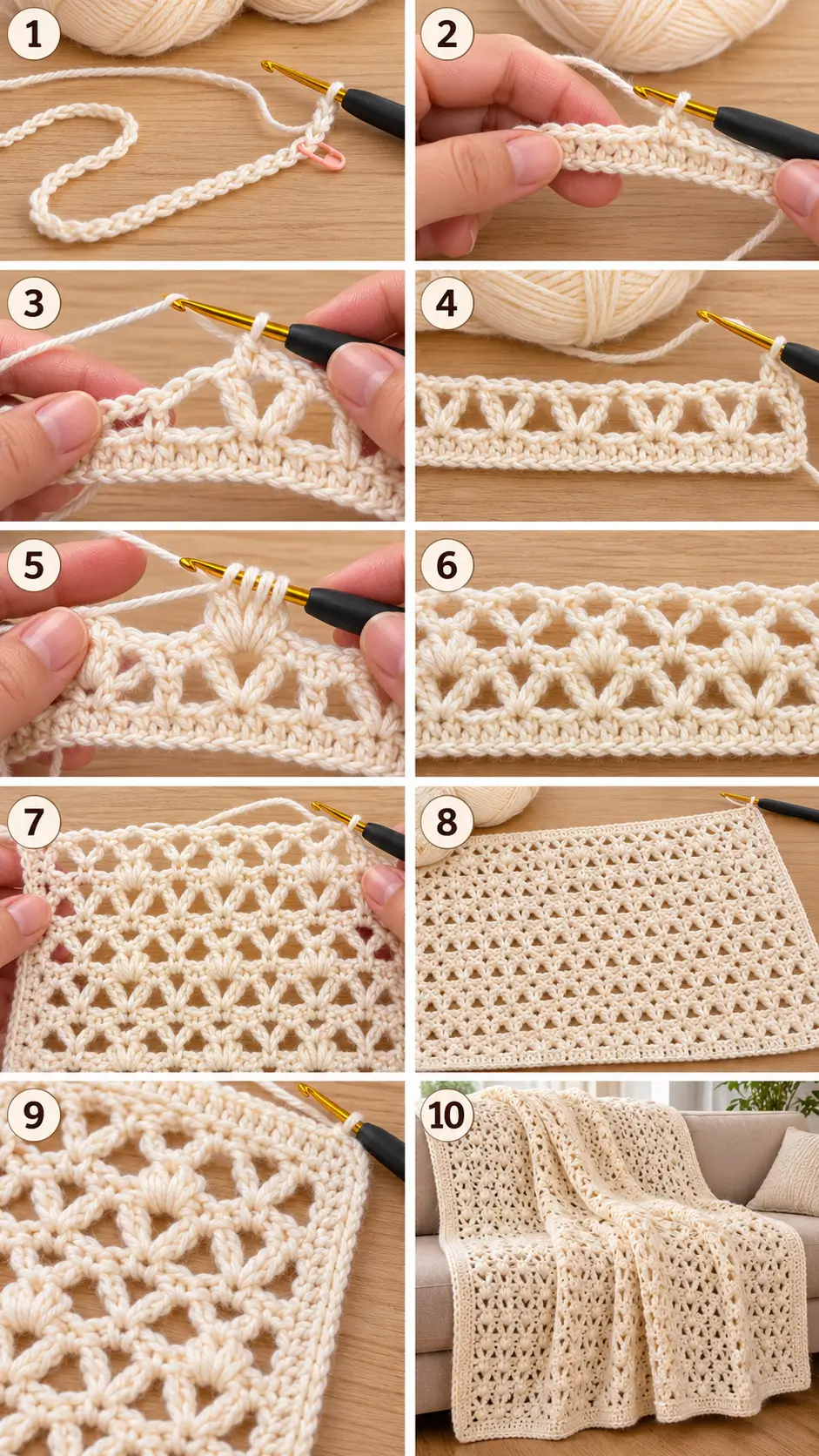
Step 1 – Create the Foundation Chain
Using your 3.5 mm crochet hook and warm ivory yarn:
Chain 244 for the 60-repeat version.
Keep your chains relaxed and evenly formed.
If your foundation tends to be tight, use a slightly larger hook for the starting chain and then switch back to the main hook.
Straighten the chain and check that it isn’t twisted.
Row 1 – Create the Single Crochet Foundation
Work one single crochet into the second chain from your hook.
Continue working one single crochet into every remaining foundation chain.
With 244 starting chains, you’ll have:
243 single crochet stitches.
Turn your work.
This creates a stable foundation that makes the openwork easier to build.
Row 2 – Establish the Open V-Stitches
This row creates the spaces needed for the raised star clusters.
- Chain 3. This counts as one double crochet at the first edge.
- Skip the next three single crochet stitches.
- Work one V-stitch into the following single crochet: 1 dc, ch 2, 1 dc.
- Chain 2.
- Skip the next three single crochet stitches.
- Work another V-stitch into the following single crochet.
- Repeat Steps 4–6 until you have completed 60 V-stitches.
After the final V-stitch:
- Chain 2.
- Skip the next single crochet.
- Work one double crochet into the last single crochet stitch.
- Turn.
Stitch structure: 60 V-stitches, with a double crochet at each outer edge and chain-2 bridges between neighboring motifs.
The central chain-2 space of every V-stitch will support the raised cluster pair in the next row.
Row 3 – Make the Raised Star Clusters
This is where the blanket begins to develop its decorative texture.
- Chain 3. This counts as the first edge double crochet.
- Chain 2.
- Locate the chain-2 opening in the center of the first V-stitch.
- Work one closed three-double-crochet cluster into that opening.
- Chain 2.
- Work another closed cluster into the same opening.
You have completed your first star pair.
- Chain 2.
- In the center chain-2 space of the next V-stitch, work CL, ch 2, CL.
- Continue across, placing one star pair into every V-stitch opening.
- After the last star pair, chain 2.
- Work one double crochet into the top of the beginning chain-3 edge stitch from the previous row.
- Turn.
Stitch structure: 60 raised star pairs with chain-2 spaces between them.
What Row 3 Should Look Like
Each V-stitch now supports two softly raised crochet clusters.
The clusters resemble tiny paired petals or star points.
The chain spaces around them keep the fabric open and flexible.
You should begin seeing a beautiful texture similar in character to delicate floral or star lace.
Row 4 – Rebuild the Open V-Stitches
This row prepares the next set of raised clusters.
- Chain 3 for the edge double crochet.
- Chain 2.
- Find the chain-2 space between the two closed clusters of the first star pair.
- Work 1 dc, ch 2, 1 dc into that opening.
- Chain 2.
- Work another V-stitch into the center chain-2 space of the next star pair.
- Continue across, placing one V-stitch into every star-pair opening.
- After the final V-stitch, chain 2.
- Work one double crochet into the top of the beginning chain-3 edge stitch from the previous row.
- Turn.
Stitch structure: 60 V-stitches.
You have now restored the same open structure used in Row 2.
Row 5 – Repeat the Raised Cluster Row
Repeat Row 3.
Work one star pair into the center chain-2 space of every V-stitch.
Maintain the chain-2 bridges between motifs.
Keep the same edge double crochets at the beginning and end.
Row 6 – Repeat the Openwork Row
Repeat Row 4.
Work one V-stitch into the center of every star pair.
Chain 2 between neighboring motifs.
The fabric now has several alternating rows of open V-stitches and raised clusters.
Continue the Two-Row Repeat
Repeat Rows 3 and 4 until the blanket reaches your desired length.
The sequence remains:
Cluster row → V-stitch row → cluster row → V-stitch row.
Work until the fabric is approximately the desired length before edging.
The stitch pattern contains 60 main motif columns when using the suggested 244-chain foundation.
Helpful Tip
Place a stitch marker near the first and last motif of each row.
This makes it easier to avoid accidentally adding or losing a repeat.
If your motif count changes, check the previous row before continuing.
Step 2 – Check the Growing Blanket
After approximately 8–12 pattern rows, lay the fabric flat.
You should see delicate, paired raised clusters arranged in regular rows.
Small chain openings surround the motifs, creating the decorative lace effect.
The blanket should remain reasonably flat without strong puckering.
If the fabric pulls inward, your chain spaces or closed clusters may be too tight.
If it looks loose and shapeless, try adjusting your hook size or maintaining firmer tension.
Step 3 – Continue to the Desired Length
Continue alternating cluster and V-stitch rows.
For a decorative throw, you can aim for approximately 60 inches in finished length.
Measure the actual blanket periodically, since stitch height varies depending on yarn and crochet tension.
The openwork should create a beautiful drape rather than a very stiff fabric.
For the neatest upper edge, finish after a V-stitch row before adding the border.
Part 2: Add a Simple Cream Crochet Border
Because the main fabric already contains a decorative lace pattern, a simple border works beautifully.
Use the same ivory yarn for a coordinated finish.
Border Round 1 – Single Crochet
With the right side facing you, join yarn near one corner if needed.
Work single crochet stitches evenly around the blanket.
Along the upper openwork edge, work into stitch tops and chain spaces.
Place approximately two single crochet stitches in each chain-2 space, adjusting if needed to keep the edge flat.
At the corner, work three single crochet stitches into the corner area.
Continue along the first side, placing stitches evenly into the ends of the rows.
Work three single crochets at the lower corner.
Along the foundation edge, work single crochet stitches evenly into the available foundation stitches.
Complete the remaining side and corner.
Join with a slip stitch.
The goal is a smooth border without rippling or pulling.
Border Round 2 – Neat Finished Edge
Chain 1.
Work one single crochet into each stitch around the blanket.
At every corner, work three single crochet stitches into the center corner stitch.
Continue around the entire edge.
Join with a slip stitch.
Fasten off.
Optional Additional Border
If you want a slightly more substantial border, add another round of single crochet.
However, a narrow border often looks best with delicate star-inspired lace because it doesn’t overwhelm the openwork design.
Part 3: Weave in the Ends
Use a tapestry needle to weave in any remaining yarn tails.
Work the yarn ends through several nearby stitches on the wrong side.
Change direction once or twice to help secure the ends.
Avoid pulling too tightly.
Because this design uses one solid color, you should have fewer yarn ends than a striped blanket, apart from those created when joining new skeins.
Part 4: Block the Crochet Blanket
Blocking can be especially helpful for lace crochet.
The process encourages the chain spaces to open evenly and helps the motif columns settle into shape.
Follow the care instructions for your yarn.
For suitable fibers:
- Gently dampen the blanket.
- Lay it flat on clean towels or blocking mats.
- Shape the sides into a neat rectangle.
- Gently open the decorative chain spaces.
- Avoid overstretching the raised clusters.
- Allow the blanket to dry completely.
Blocking may make the lace pattern more noticeable and improve the overall drape.
Your beautiful cream star-cluster lace blanket is now complete!
Tips for Beautiful Star Lace Crochet
Keep the Cluster Stitches Even
The raised clusters are the central feature of the design.
Pull each loop to a similar height for a consistent finished texture.
Don’t Make the Chain Spaces Too Tight
The chain-2 spaces need enough room to support the next row’s motifs.
Tight chains can cause the fabric to bunch.
Count Your Motifs
With the suggested foundation, every patterned row should contain 60 V-stitches or 60 star pairs.
Maintaining the same number prevents accidental increases and decreases.
Use Smooth Yarn
Smooth yarn helps show the individual cluster stitches.
Extremely fuzzy yarn may hide the small decorative openings.
Practice Before Starting a Large Blanket
Make a small sample first.
This gives you a chance to understand the repeat, choose your preferred hook size, and check the fabric’s weight and drape.
Easy Ways to Customize Your Blanket
Make a Smaller Lap Blanket
Use fewer starting motifs and stop after fewer rows.
A lighter version is lovely for a reading chair.
Create a Soft Pastel Baby Blanket
Try pale pink, gentle sage, powder blue, or warm cream.
This is an openwork design, so follow current infant safe-sleep guidance and don’t place loose blankets in a baby’s sleeping space.
Use a Cotton-Bamboo Blend
This can create an elegant drape suitable for a decorative summer throw.
Make a Matching Cushion
Use the same stitch pattern for two rectangular panels, then combine them with a suitable backing or lining.
Try a Two-Color Version
Change colors every two or four rows.
However, using one solid shade keeps the lace pattern visually cleaner and closer to the inspiration image.
Make a Long Sofa Throw
Once your width is established, continue adding rows to create a longer decorative blanket for the back of a sofa.
Frequently Asked Questions
Is this crochet pattern beginner-friendly?
The foundation and V-stitches use familiar techniques, but the closed clusters require practice.
It’s best suited to confident beginners or intermediate crocheters.
Is this the traditional crochet star stitch?
No. This design is an original star-inspired cluster lace variation. Traditional six-loop star stitch is constructed differently.
The linked CrochetBeja tutorial provides the reference technique for crocheters who want to learn that specific star stitch.
What yarn works best?
Smooth DK cotton blends, cotton-bamboo yarn, and soft acrylic yarns are suitable choices.
Can I use a larger hook?
Yes. A larger hook may create a more open, drapey fabric.
Always check your sample before committing to the full blanket.
Can I make the blanket wider?
Yes. Increase the number of motif repeats and recalculate the foundation chain using 4n + 4.
Does this blanket need a border?
A border is optional, but it can help stabilize the openwork edges and give the finished blanket a neater appearance.
Is the fabric suitable for winter?
This is primarily a decorative, breathable lace blanket.
Its warmth depends on the fiber and yarn weight, but it will generally have more open spaces than a dense crochet blanket.
Can I use this pattern for a scarf?
Yes. Make a narrower foundation chain and continue the pattern until the scarf reaches your preferred length.
More Beautiful Crochet Projects to Try
If you enjoy decorative crochet textures, explore these projects next:
- Reverse blanket stitch crochet blanket
- Interlocking block stitch crochet throw
- Easy openwork crochet shawl
- Beautiful crochet shell stitch blanket
- Beginner-friendly textured crochet blanket
- Elegant lacy crochet scarf
- Lightweight crochet cardigan
These projects offer different ways to experiment with stitch definition, raised textures, and beautiful openwork fabric.
Final Thoughts
A beautiful lace crochet blanket doesn’t need complicated color changes or dozens of separate motifs to make an impression.
This cream star-inspired cluster blanket combines delicate raised stitches, soft openwork spaces, and a timeless neutral color to create a beautiful handmade throw.
The repeating rows become familiar with practice, making it an enjoyable project for crocheters who love watching intricate-looking patterns develop gradually.
Whether you make it for your living room, as a handmade gift, or simply to explore new crochet techniques, the finished fabric offers a lovely combination of texture and elegance.