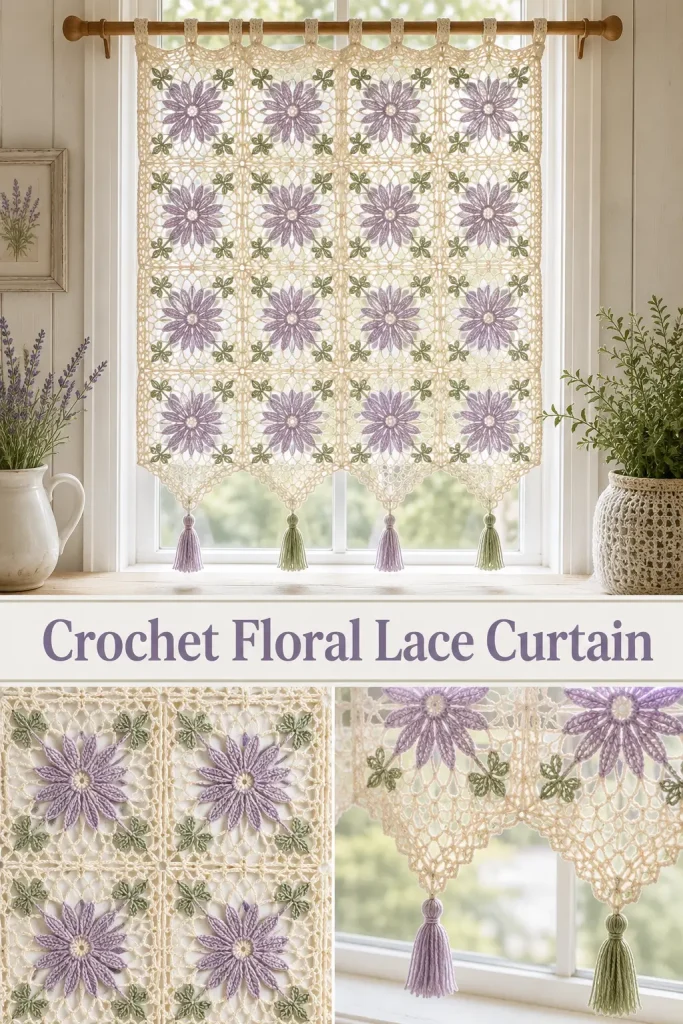
This crochet floral lace curtain is a lovely way to bring a soft handmade look to a bright window. The design is inspired by the floral panel style in the image, with repeating openwork square motifs, delicate flower centers, small leafy accents, a lacy joining mesh, and decorative tassels along the bottom.
For this version, I changed the color palette to a fresh and elegant combination that works beautifully for this kind of curtain: warm ivory for the lace framework, dusty lavender for the flowers, and sage green for the leaves and alternating tassels. The result keeps the same romantic cottage feel while giving it a softer updated look.
Description
The finished curtain is a rectangular crochet panel made from repeating floral square motifs joined into a grid. Each motif has a long-petaled flower in the center, airy lace spaces around it, and small paired leaves placed at the corners. The full panel is finished with a decorative top hanging edge for a curtain rod and a pointed lower edge with tassels.
For a curtain close to the look in the image, make 16 motifs total, arranged in 4 squares across and 4 squares down.
Materials
- DK or light worsted yarn in warm ivory
- DK or light worsted yarn in dusty lavender
- DK or light worsted yarn in sage green
- 3.5 mm or 4 mm crochet hook
- Yarn needle
- Scissors
- Stitch markers, optional
- Curtain rod for measuring the top loops
Abbreviations
- ch – chain
- sl st – slip stitch
- sc – single crochet
- hdc – half double crochet
- dc – double crochet
- sp – space
- rep – repeat
- st – stitch
- sts – stitches
- RS – right side
Pattern Notes
- US crochet terms are used.
- This is an original crochet pattern inspired by the visible floral lace curtain concept.
- The curtain is made in sections:
- floral square motifs
- small leaf accents
- joining the motifs into a panel
- top hanging edge
- bottom edging
- tassels
- The sample layout uses 16 motifs in a 4 x 4 grid.
- If you want a wider curtain, add more motifs across.
- If you want a longer curtain, add more motifs down.
Finished Size
The finished size depends on your yarn and tension.
With DK yarn and a 3.5–4 mm hook, each motif will usually measure about 5.5 to 6 inches square.
A 4 x 4 curtain panel will measure approximately:
- 22 to 24 inches wide
- 26 to 30 inches long, including the top loops and lower edging
Step-by-Step Instructions
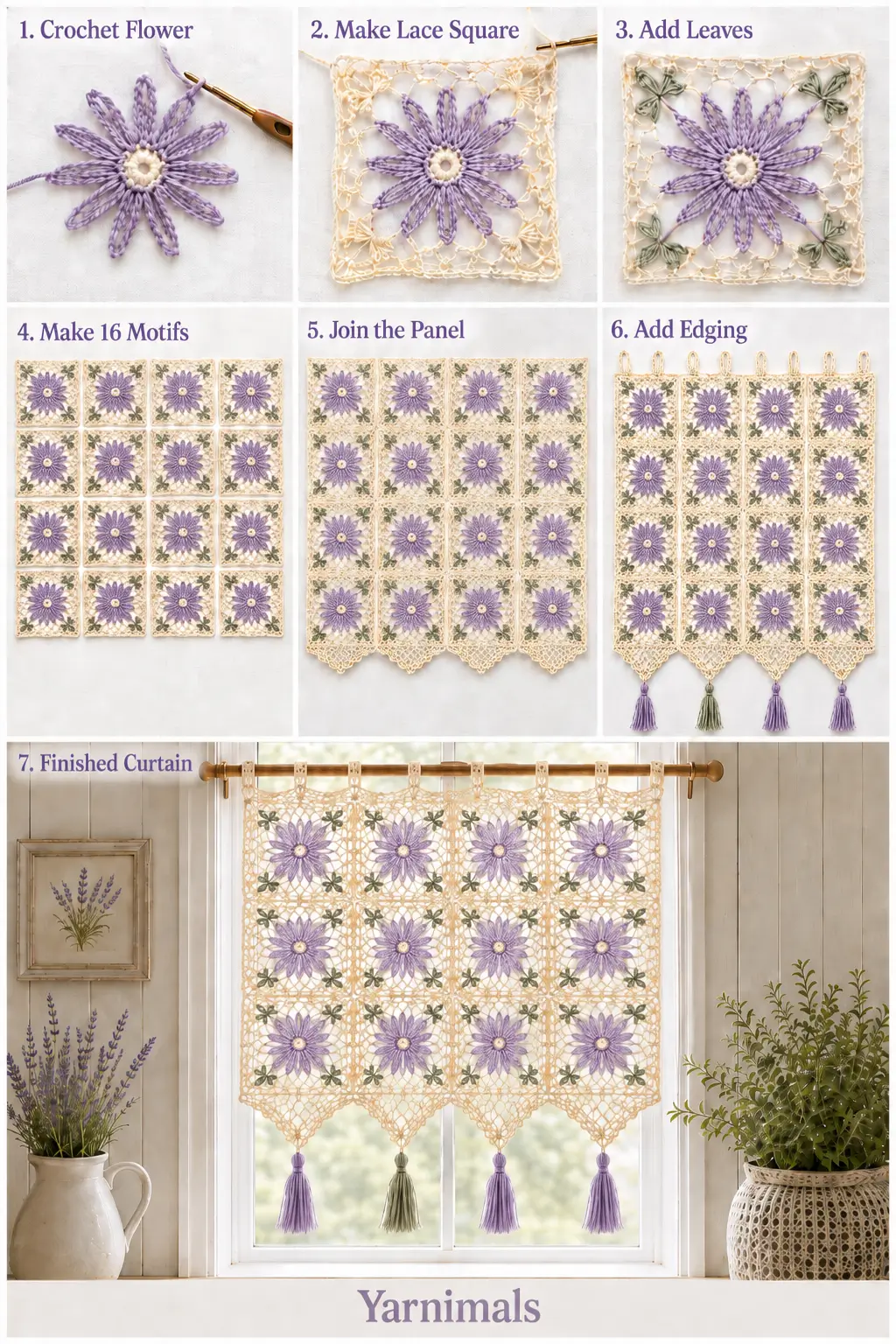
Part 1 – Floral Motif
Make 16 motifs.
Round 1 – Center Ring
Using warm ivory.
Make a magic ring.
Ch 1.
Work 12 sc into the ring.
Pull the ring closed.
Join with sl st to the first sc.
You should have 12 sts.
Round 2 – Long Flower Petals
Join dusty lavender in any stitch.
You will make one petal in each stitch around.
For each petal:
- ch 8
- sl st in 2nd ch from hook
- sc in next ch
- hdc in next 2 ch
- sc in next ch
- sl st in the last 2 ch
- sl st in the next stitch of Round 1
Repeat this all the way around.
You should have 12 long narrow petals.
Fasten off.
Round 3 – Base Loops Behind the Petals
Join warm ivory behind the petals in any petal base space.
Work:
- sc in base space
- ch 5
Repeat around behind the flower:
sc, ch 5
You should have 12 ch-5 loops behind the petals.
Join with sl st to the first sc.
Round 4 – Begin Squaring the Motif
Sl st into the first ch-5 loop.
In that same loop work:
- sc
- ch 5
- sc
This forms a corner.
In each of the next 2 ch-5 loops work:
- sc
- ch 3
In the next ch-5 loop work:
- sc
- ch 5
- sc
Repeat this pattern around:
- one corner loop
- two side loops
- one corner loop
- two side loops
Continue until all 4 corners are made.
Join with sl st.
Round 5 – Outer Lace Round
Sl st into the next corner ch-5 sp.
In the corner work:
- sc
- ch 5
- sc
Then work:
- ch 4
- sc in next ch-3 sp
- ch 4
- sc in next ch-3 sp
- ch 4
In the next corner ch-5 sp work:
- sc
- ch 5
- sc
Repeat this all the way around.
Join with sl st.
Fasten off.
At this point the motif should be a square floral lace block.
Part 2 – Leaf Accents
Each motif gets small paired leaves in the 4 corner spaces.
Join sage green in any corner ch-5 space.
For the first leaf:
- ch 6
- sl st in 2nd ch from hook
- sc in next ch
- hdc in next ch
- dc in next ch
- sl st back into the same corner space
For the second leaf in the same corner space:
Repeat the same leaf again.
You now have a pair of leaves in one corner.
Repeat in all 4 corner spaces.
Each motif will have 4 leaf pairs.
Fasten off.
Repeat this on all 16 motifs.
Part 3 – Arrange the Curtain Panel
Lay the motifs out in a 4 x 4 grid.
Make sure all flowers face the same direction.
Arrange them so the leaf corners create a balanced repeating pattern across the whole panel.
Part 4 – Join the Motifs
Use warm ivory.
You can join with a decorative zig-zag lace join to keep the curtain airy.
Place 2 motifs side by side with right sides facing up.
Join yarn in one matching corner space.
Then work this join between corresponding outer spaces of both motifs:
- sl st in first motif space
- ch 2
- sl st in second motif space
- ch 2
- sl st in next space of first motif
- ch 2
- sl st in next space of second motif
Continue alternating from one motif to the other until you reach the next corner.
Fasten off.
Join all motifs across each row first.
Then join the rows together using the same method.
When finished, you will have one large rectangular floral lace panel.
Part 5 – Side Edging
Join warm ivory on one side edge of the full panel.
Work evenly down the side using this repeat:
- sc in edge space
- ch 4
Repeat down the side.
At the end, fasten off.
Repeat on the opposite side.
This gives the curtain a neat matching lace edge.
Part 6 – Top Hanging Edge
Join warm ivory at the upper left corner of the curtain.
Top Row 1
Work sc evenly across the top edge, placing stitches into each edge space and join area.
Keep the stitches relaxed and even.
Top Row 2 – Rod Loops
Ch 1 and turn if needed.
Work:
- sc in first 3 sts
- ch 12
- skip 5 sts
- sc in next 3 sts
Repeat this across the top edge to create large hanging loops.
For a 4-motif-wide panel, make 5 evenly spaced rod loops.
These loops should be large enough to slide comfortably over your curtain rod.
Top Row 3 – Strengthen the Loops
Work back across the top.
Into each ch-12 loop, work 12 sc.
Between loops, work sc in each sc.
Fasten off.
This creates the finished decorative top heading and makes the loops strong enough for hanging.
Part 7 – Bottom Pointed Edging
Join warm ivory at the lower left corner.
Work across the lower edge using this repeat:
- sc in first edge space
- ch 5
- sc in next edge space
- ch 5
- sc in next edge space
- ch 7
- sc in next join or corner space
Repeat across the full width.
The longer ch-7 sections create the lower hanging points.
For a 4-motif-wide panel, you should have 5 lower points spaced across the bottom.
Fasten off.
Part 8 – Tassels
Make 5 tassels.
For a balanced look, alternate colors:
- tassel 1 – dusty lavender
- tassel 2 – sage green
- tassel 3 – dusty lavender
- tassel 4 – sage green
- tassel 5 – dusty lavender
To Make One Tassel
Wrap yarn around a piece of cardboard about 20–25 times.
Cut the yarn.
Slide the loops off carefully.
Tie a separate strand through the top loop bundle.
Wrap another strand about 1 inch below the top to form the tassel neck.
Trim the bottom evenly.
Attach one tassel to each bottom point.
Finishing
Weave in all ends neatly.
Lightly block the curtain so the motifs open properly and the lace pattern becomes clear.
When blocking:
- straighten the square motifs
- open the top loops evenly
- shape the bottom points
- let the tassels hang straight
Once dry, slide the top loops onto the curtain rod and hang the panel.
Color Palette Used in This Version
To keep the same floral curtain style but with a fresh updated look, use:
- warm ivory for the lace framework and top/bottom edges
- dusty lavender for the flowers
- sage green for the leaves
- dusty lavender and sage green alternating tassels
This palette works beautifully for cottage, vintage, farmhouse, and soft romantic interiors.
Tips & Variations
If you want a softer country look, you can also try:
- ivory + soft blue + eucalyptus green
- cream + muted peach + olive green
- warm white + pale mustard + sage green
Use cotton yarn if you want a crisper curtain that holds its shape well.
Use acrylic or cotton-blend if you want a softer drape.
If your motifs curl, blocking will help a lot.
If you want a wider panel, make 5 or 6 motifs across.
If you want a valance instead of a longer curtain, make only 2 or 3 motif rows.
FAQ
Can I make this curtain larger?
Yes. Add more motifs across for more width or more rows for extra length.
Do I have to use the same colors?
No. The pattern works well in many soft floral color palettes. Just keep the lace framework light so the flower motifs stay visible.
Is this a beginner pattern?
It is best for an adventurous beginner or intermediate crocheter. The motif construction is repetitive, but there are several parts including joining, edging, and tassels.
Conclusion
This crochet floral lace curtain is a beautiful home decor project that turns simple repeated motifs into a soft decorative window panel. The airy square flowers, leafy accents, and tassel edging give it a handmade vintage charm, while the new dusty lavender, sage, and ivory color palette keeps it fresh and elegant. If you love crochet home decor and floral lace patterns, this is a lovely project to make for a bright kitchen window, reading nook, or cozy cottage-style room.