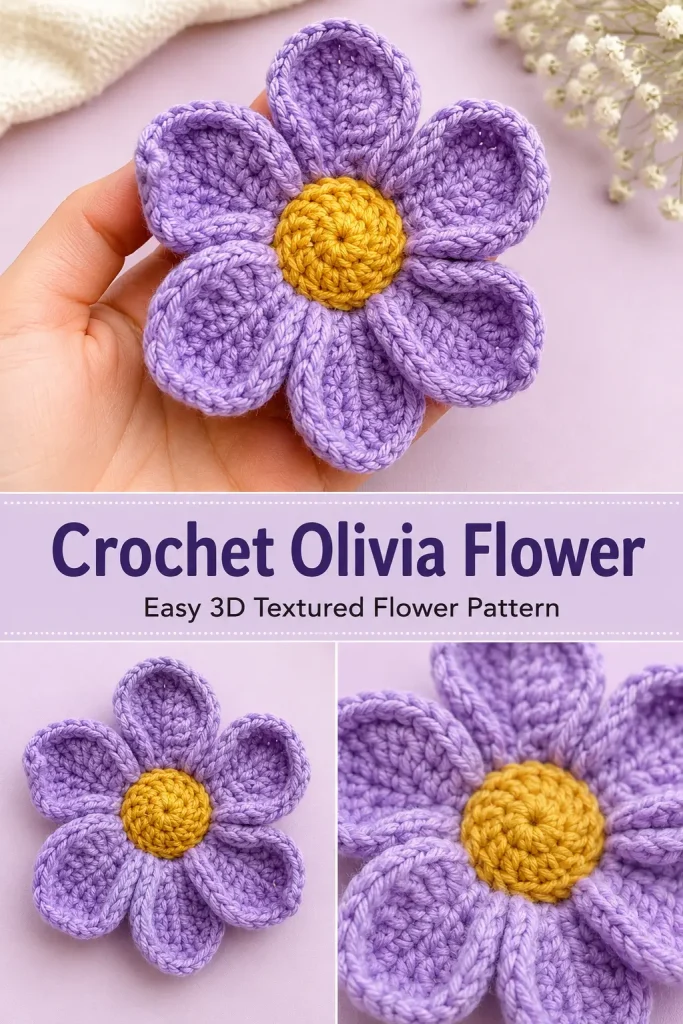
This beautiful crochet flower has a soft, dimensional look with six sculpted petals surrounding a bright yellow center. The petal construction creates a gently curled, layered effect that gives the flower much more texture than a standard flat crochet motif.
For this pattern, keep the flower design and colors exactly as shown: a golden yellow center with soft lavender petals. You can also make additional flowers in the same construction using the pale pink and white colorways shown alongside it, but the main featured flower remains lavender and yellow.
Description
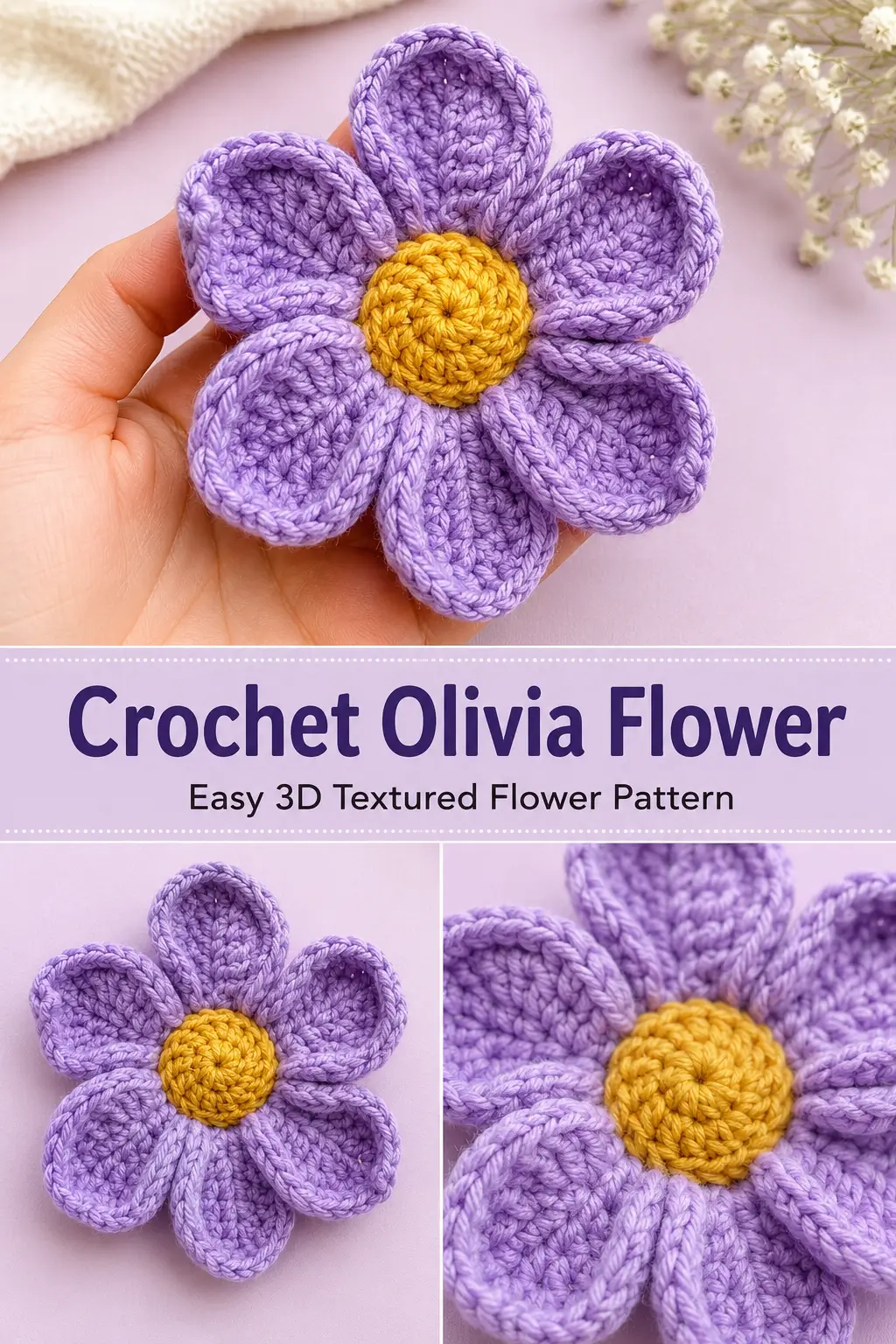
The finished crochet flower has a small circular golden-yellow center surrounded by six large lavender petals. Each petal is built from seven partially completed treble crochet stitches worked into one stitch, then finished with a combination of single crochet stitches and chain spaces.
This unusual construction makes the petals naturally curl and overlap slightly, creating the distinctive 3D flower shape.
The finished motif is ideal for crochet bags, blankets, hats, hair accessories, garlands, cushions, wreaths, or other handmade crochet decor.
Materials
- DK cotton yarn in golden yellow
- DK cotton yarn in soft lavender
- 4 mm crochet hook
- Yarn needle
- Scissors
You can use a different yarn weight if needed, paired with an appropriate crochet hook.
Abbreviations
- ch – chain
- sc – single crochet
- dc – double crochet
- tr – treble crochet
- sl st – slip stitch
- st – stitch
- sts – stitches
Pattern Notes
US crochet terminology is used.
The flower consists of:
- one yellow circular center
- six large textured lavender petals
The beginning loose ch 1 in the yellow center does not count as a stitch.
Each petal is worked into one stitch of the yellow center.
After completing a petal, skip one center stitch before beginning the next petal.
This creates exactly 6 petals around the 12-stitch center.
Step-by-Step Instructions
Yellow Flower Center
Using golden yellow yarn, make a magic ring.
Ch 1 loosely.
This ch 1 does not count as a stitch.
Work 12 dc into the magic ring.
When all 12 dc are complete, gently pull the magic ring almost closed.
Do not tighten it completely until you have identified the first dc.
Ignoring the beginning ch 1, sl st into the top of the first dc.
Cut the yellow yarn, leaving enough length for weaving in.
Pull the yarn through.
Now tighten the magic ring completely.
Weave in both yellow yarn ends securely.
You should have:
12 dc
Lavender Petals
Join soft lavender yarn into one of the yellow dc stitches.
Place a slip knot on your hook and pull the loop through to the front of the work.
Petal 1
Ch 5.
Working back into the same stitch where the lavender yarn was joined, begin making treble crochet stitches.
First Partial Treble
Yarn over twice.
Insert hook into the same yellow stitch.
Yarn over and pull up a loop.
Yarn over and pull through 2 loops.
Yarn over and pull through 2 loops.
Stop here.
Do not complete the treble.
Leave the final loops on the hook.
Continue Partial Trebles
Work 7 partially completed treble crochet stitches total into the same stitch.
After completing all seven partial trebles, together with the ch-5, you should have 8 loops on the hook.
Work the Loops Off
Yarn over.
Pull through the first loop only.
Then repeat:
yarn over, pull through 2 loops
until only one loop remains on the hook.
This creates the tall textured body of the petal.
Shape the Top of the Petal
Ignore the original ch-5.
Working between the treble stitches:
Sc between the first two trebles.
Sc between the next two trebles.
Sc between the next two trebles.
You now have:
3 sc
Ch 2.
Work 1 sc back into that same space.
Continue across the remaining trebles:
Sc between the next two trebles.
Sc between the next two trebles.
Sc between the final two trebles.
You have now worked:
3 sc, ch 2, sc, 3 sc
across the upper part of the petal.
Ch 5.
Sl st back into the same yellow stitch where the petal began.
The petal should naturally curve.
Move to the Next Petal
Skip the next yellow stitch.
Sl st into the following yellow stitch.
You are now ready to make the next petal.
Petals 2–6
Repeat the exact same petal construction.
For each petal:
- Ch 5.
- Work 7 partially completed tr into the same yellow stitch.
- With 8 loops on hook, yarn over and pull through the first loop.
- Yarn over and pull through 2 loops repeatedly until one loop remains.
- Ignore the beginning ch-5.
- Work 3 sc between the first sections of the trebles.
- Ch 2.
- Sc back into the same space.
- Work 3 more sc between the remaining trebles.
- Ch 5.
- Sl st into the same yellow stitch.
- Skip the next yellow stitch.
- Sl st into the following yellow stitch.
Continue until you have completed:
6 petals
After the final petal, cut the lavender yarn leaving enough length to weave in securely.
Pull the yarn through.
Shape the Flower
Each petal will have:
- one slightly curled side
- one flatter side
Arrange the petals so the curled portions sit toward the back of the flower.
This helps the petals lift naturally and gives the finished flower its layered 3D appearance.
Gently shape each petal with your fingers.
Do not flatten them aggressively.
Optional Petal Securing
If you want the flower to remain more upright and dimensional, use a yarn needle and matching lavender yarn to place a few tiny stitches between neighboring petals.
This is optional.
If left unsecured, the petals can be flattened or lifted depending on how you want to use the flower.
Finishing
Weave in the lavender yarn ends.
For extra security, the final petal can be lightly attached to the first petal with a small hidden stitch.
Adjust all six petals so they are evenly spaced around the yellow center.
The completed flower should have:
- 1 round yellow center
- 6 lavender textured petals
- slightly curled petal edges
- strong dimensional texture
- no leaves
- no additional edging
Design Consistency Lock
Keep the featured flower exactly as follows:
- golden-yellow center
- soft lavender petals
- 12 dc in the center
- 6 petals
- 7 partial treble stitches per petal
- ch-5 beginning and ending each petal
- raised textured petal construction
- slightly curled petals
- no leaves
- no extra flower rounds
- no beads
- no buttons
- no contrasting petal edging
Do not simplify the petals into ordinary shell stitches because that would change the finished appearance.
Tips & Variations
Cotton yarn works especially well because it gives the petals clear stitch definition and enough structure to maintain their shape.
Keep the ch-5 fairly relaxed. If it is too tight, the petal may curl too aggressively.
The seven partial treble stitches are intentionally crowded into one stitch. Work slowly and keep the yellow center stitch open enough to insert the hook repeatedly.
If the petal becomes difficult to work into, gently pull the stitches apart with your fingers before inserting the hook again.
The finished flower can be made larger by using thicker yarn and a larger hook without changing the stitch counts.
You can also make matching flowers in the same construction using the soft pink with yellow center or white with yellow center colorways shown alongside the lavender flower.
FAQ
How many petals does this crochet flower have?
The finished flower has 6 petals. Because the yellow center contains 12 stitches, each petal uses one stitch and the next stitch is skipped.
Why are the treble stitches left unfinished?
Leaving the seven treble stitches partially completed allows them to be worked off together in a Tunisian-style sequence. This creates the thick, textured petal shape.
Can I flatten the petals?
Yes. The petals naturally curl, but they can be gently flattened or lifted depending on how you plan to use the flower.
Conclusion
This textured crochet flower is a lovely small project when you want something more dimensional than a basic flat flower motif. The golden-yellow center and six soft lavender petals create an elegant floral design, while the unusual partial-treble technique gives every petal its distinctive curled texture. Once you become comfortable with the petal repeat, these flowers are quick to make for bags, blankets, hats, accessories, and crochet home decor.