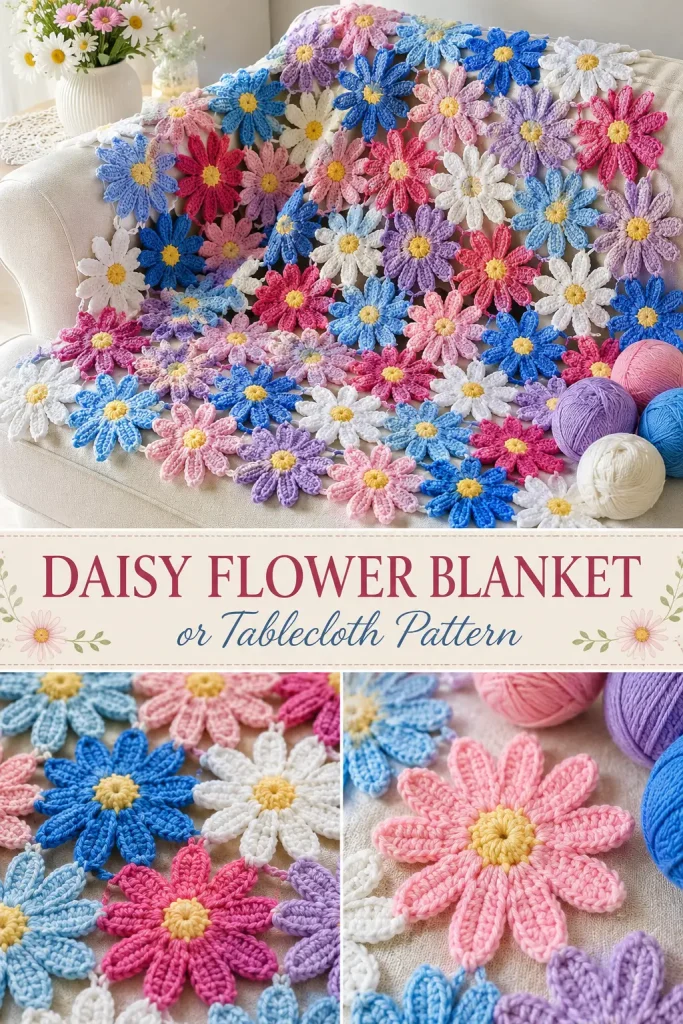
This colorful crochet flower blanket is bright, cheerful, and full of handmade charm. Each motif is made as a small daisy-style flower with a soft yellow center and long rounded petals in pretty colors like sky blue, royal blue, white, pink, lavender, and deep rose.
The finished project can be used as a baby blanket, sofa throw, tablecloth, picnic blanket, bed runner, or decorative crochet cover. Because the design is made from separate flowers, you can make it as small or as large as you like.
Description
This crochet flower blanket is made from many joined daisy motifs. Every flower has a round yellow center and long petal loops worked in one solid color. The flowers are connected edge to edge so they create a flexible floral fabric with small open spaces between the motifs. The color mix gives the blanket a happy garden look, while the soft rounded petals add texture and movement. It is a beautiful stash-busting project and a lovely beginner-friendly motif pattern once you learn the flower repeat.
Materials
- Medium weight yarn in yellow for flower centers
- Medium weight yarn in sky blue
- Medium weight yarn in royal blue
- Medium weight yarn in white
- Medium weight yarn in pink
- Medium weight yarn in lavender
- Medium weight yarn in deep rose or magenta
- 4.0 mm or 4.5 mm crochet hook
- Yarn needle
- Scissors
- Stitch markers
- Measuring tape
- Blocking mat and pins, optional
Abbreviations
- MR = magic ring
- ch = chain
- sl st = slip stitch
- sc = single crochet
- hdc = half double crochet
- dc = double crochet
- tr = treble crochet
- st = stitch
- sp = space
- rep = repeat
Pattern Notes
- This project is made from separate crochet flower motifs.
- Each flower has a yellow center and one petal color.
- The petals are long, rounded, and slightly open, giving the motif a daisy look.
- You can sew motifs together or join them as you go.
- The blanket/tablecloth size depends on how many flowers you make.
- Use the same yarn weight for all flowers so the motifs match in size.
- Block the motifs lightly before joining if you want a neater finished fabric.
Finished Size
One flower motif measures approximately 3 to 3.5 inches wide, depending on yarn and tension.
Suggested layouts:
- Small table mat: 4 x 4 flowers
- Baby blanket: 8 x 10 flowers
- Lap blanket: 10 x 12 flowers
- Tablecloth or throw: 12 x 16 flowers or larger
Make one flower first, measure it, then decide your final width and length.
Step-by-Step Instructions
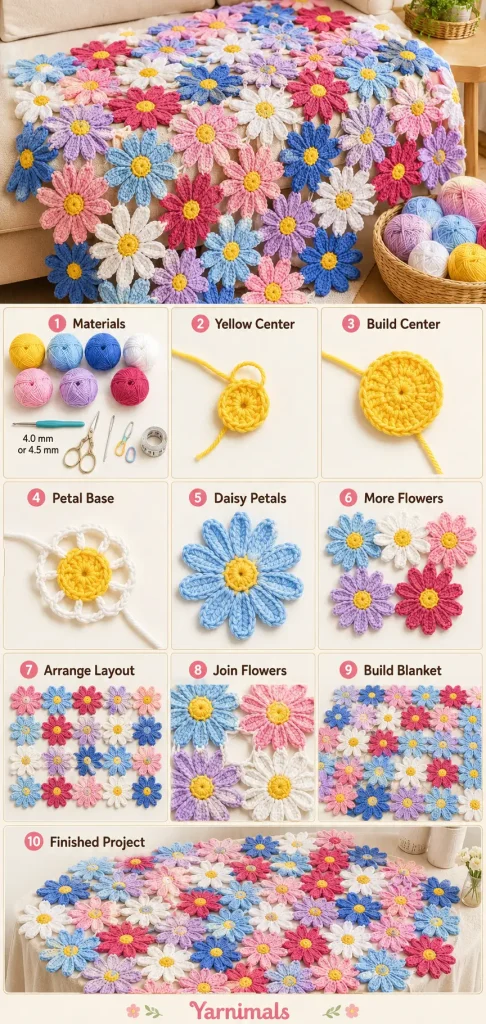
Flower Motif
Make as many flowers as needed.
Use yellow for the center and one petal color for the outer round.
Round 1: Yellow Center
With yellow yarn, make a MR.
Ch 1.
Work 12 sc into the ring.
Pull the ring closed.
Join with sl st to the first sc.
12 sc
Round 2: Build the Center
Ch 1.
Work 2 sc in each st around.
Join with sl st to the first sc.
24 sc
Fasten off yellow.
This creates a small round yellow center.
Round 3: Petal Base
Join petal color in any stitch.
Ch 1.
Sc in the same st.
Ch 3, skip next st, sc in next st.
Rep from ch 3, skip next st, sc in next st around.
Join with sl st to the first sc.
You should have 12 ch-3 spaces.
These spaces are the base for the long petals.
Round 4: Long Daisy Petals
Sl st into the first ch-3 sp.
In the same ch-3 sp, work:
Sc, hdc, dc, tr, dc, hdc, sc.
This makes one long rounded petal.
Repeat the same petal sequence in each ch-3 sp around:
Sc, hdc, dc, tr, dc, hdc, sc.
Join with sl st to the first sc.
Fasten off, leaving a tail for sewing if you plan to sew the flowers together.
You should have 12 long daisy petals.
Optional Fuller Petal Round
If you want the petals to look thicker and more raised, work this instead of the simple petal sequence:
In each ch-3 sp, work:
Sc, hdc, 2 dc, tr, 2 dc, hdc, sc.
This gives each petal a fuller rounded shape.
Make More Flowers
Make flowers in several colors:
- sky blue petals with yellow center
- royal blue petals with yellow center
- white petals with yellow center
- pink petals with yellow center
- lavender petals with yellow center
- deep rose petals with yellow center
For a balanced flower blanket, make similar numbers of each color.
For a more natural garden look, arrange the colors randomly instead of making stripes.
Join-As-You-Go Method
This method connects the flowers while making the final petal round.
Make the first flower completely.
For the second flower, work the yellow center and petal base as usual.
On the final petal round, when you reach a petal that should connect to the first flower:
Work sc, hdc, dc.
Ch 1.
Sl st into the top of the matching petal on the finished flower.
Ch 1.
Continue the petal with tr, dc, hdc, sc.
This joins the petals together at the outer point.
For stronger joining, connect 2 nearby petals between each pair of flowers.
Continue joining flowers side by side until you complete a row.
Then join rows together in the same way, connecting petals where they touch.
Sewn Join Method
If you prefer to make all flowers first, use this method.
Lay the flowers on a flat surface in your chosen layout.
Place flowers close together so the petals touch.
Thread a yarn needle with matching yarn or a neutral color.
Sew through the back loops of two touching petal tips.
Make 2 or 3 small stitches at each connection point.
Move to the next touching petal and repeat.
Join flowers into rows first, then join the rows together.
Keep the stitches hidden on the back so the front looks clean.
How to Arrange the Colors
Lay all motifs on the floor or table before joining.
Try this simple layout idea:
Row 1: pink, white, royal blue, sky blue, lavender
Row 2: royal blue, yellow-center white, deep rose, pink, sky blue
Row 3: lavender, sky blue, white, royal blue, pink
Row 4: deep rose, pink, lavender, white, royal blue
Continue mixing colors so no one color is grouped too heavily in one area.
Fill Small Gaps
The flower layout will naturally have small open spaces between motifs.
You can leave them open for a light tablecloth effect.
For a blanket, you may want the fabric slightly more secure.
To fill gaps:
Join yarn at the back of one flower.
Ch 3.
Sl st into the back of the next flower.
Ch 3.
Sl st into the next nearby flower.
Fasten off and weave in the ends.
Keep these gap joins loose so the blanket stays flexible.
Optional Border
A border helps the blanket or tablecloth look more finished.
Join yarn in any outer petal tip.
Border Round 1
Ch 1.
Sc evenly around the outside edge.
Work 1 sc into petal sides.
Work 2 sc into each outer petal tip.
Work 1 sc or sl st into dips between petals.
Join with sl st to first sc.
Border Round 2
Ch 1.
Sc in each st around.
At corners or outer curves, work 2 sc if needed so the border sits flat.
Join with sl st to first sc.
Fasten off and weave in ends.
Optional Scalloped Border
For a softer decorative finish:
Ch 1.
Skip 1 st.
Work 5 dc in next st.
Skip 1 st.
Sl st in next st.
Rep around the edge.
Adjust spacing as needed around flower curves.
Fasten off and weave in all ends.
Finishing
Weave in all loose yarn tails.
Lay the blanket or tablecloth flat.
Gently shape the flowers with your fingers.
Lightly block the finished piece if needed.
Do not press the petals flat. The rounded daisy texture should stay soft and dimensional.
Tips & Variations
Use cotton yarn if you want to make a tablecloth or table runner.
Use soft acrylic yarn if you want a blanket or throw.
For a baby blanket, choose soft washable yarn.
For a spring tablecloth, use mostly white, pink, yellow, and sky blue.
For a bold blanket, use royal blue, magenta, lavender, and bright pink.
For a calmer version, use cream petals with yellow centers and a few pastel accent flowers.
If your flowers curl, use a slightly larger hook.
If your flowers look too loose, use a smaller hook.
To make the blanket warmer, join the flowers closer together.
To make the tablecloth lighter, leave more open space between motifs.
FAQ
Is this crochet flower blanket beginner-friendly?
Yes, it is beginner-friendly once you are comfortable with basic stitches and working in rounds. The flower motif repeats the same steps each time.
Can I use this pattern as a tablecloth?
Yes. Use cotton yarn and block the finished piece well so it lays nicely on the table.
How many flowers do I need?
It depends on your desired size. Make one flower first, measure it, then multiply the number of flowers needed for your width and length.
Can I make the flowers in one color?
Yes. A blanket made with all white daisies and yellow centers would look beautiful. You can also use one petal color for a cleaner modern style.
Conclusion
This easy crochet flower blanket or tablecloth is a bright and joyful project made from simple daisy motifs. The yellow centers, colorful petals, and joined floral layout create a handmade piece that feels cheerful, soft, and full of personality.
Make it in playful colors like the sample, or choose your own palette for a blanket, tablecloth, throw, or decorative crochet cover you will love using.