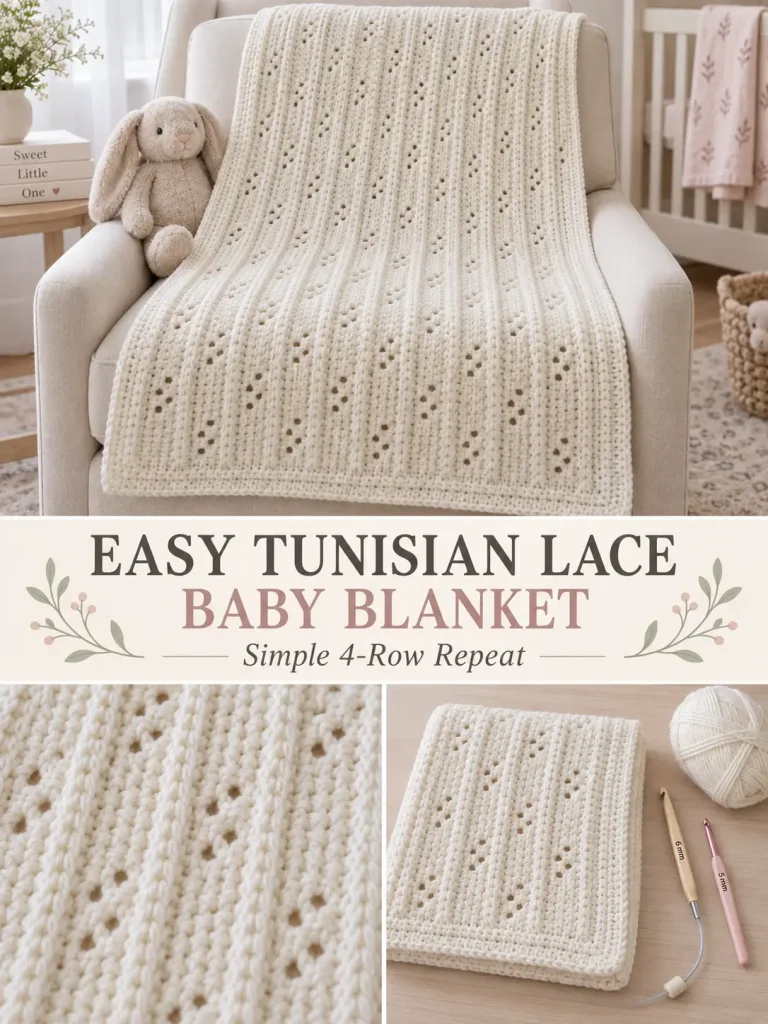
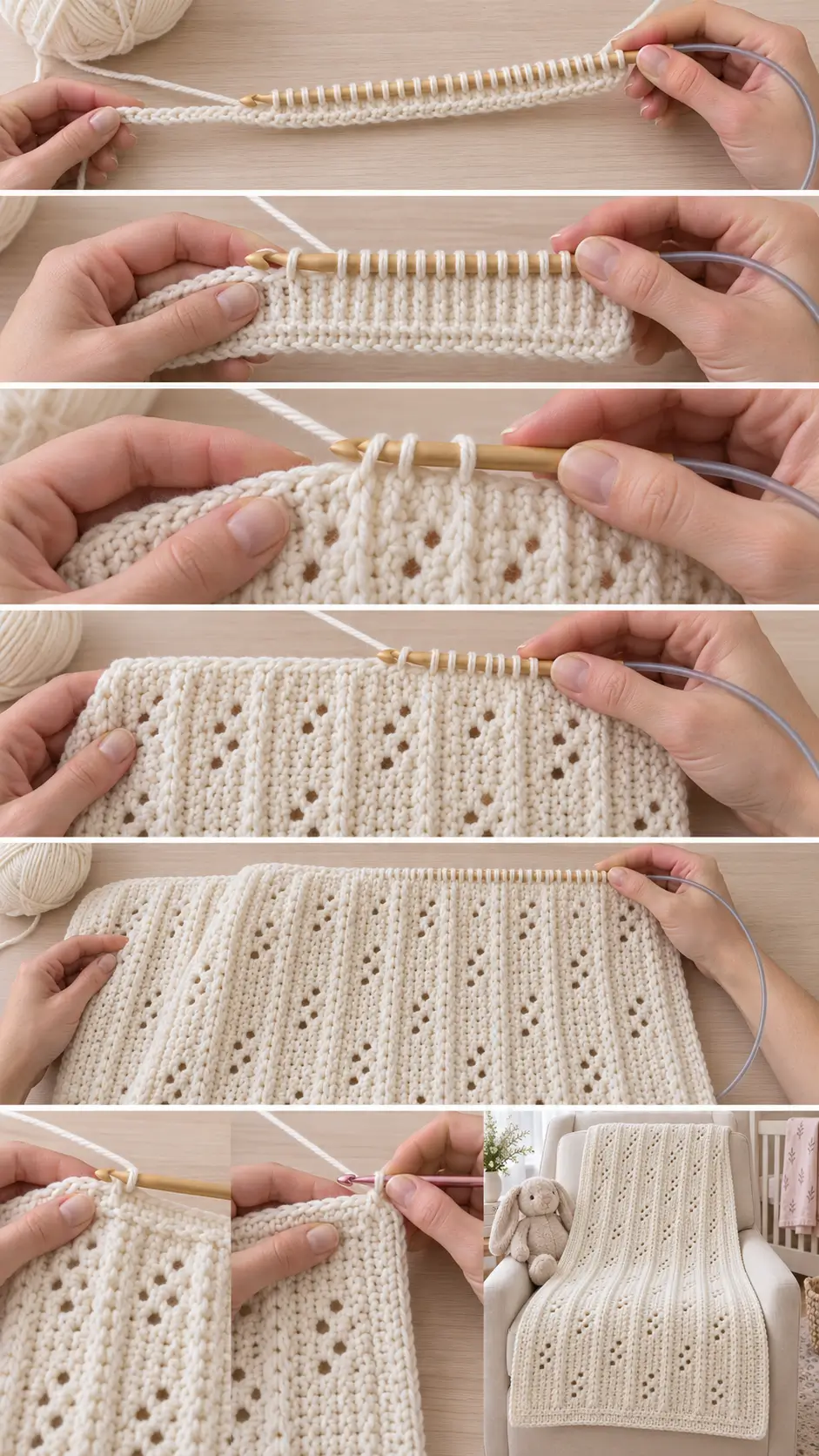
This soft white baby blanket uses a light, open Tunisian crochet texture with long vertical lines and small staggered eyelets. The fabric looks detailed, but the entire blanket is built from a simple repeating combination of Tunisian simple stitch, Tunisian simple stitch two together, and yarn overs.
The lace repeat is worked between plain Tunisian rows, which keeps the fabric stable while creating the delicate vertical texture.
Made in one solid color, the stitch pattern becomes the star of the blanket. Warm white gives it a classic baby-shower look, but the design also works beautifully in blush, sage, pale blue, oatmeal, or soft gray.
Pattern at a Glance
Skill level: Advanced beginner
Terminology: US crochet terms
Technique: Tunisian crochet
Finished size: Approximately 32 × 40 inches after blocking
Yarn: DK / Category 3 baby yarn
Main hook: 6 mm Tunisian crochet hook with cable
Border hook: 5 mm regular crochet hook
Construction: One flat rectangular panel + crocheted border
Starting chain: 102
Stitch multiple: Any even number
Main repeat: 4 rows
Materials
You will need:
- approximately 1,250–1,450 yards DK / Category 3 baby yarn
- 6 mm Tunisian crochet hook with a cable long enough to hold at least 102 loops
- 5 mm regular crochet hook for the border
- yarn needle
- scissors
- stitch markers
- blocking mats and pins, optional
A machine-washable acrylic, cotton blend, or soft baby yarn works well.
Suggested Color
For the classic version:
Warm White / Soft Ivory
Other beautiful choices include:
- dusty rose
- pale sage
- powder blue
- oatmeal
- light lavender
- soft gray
- muted peach
A solid color shows the lace texture most clearly.
Gauge
After light blocking:
14 stitches × 12 rows = approximately 4 inches
Gauge does not have to be exact for a blanket, but it will affect the finished measurements and yarn amount.
Finished Measurements
Approximately:
32 inches wide × 40 inches long
including the border.
The central Tunisian panel measures approximately:
29 × 36½–37 inches
before the border is added.
Abbreviations
- ch = chain
- sc = single crochet
- hdc = half double crochet
- sl st = slip stitch
- st = stitch
- sts = stitches
- Tss = Tunisian simple stitch
- Tss2tog = Tunisian simple stitch 2 together
- yo = yarn over
- Lts = last Tunisian stitch
- RetP = return pass
Understanding Tunisian Crochet Rows
Unlike standard crochet, each Tunisian row is completed in two stages:
Forward Pass
You work from right to left for right-handed crocheters, picking up loops and leaving them on the hook.
Return Pass
You work back across the loops without turning the fabric.
The blanket remains with the right side facing you throughout the Tunisian section.
Standard Return Pass
Use this same return pass after every forward pass unless otherwise stated.
With all loops on the hook:
Ch 1.
Then:
Yarn over, pull through 2 loops.
Repeat:
yo, pull through 2 loops
until only one loop remains on the hook.
That remaining loop becomes the first loop of the next row.
Tunisian Simple Stitch — Tss
Insert the hook from right to left under the front vertical bar of the next stitch.
Yarn over.
Pull up one loop.
Leave that loop on the hook.
Tunisian Simple Stitch 2 Together — Tss2tog
Insert the hook under the front vertical bars of the next 2 stitches at the same time.
Yarn over.
Pull one loop through both vertical bars.
Leave that new loop on the hook.
You have turned two stitch positions into one loop.
A yarn over is then used elsewhere in the repeat to restore the stitch count.
Yarn Over — yo
Bring the yarn over the hook from back to front in the normal direction.
Leave the yarn-over loop on the hook.
Do not insert the hook into a stitch.
The yarn over creates the small open space in the lace pattern.
Last Tunisian Stitch — Lts
When you reach the final stitch of a forward pass, insert the hook under both vertical bars of the outside edge stitch.
Yarn over.
Pull up one loop.
Working under both bars creates a firmer, neater edge.
Important Stitch Count
The blanket begins with:
102 stitches
The first loop already sitting on the hook counts as the first stitch.
The final outside edge stitch is worked separately as the Lts.
That leaves:
100 stitches
in the central pattern area.
Those 100 stitches divide perfectly into:
50 pairs
for the lace repeat.
FOUNDATION ROW
Using the 6 mm Tunisian crochet hook:
Ch 102.
Beginning in the second chain from the hook, insert the hook into the back bump of the chain.
Yarn over and pull up a loop.
Continue pulling up one loop from every remaining chain.
At the end you should have:
102 loops on the hook
Work the standard Return Pass.
Do not turn.
ROW 1 — PLAIN TUNISIAN SETUP ROW
The first loop is already on the hook.
Tss in each of the next:
100 stitches
Work Lts in the final edge stitch.
You should have:
102 loops
Work the standard Return Pass.
This plain row gives the lace pattern a stable foundation.
ROW 2 — LACE ROW A
The first loop is already on the hook.
Across the next 100 stitches, repeat:
Tss2tog, yo
a total of:
50 times
Work Lts in the final edge stitch.
You should still have:
102 loops
Work the standard Return Pass.
ROW 3 — PLAIN TUNISIAN ROW
Tss in each of the next:
100 stitches
Work Lts.
Work the standard Return Pass.
ROW 4 — LACE ROW B
This row reverses the placement of the yarn over so the openings shift.
Across the next 100 stitches, repeat:
yo, Tss2tog
a total of:
50 times
Work Lts in the final edge stitch.
You should have:
102 loops
Work the standard Return Pass.
ROW 5 — PLAIN TUNISIAN ROW
Tss in each of the next:
100 stitches
Work Lts.
Work the standard Return Pass.
Main 4-Row Repeat
The complete texture repeat is:
Row 2
Tss2tog, yo
Row 3
Plain Tss
Row 4
yo, Tss2tog
Row 5
Plain Tss
The alternating placement of the yarn overs creates staggered openings while the plain rows form the long vertical structure between them.
ROWS 6–109
Repeat:
Rows 2–5
another 26 times.
At the end of Row 109, you will have completed:
27 full lace repeats
in total.
Keep checking that every row finishes with:
102 loops before the Return Pass
If your stitch count changes, correct the mistake before continuing.
ROW 110 — FINAL PLAIN ROW
Tss across the next:
100 stitches
Work Lts.
Complete the standard Return Pass.
This plain row gives the top edge a stable finish before binding off.
BIND-OFF ROW
Do not work another full Tunisian row.
Insert the hook under the front vertical bar of the next stitch.
Yarn over and pull through:
- the stitch
- and the loop already on the hook
This creates a Tunisian slip-stitch bind off.
Continue across each stitch.
For the final edge stitch, insert the hook under both outside vertical bars.
Yarn over and pull through everything on the hook.
Fasten off.
Check the Main Panel
Before adding the border, lay the blanket flat.
You should see:
- long vertical Tunisian stitch columns
- small repeating eyelets
- staggered lace placement
- no sudden narrowing or widening
- straight side edges
- one solid color throughout
The fabric may curl slightly before blocking and bordering.
That is normal with Tunisian crochet.
PART 2 — CROCHET THE BORDER
Switch to the:
5 mm regular crochet hook
Use the same warm-white yarn.
Border Round 1
Join yarn at any corner.
Ch 1.
Across the top edge:
Sc in each stitch.
At the corner:
3 sc
Along the first long side, work sc evenly into the Tunisian row ends.
A useful starting ratio is approximately:
7 sc over every 6 row ends
This helps compensate for the difference between stitch gauge and row gauge.
At the next corner:
3 sc
Work sc evenly across the foundation edge.
Work:
3 sc
in the next corner.
Continue evenly up the second long side.
At the final corner:
3 sc
Join with sl st to the first sc.
Check the Border Before Continuing
Lay the blanket flat.
If the edge is pulling inward, you need slightly more side stitches.
If the edge is rippling or ruffling, use slightly fewer side stitches.
Correcting the first border round now will make the remaining rounds much easier.
Border Round 2
Ch 1.
Hdc in each stitch around.
At each corner, work:
3 hdc
into the center corner stitch.
Join with sl st.
Border Round 3
Ch 1.
Sc in each stitch around.
At each corner:
3 sc
Join.
Border Round 4
Ch 1.
Work sc loosely in each stitch around.
At each corner:
3 sc
Join.
Fasten off.
Optional Ribbed Final Edge
For a slightly more textured border, work Border Round 4 through the:
back loop only
instead of through both loops.
This creates a subtle raised line around the finished blanket.
BLOCKING
Blocking makes a noticeable difference with Tunisian lace.
Lightly wet the blanket or follow the care instructions for your yarn.
Gently stretch it to approximately:
32 × 40 inches
Pin the corners and edges straight.
Do not aggressively stretch the eyelets.
Allow the blanket to dry completely before removing the pins.
What the Finished Texture Should Look Like
The finished fabric should have:
- a soft vertical structure
- repeating open spaces
- subtle diamond-like movement
- good drape
- enough density to still feel like a blanket
- a clean solid border
The lace should look airy without becoming a loose net.
How to Resize the Blanket
This pattern is very easy to resize.
The stitch pattern works over:
Any even number of stitches
The two outside edge stitches are included in that total.
For best results, keep the total stitch count even.
Smaller Stroller Blanket
Start with:
90 chains
At the listed gauge, the center panel will be approximately:
25½–26 inches wide
Add the border for a finished width of approximately:
28 inches.
Standard Baby Blanket
Start with:
102 chains
Finished size approximately:
32 × 40 inches
Larger Crib or Toddler Blanket
Start with:
118 chains
The center panel will be approximately:
33½–34 inches wide
With the border, expect approximately:
36–37 inches wide.
Continue the 4-row repeat until the desired length.
How to Change the Length
Continue repeating:
Rows 2–5
until the blanket is close to your desired length.
For the cleanest finish, complete the full 4-row repeat.
Then work:
1 additional plain Tss row
before binding off.
Yarn Estimates for Other Sizes
These are approximate because yarn usage changes with gauge and fiber.
Stroller Size
Approximately 900–1,100 yards
Baby Size
Approximately 1,250–1,450 yards
Larger Crib/Toddler Size
Approximately 1,650–1,900 yards
Having one extra skein is useful when matching dye lots.
What If I Don’t Have a Tunisian Hook With a Cable?
A short standard crochet hook will not comfortably hold more than 100 loops.
For this blanket, use either:
- a long Tunisian crochet hook
- or an interchangeable Tunisian hook with a cable
A flexible cable makes a blanket much easier to manage because the weight of the fabric can rest in your lap.
What If My First Edge Is Curling?
Some curling is normal with Tunisian crochet.
The combination of:
- lace openings
- plain stabilizing rows
- blocking
- four border rounds
should reduce it considerably.
If your fabric curls very strongly, try going up to a:
6.5 mm Tunisian hook
while keeping the 5 mm border hook.
What If My Lace Holes Are Too Large?
Your yarn overs may be too loose.
Keep the yarn-over loop approximately the same height as the surrounding loops on the hook.
Do not intentionally pull it taller.
You can also move down to a:
5.5 mm Tunisian hook
if the entire fabric feels too open.
What If My Blanket Is Too Dense?
Move up one hook size.
A:
6.5 mm or 7 mm Tunisian hook
will produce more drape and slightly larger openings.
Always make a small swatch before restarting the entire blanket.
What If I Lose a Stitch?
The easiest way to prevent this is to count the loops before every Return Pass.
For this size, you should always have:
102 loops
If you have 101, you probably:
- missed a stitch
- forgot a yarn over
- accidentally worked a decrease without replacing the lost loop
If you have 103, you probably added an extra yarn over.
Correct the row before completing several more rows.
Why Does Tss2tog Not Make the Blanket Narrower?
A Tss2tog combines two stitch positions into one new loop.
Immediately adding a yarn over replaces the missing loop.
So:
2 original stitch positions → 1 Tss2tog loop + 1 yarn-over loop
The stitch count stays unchanged.
What If My Side Edges Are Loose?
Always work the final Tunisian stitch under:
both vertical bars
of the last edge stitch.
This creates a much stronger side edge than working through only one bar.
Also avoid making the final loop excessively tall.
What If My Side Edges Are Tight?
Pull the last loop of the forward pass slightly higher before beginning the Return Pass.
A very tight outside stitch can gradually shorten one edge and cause the blanket to curve.
How to Keep the Foundation Chain From Becoming Too Tight
Use relaxed tension when making the starting chain.
If your chains are naturally tight, make the foundation chain with a:
6.5 mm or 7 mm hook
then switch to the 6 mm Tunisian hook when pulling up the foundation loops.
A flexible foundation helps the lower edge match the width of the finished fabric.
Can I Make This With Worsted-Weight Yarn?
Yes.
Use approximately a:
6.5–7 mm Tunisian hook
and make fewer starting stitches because the yarn is thicker.
Make a gauge swatch first, then use any even starting stitch count that produces your desired width.
Can I Make It in More Than One Color?
Yes.
A simple striped version works beautifully.
Try:
- 8 rows warm ivory
- 8 rows dusty rose
- 8 rows warm ivory
- 8 rows sage
Or keep the entire body white and use a contrasting border.
For the cleanest vertical texture, the solid-color version remains especially effective.
Can a Beginner Make This Blanket?
This is a good next project once you understand the basic Tunisian forward and return passes.
You only need to learn three main actions:
- Tunisian simple stitch
- Tunisian simple stitch 2 together
- yarn over
After the first few repeats, the pattern becomes very rhythmic.
Baby Blanket Finishing Tips
Weave every yarn end securely into several directions.
Avoid adding:
- buttons
- beads
- long fringe
- loose tassels
- detachable decorations
A simple crocheted border keeps the blanket soft and practical.
Wash and dry the finished blanket according to the yarn label before gifting.
For infants, use handmade blankets for supervised cuddling, stroller use, tummy time, or decoration rather than as loose bedding in an unattended sleep space.
Final Thoughts
This blanket gets its delicate look from a very small set of Tunisian crochet techniques.
The plain rows create strong vertical lines.
The Tss2tog + yarn-over rows open the fabric.
Reversing the yarn-over placement on the second lace row shifts those openings and gives the blanket its subtle geometric movement.
Once you understand the four-row repeat, the rest of the blanket is simply:
lace row → plain row → shifted lace row → plain row.
The result is a soft, elegant baby blanket that looks far more complicated than the stitches required to make it.