Gorgeous Stacked Shell Crochet Stitch – Lacy Pattern for Shawls and Blouses
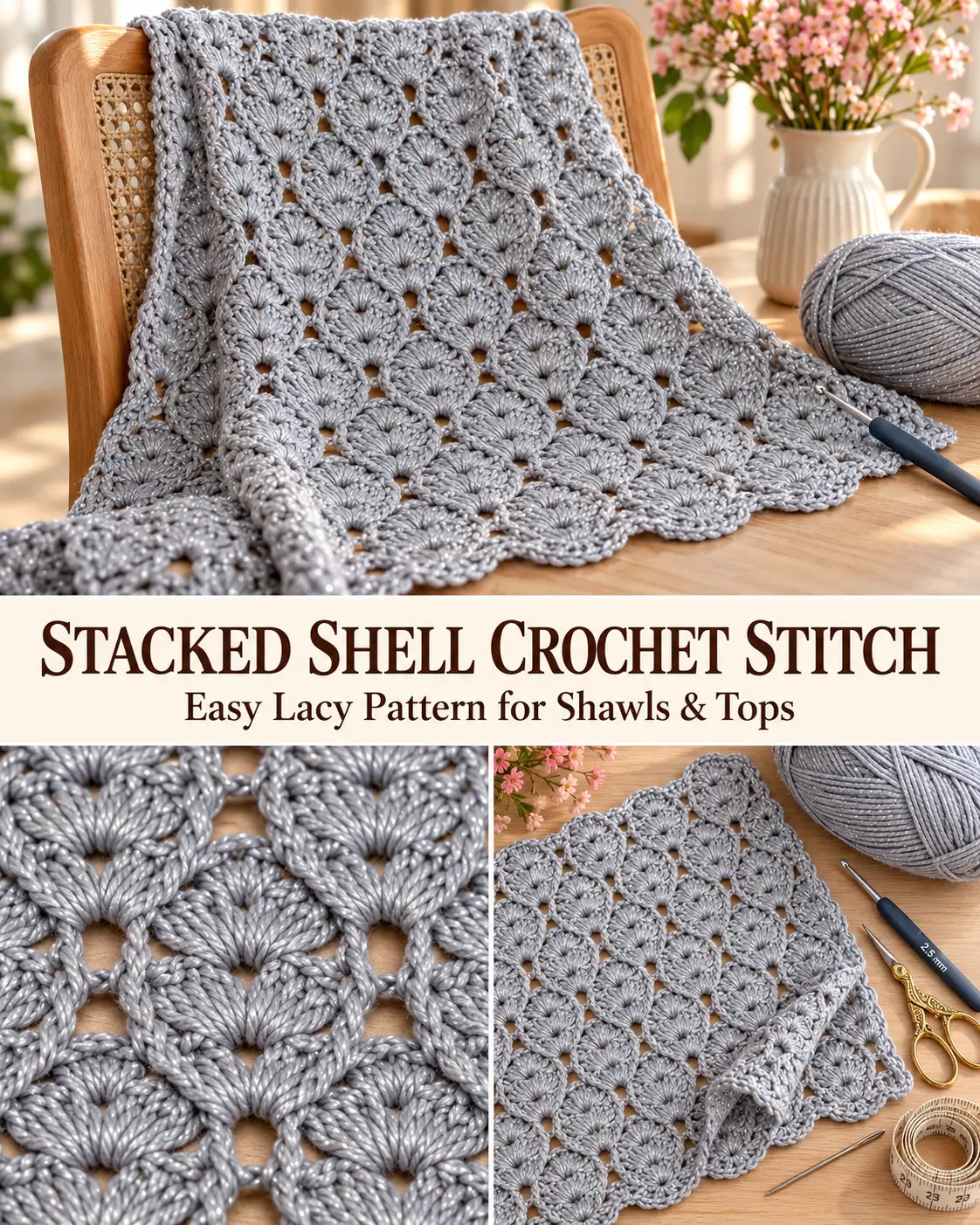
If you love crochet stitches that look intricate but use simple techniques, this gorgeous stacked shell crochet stitch is a beautiful pattern to try. Its delicate fan-shaped motifs, tiny lace openings, and repeating textured rows create an elegant fabric that’s perfect for handmade clothing and accessories.
The most eye-catching feature of this stitch is the way the crochet shells appear to stack above one another. Each shell spreads outward like a tiny fan, while the small chain spaces between the motifs give the fabric a light, airy appearance.
When crocheted with soft silver-gray yarn featuring a subtle shimmer, the pattern takes on an especially beautiful finish. The raised shell details catch the light, making even a simple rectangular swatch look delicate and sophisticated.
Despite its elaborate appearance, this crochet stitch uses familiar techniques, including chains, single crochet, and double crochet.
Once you’ve completed the foundation and first shell rows, the pattern continues with a simple two-row repeat.
Whether you’re planning a lightweight crochet shawl, summer blouse, decorative scarf, or elegant tunic, this textured stitch offers plenty of creative possibilities.
Why You’ll Love This Crochet Stitch
This beautiful crochet pattern combines delicate texture with a practical repeating design.
- Stunning stacked shells: Repeating five-double-crochet fans create attractive raised motifs.
- Beautiful lace openings: Chain spaces between the shells keep the fabric airy.
- Simple stitch combinations: The pattern uses chains, single crochet, and double crochet.
- Easy-to-follow repeat: Once the setup is complete, only two rows need to be repeated.
- Perfect for wearable projects: The open texture works beautifully for scarves, shawls, and lightweight tops.
- Gorgeous in shimmering yarn: Smooth silver-gray yarn highlights the shell shapes and stitch definition.
- Customizable width: Change the number of shell repeats to create different-sized projects.
The stitch becomes especially satisfying after several rows, when the repeating fans begin forming a continuous textured pattern.
Stacked Shell Crochet Stitch Pattern Details
Skill level: Adventurous beginner to intermediate
Crochet terminology: US terms
Construction: Worked flat in turned rows
Main stitch: Five-double-crochet shell
Stitch multiple: 9 + 1 stitches
Starting chain: Multiple of 9 + 3 chains
Suggested practice foundation: Chain 39
Hook size: 2.5 mm
Recommended yarn: Fingering-weight (#1) cotton or cotton-blend yarn
Suggested color: Soft silver-gray with a delicate shimmer
Pattern repeat: Two rows after setup
Suitable projects: Shawls, scarves, blouses, lightweight tunics, decorative panels, and accessories
The starting chain includes two additional chains because the first double crochet row begins in the third chain from the hook.
Materials You’ll Need
To practice this beautiful crochet pattern, gather:
- Smooth fingering-weight yarn in silver-gray
- 2.5 mm crochet hook
- Scissors
- Yarn needle
- Measuring tape
- Optional stitch markers
Choosing the Best Yarn
The yarn you select can make a big difference in how the finished shell pattern looks.
For crisp, well-defined shells, choose a smooth yarn that allows the individual double crochet stitches to remain visible.
Cotton yarn creates defined stitches and is a good option for warm-weather accessories.
Cotton-viscose blends can provide additional drape and a soft finish suitable for shawls and lightweight garments.
A fingering-weight yarn with a subtle metallic thread can also look beautiful, especially when crocheted in pearl gray or silver.
Avoid very fuzzy yarns because they may hide the delicate fan-shaped motifs.
If you plan to make a larger shawl or blouse, crochet a small swatch first to see how the fabric hangs and stretches.
Crochet Abbreviations
| Abbreviation | Meaning |
|---|---|
| ch | Chain |
| sc | Single crochet |
| dc | Double crochet |
| sl st | Slip stitch |
| st / sts | Stitch / stitches |
| sp | Space |
| sk | Skip |
| rep | Repeat |
| RS | Right side |
| WS | Wrong side |
Special Stitch: Five-Double-Crochet Shell
The shell is the main decorative element in this pattern.
To make one five-double-crochet shell:
- Yarn over.
- Insert your hook into the indicated stitch.
- Yarn over and pull up a loop.
- Yarn over and pull through two loops.
- Yarn over and pull through the remaining two loops.
- Work four more double crochet stitches into the same stitch.
You now have five double crochet stitches sharing one foundation point.
These stitches spread outward to create a fan shape.
One shell contains five double crochet stitches.
In this pattern, each shell is worked into the center of the corresponding shell section from the previous repeat.
Understanding the Stacked Shell Pattern
The pattern is based on repeating groups of nine foundation stitches.
Each nine-stitch group eventually supports one five-double-crochet shell and its surrounding lace spaces.
The special shell row creates the raised fan-shaped texture.
The following single crochet row stabilizes the fabric and establishes the stitch positions needed for the next shell row.
Because the shells are placed above previous shells, the motifs form recognizable stacked columns.
The chain spaces between the fans create decorative openings and prevent the fabric from becoming completely solid.
Important Pattern Notes
Before starting, remember these details:
- The pattern uses a stitch multiple of nine plus one.
- Add two extra foundation chains for the first double crochet setup row.
- The beginning chain 1 does not count as a stitch.
- The beginning chain 2 in the double crochet setup row does not count as a stitch.
- Each shell contains exactly five double crochet stitches.
- Work the stabilizing single crochet stitches into the indicated chain spaces and stitch tops.
- The stabilizing row restores the same stitch count as the setup rows.
- Do not add extra stitches into the turning chains.
- Turn your work after every row.
- Keep the chain spaces relaxed so the lace remains flexible.
Step-by-Step Instructions
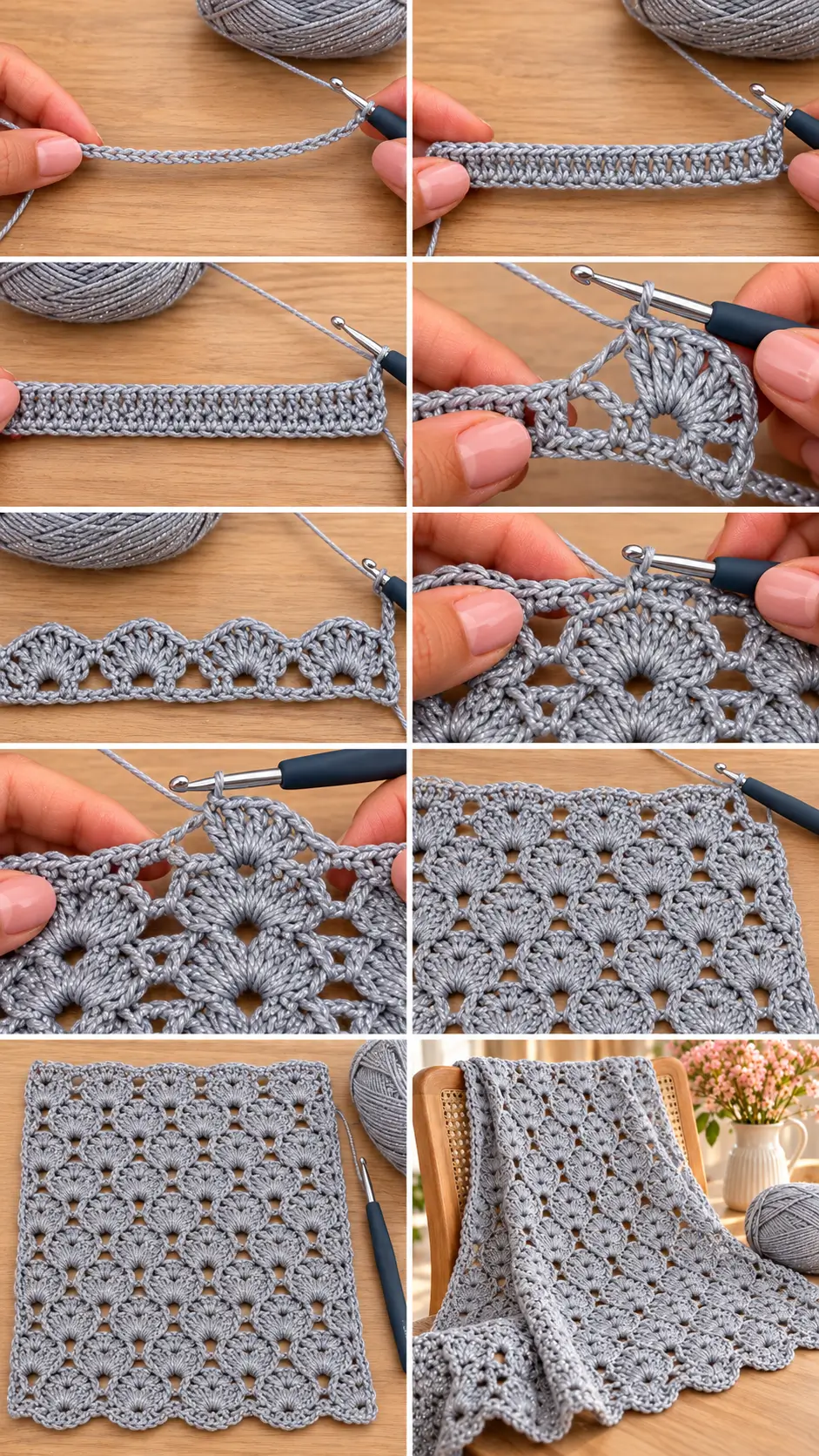
We’ll begin with a practice swatch containing four shell repeats.
For this sample:
Chain 39.
After the setup rows, you will have 37 stitches.
The shell section contains four repeated groups of nine stitches, plus one edge stitch.
Step 1: Create the Foundation Chain
Make a slip knot and place it on your 2.5 mm crochet hook.
Chain 39.
Keep your foundation chain even and relaxed.
A tight foundation can cause the bottom edge of the sample to pull inward.
If you’re using a slightly shimmering yarn, avoid splitting the strands as you make the chains.
Once you’ve completed all 39 chains, begin the first setup row.
Step 2: Crochet the First Double Crochet Row
Setup Row 1
Work 1 dc into the third chain from the hook.
Continue working 1 dc into each remaining foundation chain.
At the end of the row, turn your work.
Stitch count: 37 dc.
The first two skipped chains do not count as stitches.
This row creates a stable base for the shell pattern.
Make sure every double crochet is worked into a separate chain.
Step 3: Make the Single Crochet Setup Row
Setup Row 2
Chain 1 and turn.
Work 1 sc into each double crochet across.
Turn your work.
Stitch count: 37 sc.
This row gives you a clean foundation for the first shell sequence.
Count the stitches before continuing.
The shell repeat depends on maintaining the correct number of foundation stitches.
Part 2: Create the First Row of Crochet Shells
Step 4: Crochet the First Shell Row
Row 3 – Shell Pattern
Chain 1 and turn.
Work 1 sc into the first stitch.
Now begin the repeating shell sequence.
First shell repeat:
- Chain 3.
- Skip the next 3 single crochet stitches.
- Work 5 dc into the following stitch.
- Chain 4.
- Skip the next 4 stitches.
- Work 1 sc into the next stitch.
You have completed one nine-stitch shell repeat.
Repeat this same sequence three more times across the row.
For the 37-stitch practice sample, you will have:
- 4 five-double-crochet shells
- 4 chain-3 spaces
- 4 chain-4 spaces
- 5 single crochet stitches, including the beginning edge stitch
Turn your work.
What You Should Notice
Your row should now have several raised fan-shaped shells separated by chain spaces.
The upper edge will appear gently scalloped because the double crochet stitches are taller than the single crochet anchors.
This is an intentional part of the stitch design.
The following row will stabilize the shell shapes.
Step 5: Crochet the Stabilizing Row
Row 4 – Single Crochet Foundation for the Next Shells
Chain 1 and turn.
Work 1 sc into the first single crochet stitch.
Because you have turned the work, you will encounter the chain-4 space before the five-double-crochet shell.
For each shell repeat, work:
- Work 1 sc into the next chain-4 space.
- Work 1 sc into each of the next 5 double crochet stitches.
- Work 2 sc into the following chain-3 space.
- Work 1 sc into the next single crochet stitch.
Repeat this sequence four times across the row.
Turn your work.
Stitch count: 37 sc.
Stitch Count Check
Each repeated section produces:
- 1 sc in the chain-4 space
- 5 sc across the shell stitches
- 2 sc in the chain-3 space
- 1 sc in the following anchor stitch
That equals 9 single crochet stitches per repeat.
For four repeats:
4 × 9 = 36 stitches.
Add the first edge single crochet:
36 + 1 = 37 stitches.
Your stabilizing row should now contain exactly the same number of stitches as the original setup rows.
This is important because it prepares the fabric for another identical shell row.
Part 3: Stack the Next Row of Shells
Step 6: Crochet the Second Shell Row
Row 5 – Repeat the Shell Sequence
Chain 1 and turn.
Work 1 sc into the first stitch.
Repeat the following sequence across:
Chain 3, skip the next 3 stitches, work 5 dc into the following stitch, chain 4, skip the next 4 stitches, work 1 sc into the next stitch.
Repeat four times.
Turn your work.
How the Shells Align
Because the previous single crochet row restored the correct stitch positions, the new five-double-crochet shells sit above the earlier shell sections.
The center insertion point of each new shell aligns with the middle of the corresponding five-stitch section from the previous row.
This creates the stacked appearance.
The little chain spaces remain between the raised motifs, helping the fabric maintain its lace-like texture.
Step 7: Work the Next Stabilizing Row
Row 6
Chain 1 and turn.
Work 1 sc into the first stitch.
Repeat:
1 sc into the next chain-4 space, 1 sc into each of the next 5 dc, 2 sc into the next chain-3 space, 1 sc into the following sc.
Repeat four times.
Turn your work.
Stitch count: 37 sc.
You have now completed two full shell sections.
Look closely at your work.
You should begin seeing repeated fan motifs positioned in organized columns.
Part 4: Continue the Stacked Shell Pattern
Step 8: Repeat Rows 5–6
Continue repeating the same two-row sequence until your fabric reaches the desired length.
Shell row:
Chain 1, turn. Work 1 sc into the first stitch. Repeat the chain-3, five-double-crochet shell, chain-4, and single crochet sequence across.
Stabilizing row:
Chain 1, turn. Work 1 sc in the first stitch. Across each shell repeat, work 1 sc into the chain-4 space, 1 sc into each of the five double crochets, 2 sc into the chain-3 space, and 1 sc into the next single crochet.
For a practice swatch, work approximately six to ten shell rows.
For a larger project, continue until the fabric reaches your preferred length.
When to Stop
For a straight upper edge, finish after completing a stabilizing single crochet row.
For a decorative scalloped edge, you can finish after a shell row, although the edge may require additional shaping depending on the project.
If you’re using this stitch for a blouse or cardigan panel, a straight single crochet finishing row is usually easier to sew.
Part 5: Finishing Your Crochet Swatch
Step 9: Fasten Off
After completing your final stabilizing row, cut the yarn, leaving a tail approximately 6 inches long.
Pull the yarn tail through the last loop to secure it.
Thread the tail onto a yarn needle.
Weave it securely into several nearby stitches on the wrong side of the fabric.
Change direction at least once when weaving in the tail.
Trim the remaining yarn.
Step 10: Shape the Fabric
Lay the finished crochet swatch on a flat surface.
Gently arrange the edges so the shell motifs sit evenly.
For yarn suitable for wet blocking, lightly dampen the sample and gently pin it to the desired dimensions.
Allow it to dry fully before removing the pins.
Do not overstretch the fan motifs.
The goal is to open the lace spaces slightly while preserving the rounded shape of the shells.
Follow the care recommendations for your chosen yarn.
How to Adjust the Stitch Pattern Width
This pattern can be adjusted to create wider or narrower crochet panels.
The stitch count must follow:
Multiple of 9 + 1 stitches.
Because the first setup row begins in the third chain, the foundation chain requires two additional chains.
Therefore:
Starting chain = multiple of 9 + 3.
Suggested Starting Chains
| Shell repeats | Starting chains | Setup stitches |
|---|---|---|
| 3 | 30 | 28 |
| 4 | 39 | 37 |
| 5 | 48 | 46 |
| 6 | 57 | 55 |
| 8 | 75 | 73 |
| 10 | 93 | 91 |
| 12 | 111 | 109 |
Each additional shell repeat adds nine setup stitches.
Choose the appropriate number of repeats for your project, then crochet a swatch to determine the actual width.
Remember that openwork fabrics may widen or lengthen after blocking.
How to Make a Wider Shawl
For a shawl made from a simple rectangular panel, begin with enough foundation chains to create your preferred width.
Work the repeating shells until the fabric reaches your desired length.
For a generous wrap, make a sample first to calculate the number of shell repeats required.
How to Use the Stitch for a Blouse
For a blouse, use the stitch to create rectangular front and back panels.
Measure your gauge carefully, including the fabric’s stretch after blocking.
Make sure both panels contain the same number of repeats and rows.
For shaped garments, armholes and necklines need a separate shaping plan rather than simply following the rectangular swatch instructions.
How to Make a Scarf
For a scarf, choose a narrower foundation chain.
Continue working the two-row pattern until the fabric reaches your preferred length.
A soft cotton-viscose blend or lightweight acrylic yarn can create a comfortable scarf with a lovely drape.
Beautiful Yarn Colors for This Stitch
Although silver-gray looks especially elegant, the stacked shell pattern can be made in many other colors.
1. Silver-Gray With Subtle Shimmer
A soft pearl-gray yarn with delicate metallic strands highlights the raised shells and gives the lace fabric a sophisticated appearance.
This is a beautiful choice for evening shawls and lightweight blouses.
2. Warm Ivory
Ivory yarn creates a classic, delicate appearance.
It’s a lovely choice for romantic shawls, lightweight cardigans, and elegant summer accessories.
3. Dusty Rose
Muted dusty rose adds softness to the layered shells.
The shade works especially well for feminine scarves and lightweight crochet tops.
4. Sage Green
A soft sage green gives the pattern a modern, understated appearance.
The delicate shell texture pairs beautifully with natural colors and relaxed summer outfits.
5. Soft Lavender
Lavender creates a pretty pastel finish while keeping the individual shell motifs visible.
6. Deep Teal
A rich teal yarn produces a more dramatic version of the stitch.
Choose smooth yarn and good lighting when crocheting darker colors so the shell details remain easy to identify.
Tips for Beautiful Stacked Shell Crochet
Keep Your Shells the Same Size
Every fan must contain exactly five double crochet stitches.
If one shell has four stitches and another has six, the textured pattern may appear uneven.
Count each shell as you work.
Keep the Chain Spaces Relaxed
The chain spaces are responsible for much of the lacy appearance.
Avoid pulling the chains too tightly.
The open sections should sit comfortably between the shells without drawing the fabric inward.
Count the Stabilizing Rows
The stabilizing single crochet row restores the correct stitch count.
For the sample, every stabilizing row should contain 37 stitches.
If the count changes, the next shell row may no longer align.
Use Smooth Yarn
Smooth yarn makes the structure of each fan easier to see.
Very fuzzy fibers can make it difficult to identify the double crochet stitches when working the following row.
Practice Before Starting a Garment
If you’re planning a blouse or tunic, make a reasonably large gauge swatch.
Wash and block the swatch using the same method you intend to use for the finished garment.
This helps you understand the fabric’s final dimensions and drape.
Watch the Edge Stitches
The first and last single crochet stitches help define the sides of your fabric.
Avoid accidentally adding stitches into the turning chains.
Use stitch markers if needed.
Common Problems and Solutions
Why Aren’t My Shells Aligning?
The stabilizing row may contain too many or too few single crochet stitches.
Check that you’re following the chain-space placement carefully.
For each repeat, work one single crochet into the chain-4 space and two into the chain-3 space, along with the five stitches across the shell and the anchor single crochet.
Why Is My Fabric Pulling Inward?
The chain spaces may be too tight for the width of the skipped stitches.
Try using more relaxed chain tension or a slightly larger crochet hook.
If the fabric still puckers, make a new swatch before continuing with a larger project.
Why Are My Shells Too Flat?
The yarn may be too soft or the stitch tension too loose.
Choose yarn with enough structure to show the fan shape clearly.
Blocking can also help improve the appearance of the motifs.
Why Are My Edges Uneven?
You may be skipping the first or last single crochet stitch.
Every row begins with a clear edge stitch.
The stabilizing rows should return to the same total stitch count.
Why Does My Fabric Feel Stiff?
Your hook may be too small for your chosen yarn.
Try a slightly larger hook to create more flexible stitches.
This can be particularly helpful when making shawls and wearable garments.
Why Are the Lace Openings Too Large?
The chain spaces naturally create visible openings in this variation.
If you prefer a denser fabric, experiment with a finer hook or a slightly different shell pattern after making a swatch.
Avoid changing only the chain counts midway through a project, as that may affect the alignment and overall width.
Frequently Asked Questions
Is the Stacked Shell Crochet Stitch Beginner-Friendly?
It’s suitable for adventurous beginners who are comfortable with basic single crochet and double crochet.
The main challenge is learning the placement of the chain spaces and keeping the stitch count consistent.
Is This a Two-Row Crochet Pattern?
Yes.
After the two setup rows, the design repeats one decorative shell row and one stabilizing single crochet row.
Once you’ve learned these two rows, you can continue making the fabric to your preferred length.
Can I Use This Stitch for a Crochet Shawl?
Absolutely.
The airy shell design is especially suitable for rectangular wraps and lightweight shawls.
Choose a soft yarn with good drape for comfortable wear.
Can I Use This Stitch for a Summer Blouse?
Yes.
The openwork fabric can be used for crochet garment panels.
However, a blouse requires additional measurements, shaping, and assembly instructions.
Depending on the size of the lace openings, you may prefer to wear a camisole underneath.
What Is the Best Hook Size?
A 2.5 mm crochet hook is a suitable starting point for fine yarn.
The best hook size depends on your yarn and desired fabric texture.
Make a swatch and adjust as necessary.
Can I Use Cotton Yarn?
Yes.
Cotton yarn provides excellent stitch definition and is a good choice for warm-weather crochet projects.
A cotton-viscose blend can offer additional softness and drape.
Can I Make the Pattern With Worsted-Weight Yarn?
Yes, but the resulting shells will be larger and the fabric thicker.
Use a hook appropriate for your yarn and make a gauge swatch before calculating project dimensions.
How Do I Make the Pattern Wider?
Add additional groups of nine stitches to the foundation.
Remember to include the one extra stitch and the two setup chains.
Each extra shell repeat requires nine additional foundation chains.
Can I Add a Border?
Yes.
For a rectangular scarf or shawl, a simple single crochet border can help finish the edges.
Work the border evenly around the fabric, adjusting the stitch distribution along the row ends so the edging lies flat.
For garments, it may be preferable to finish the panel edges with a narrow single crochet row before assembly.
Should I Block This Crochet Stitch?
Blocking is optional but can be helpful for lace patterns.
It may improve stitch definition, open the chain spaces, and help create even dimensions.
Always follow the care instructions for the yarn you choose.
More Beautiful Crochet Projects to Try
If you enjoy the delicate texture of this stacked shell stitch, there are many other crochet patterns worth exploring.
Lacy fan stitch scarves, textured summer shawls, shell stitch cardigans, lightweight crochet tops, and decorative wraps all offer opportunities to experiment with openwork crochet.
You might also enjoy learning how to make crochet lace motifs, delicate granny squares, and other repeating stitch patterns that combine fans with chain spaces.
For larger wearable projects, using a crochet stitch chart or digital pattern-design tool can also help you plan repeat placement and garment dimensions.
Final Thoughts
This beautiful stacked shell crochet stitch is a lovely choice for anyone who enjoys delicate, textured crochet designs.
The repeating five-double-crochet fans create a graceful layered effect, while the chain spaces add the lightness needed for shawls, scarves, and other wearable projects.
The pattern becomes easier to follow once you’ve practiced the shell row and its stabilizing single crochet row.
In soft silver-gray yarn with a subtle shimmer, the stitch creates an elegant fabric that catches the light beautifully.
You can also experiment with romantic pastels, natural neutrals, or deeper jewel tones to suit your personal style.
Whether you’re practicing a new crochet technique or preparing to make a beautiful handmade accessory, this repeating shell pattern offers plenty of possibilities.
Choose your favorite lightweight yarn, grab your crochet hook, and enjoy creating rows of beautiful stacked crochet shells!