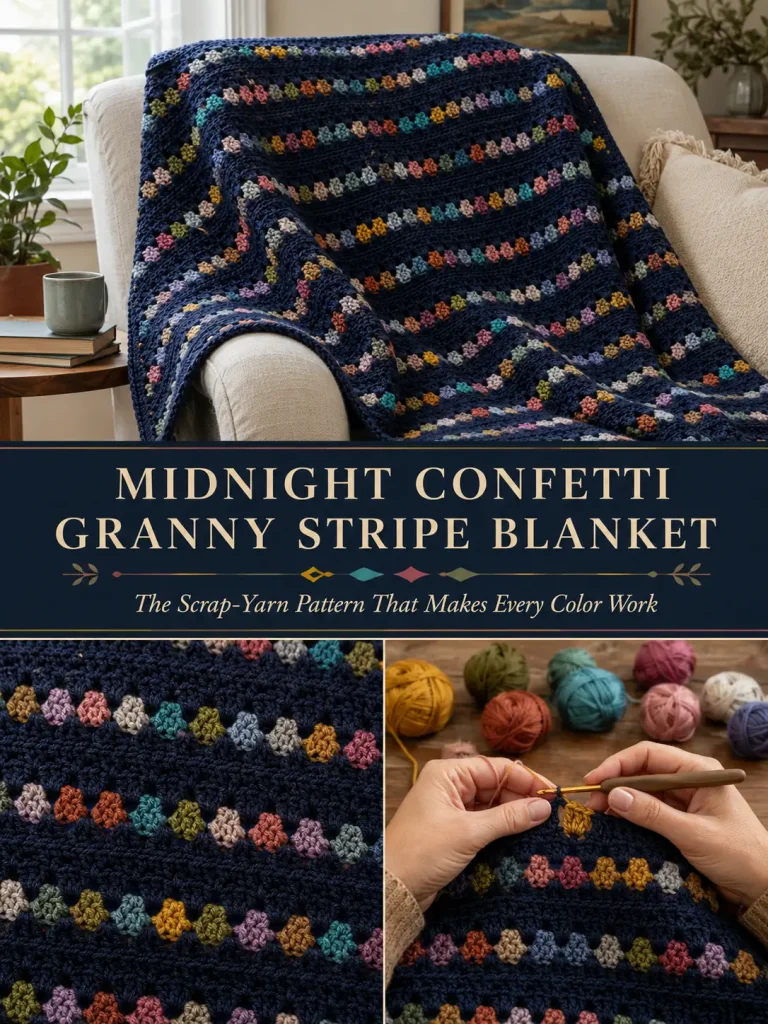
Skill level: Confident beginner
Terminology: US crochet terms
Construction: Worked flat in rows
Main stitch: Granny stripe / 3-double-crochet groups
Foundation multiple: 6 + 1
Main color: Deep midnight navy
Accent colors: Assorted small yarn scraps or mini skeins
This pattern is designed to be easily resized.
The Color Look
To reproduce the rich look of the inspiration, don’t use black as the background.
Use a very dark:
Midnight navy
or:
Blue-black / deep indigo
Then collect small quantities of muted and jewel-toned yarn.
Good accent colors include:
- moss green
- olive
- teal
- turquoise
- dusty blue
- mustard
- ochre
- rust
- burnt orange
- dusty rose
- berry
- lavender
- soft violet
- oatmeal
- pale gray
You do not need equal amounts of each accent.
That’s part of what makes this such a good leftover-yarn project.
Yarn
For the closest soft, drapey look, use:
Fingering / sock-weight yarn
Use the same approximate yarn weight for both:
Color A
Midnight navy
Color B
Your changing scrap color
A 4 mm hook is a good starting point for fingering-weight yarn if you want a relaxed blanket fabric rather than a tight sock-like fabric. The linked inspiration likewise uses fingering-weight yarn with a 4 mm hook for drape.
You can also use:
- DK
- worsted
- other matching yarn weights
but your finished dimensions and yarn use will change.
Materials
You’ll need:
- Deep midnight-blue yarn
- Assorted same-weight yarn scraps
- 4 mm crochet hook for fingering yarn, or suitable hook for your yarn
- Scissors
- Yarn needle
- Stitch markers, optional
Abbreviations
- ch = chain
- dc = double crochet
- sc = single crochet
- sl st = slip stitch
- sp = space
- st = stitch
- sts = stitches
- sk = skip
- rep = repeat
A granny group in this pattern means:
3 dc worked into the same space
Before Starting: Make a Small Test
This is worth doing.
Use your navy yarn and one scrap color.
Ch 37.
Thirty-seven follows our:
multiple of 6 + 1
rule.
Work the first four rows of the pattern.
Check:
- drape
- stitch definition
- yarn compatibility
- whether carried yarn shows too much
- whether you like the hook size
If the fabric is too stiff, go up a hook size.
If it feels extremely loose, go down slightly.
Blanket Width
For a medium sofa throw using fingering-weight yarn, you can begin with:
Ch 181
because:
30 × 6 + 1 = 181
Your actual width will depend on yarn and tension.
After completing Row 1, measure the fabric.
If necessary, restart and add or remove 6 chains at a time.
That’s safer than pretending every fingering yarn produces exactly the same blanket width.
IMPORTANT COLOR TECHNIQUE
Each colorful row uses:
- Color A = midnight navy
- Color B = one scrap color
Do not cut the yarn every time you change clusters.
Instead, drop the unused color toward the wrong side of the blanket and pick it up again when needed.
Because each float travels only behind one neighboring granny group, the distance remains short.
Keep those floats:
loose, not tight.
They must not pull the fabric inward.
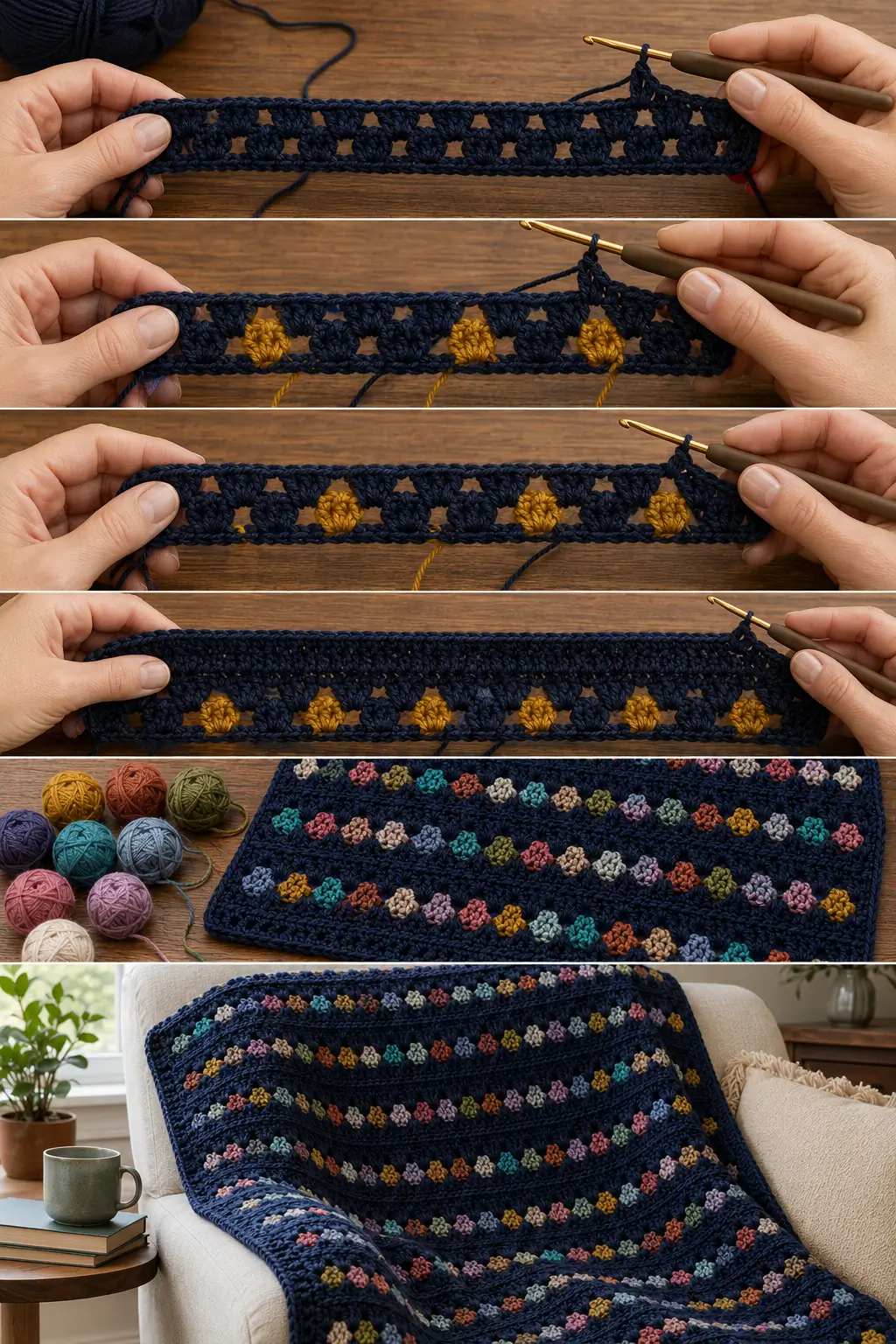
How to Change Color Cleanly
On the final double crochet before a color change:
- Yarn over.
- Insert hook.
- Yarn over and pull up a loop.
- Yarn over and pull through 2 loops.
- Instead of finishing with the old color, yarn over with the new color.
- Pull the new color through the remaining 2 loops.
The next stitch is now ready in the new color.
This creates a much cleaner transition.
FOUNDATION — MIDNIGHT NAVY
With Color A:
Ch 181, or another number following 6 + 1.
ROW 1 — NAVY GRANNY FOUNDATION
Working in navy:
Dc in the 4th chain from the hook.
The skipped beginning chains form the turning chain.
Now repeat:
Skip 2 chains, 3 dc in next chain
until 3 chains remain.
Skip 2 chains.
Work:
2 dc in final chain.
Turn.
You should now have:
- a 2-dc group at each edge
- 3-dc granny groups between them
This establishes the classic granny-stripe structure.
The standard granny stripe is commonly built from 3-dc groups worked in the spaces between the groups below. (lullabylodge.com)
ROW 2 — FIRST CONFETTI ROW
Keep Color A attached.
Attach your first scrap color as Color B.
Ch 3 with navy.
This counts as the edge dc.
Turn.
In the first space between stitch groups, switch to Color B and work:
3 dc in Color B
Switch to navy.
In the next space:
3 dc in Color A
Now repeat across:
3 dc Color B in next sp
3 dc Color A in next sp
Continue alternating.
With the 6 + 1 starting multiple used here, the layout allows the colorful groups to distribute regularly across the row.
At the far edge, finish with:
1 dc in the top of the turning chain
using navy.
Turn.
What Row 2 Should Look Like
You should see:
navy edge → colored group → navy group → colored group → navy group
repeated across.
The colorful yarn should appear as small isolated blocks rather than a continuous stripe.
ROW 3 — SHIFT THE COLOR BLOCKS
Ch 3 with navy.
Turn.
Work:
1 dc in the first space
using navy.
Together with the ch 3, this creates the 2-dc edge.
Now work into the next space:
3 dc in navy
In the next space:
3 dc in Color B
Continue alternating:
navy → Color B → navy → Color B
across the center of the row.
In the final space work:
2 dc in navy
Turn.
Because granny groups are worked into the gaps between the previous row’s groups, the colored blocks naturally shift relative to Row 2.
This creates the scattered, almost floral effect.
ROW 4 — MIDNIGHT DIVIDER
You can now fasten off Color B.
Keep Color A.
Ch 3.
Turn.
Work the entire granny row in midnight navy.
If this row corresponds to the Row-2 structure:
3 dc in every space across, ending with 1 dc in the edge stitch.
If it corresponds to the Row-3 structure:
dc in first space to complete the 2-dc edge, 3 dc in every middle space, 2 dc in final space.
The important thing is to preserve the normal alternating granny-stripe edge structure.
This completely dark row becomes our visual separator.
ONE COMPLETE COLOR SECTION
You have now completed one accent section:
Row 2
Color B floating between navy groups
Row 3
Color B shifted between navy groups
Row 4
Solid navy divider
Now choose a new scrap color.
ROW 5 — NEW COLOR
Attach another Color B.
Repeat the appropriate granny-stripe row while alternating:
new scrap color / navy / new scrap color / navy
across.
ROW 6
Continue with the same accent color, but shift the colored clusters just as you did previously.
ROW 7
Work completely in midnight navy.
Fasten off the accent color.
THE MAIN BLANKET REPEAT
Continue repeating this three-row rhythm:
Row A
Alternating accent + navy groups
Row B
Alternating groups again, naturally offset by the granny-stripe structure
Row C
All navy
Then change to a new accent yarn.
Example Scrap-Color Sequence
You could use:
- Mustard
- Dusty pink
- Moss
- Pale blue
- Rust
- Teal
- Oatmeal
- Lavender
- Olive
- Berry
- Turquoise
- Golden brown
- Mauve
- Gray-green
Then simply start using whatever scraps remain.
The colors do not need to repeat in a perfect order.
Randomness is part of the appeal.
How Long Should the Blanket Be?
Continue until you like the proportions.
A comfortable sofa throw might be around:
55–65 inches long
but there is no required length.
Before beginning the border, finish with:
one solid navy row.
That gives the top edge a clean finish.
Using Very Small Scraps
This is where the pattern becomes especially useful.
Because Color B only appears in alternating granny groups across two rows, you need much less of each accent color than you would for a complete full-width stripe.
If you’re worried a scrap may run out:
weigh it first.
If it’s tiny, use it for only one confetti row, then switch to another related color on the following row.
That creates even more variation.
What If My Scrap Yarns Aren’t Exactly the Same?
A small difference is usually manageable.
But don’t mix something extremely thin with something substantially thicker.
Ideally, your yarns should have:
- similar weight
- similar stitch gauge
- similar washing requirements
Hand-dyed sock minis are especially good for this style.
What If I Don’t Want So Many Ends?
Instead of many separate mini skeins, use one:
gradient or long color-changing yarn
as Color B.
Keep midnight navy as Color A.
Allow the accent yarn to change colors naturally as you crochet.
This gives the blanket a similar multicolor effect with dramatically fewer ends.
The original inspiration also suggests a color-changing yarn as an alternative when you want fewer ends. (theguywiththehook.com)
Keeping the Edges Straight
The most common granny-stripe mistake is losing the edge stitch.
Use a stitch marker in:
- first edge stitch
- last edge stitch
if necessary.
Remember that granny rows alternate between slightly different edge constructions.
One row begins with a single turning-chain edge and finishes with one dc.
The next uses a 2-dc edge.
This staggering is normal.
If Your Blanket Starts Getting Narrower
You are probably missing:
- the first granny space
- the last granny space
- the final edge stitch
Stop and compare the current row with the row below.
Do not try to fix several missing groups by adding random stitches later.
Undo the affected row.
If the Color Floats Pull the Blanket
Your inactive yarn is being carried too tightly.
When you switch colors:
give the unused strand a tiny bit of slack before working the next cluster.
Periodically stretch the fabric gently sideways.
The row should remain relaxed.
What If the Accent Yarn Shows on the Back?
A small float behind a neighboring cluster is expected with this colorwork method.
Keep all floats on the wrong side.
If you want an especially clean back, you can crochet over the inactive strand for part of the adjacent cluster.
But don’t trap it so tightly that it distorts the fabric.
Weave in Ends as You Go
This pattern can generate many ends.
Do not wait until you’ve made a six-foot blanket.
Every few accent sections:
weave in the finished Color B tails.
Future-you will appreciate this enormously.
BORDER
Once the blanket reaches the desired length, use midnight navy.
The colorful field is already busy, so the border should stay simple.
Border Round 1
Join navy in any corner.
Ch 1.
Work sc evenly around the whole blanket.
Across the top and bottom
Work approximately:
1 sc in every stitch
Along the row ends
A practical starting point is approximately:
2 sc per granny-row end
but watch the fabric rather than blindly following the number.
At each corner:
3 sc
Join with sl st.
Check the Border
Lay the blanket flat.
If it ruffles:
You have too many side stitches.
If it pulls inward:
You need slightly more room.
Correct this before adding another border round.
Border Round 2
Ch 1.
Sc in every stitch around.
At each corner:
3 sc in the center corner stitch
Join.
Optional Final Edge
For a slightly more finished texture, add one round of:
reverse single crochet / crab stitch
in navy.
Or stop after two simple rounds if you prefer a softer edge.
I would not add a brightly colored border.
The dark frame is what makes the tiny colored groups stand out.
Blocking
Blocking can improve the drape, particularly when using hand-dyed sock yarn.
Use a method appropriate for your fiber.
Shape the blanket gently.
Do not stretch the granny spaces aggressively.
Allow it to dry completely.
How to Make a Wider Blanket
Add:
6 chains
to the foundation for every width repeat you want to add.
So possible starting counts include:
- 145
- 151
- 157
- 163
- 169
- 175
- 181
- 187
- 193
as long as the selected count follows:
6n + 1
Why This Version Uses a Multiple of 6 + 1
A normal granny stripe can be built on a multiple of 3 + 1. (lullabylodge.com)
For this particular pattern, I doubled that repeat to:
6 + 1
because we want enough structure to alternate:
navy cluster / colored cluster
regularly across the row.
That is part of what makes this a new pattern rather than a reproduction of the linked one.
Want More Color?
Instead of:
2 confetti rows + 1 navy row
try:
3 confetti rows + 1 navy row.
The blanket will look brighter.
Want a Darker Blanket?
Use:
1 confetti row + 2 navy rows.
You’ll get much more midnight blue with smaller flashes of color.
Want the Look in Worsted Yarn?
You can absolutely make it with Category 4 yarn.
Use an appropriate larger hook and reduce your foundation-chain count dramatically.
Do not use the 181-chain sample blindly.
Make a swatch and select a foundation multiple of:
6 + 1
that produces the width you want.
Best Use for Advent Mini Skeins
This project is perfect when you have lots of small colors but don’t necessarily like them enough to use each one for a huge stripe.
The navy ties everything together.
A neon yellow that feels too loud on its own?
It becomes one tiny sparkle.
A strange green?
Another tiny flower.
A leftover dusty pink?
Suddenly it fits.
That dark constant color does most of the design work for you.
Frequently Asked Questions
Is this a granny-stripe blanket?
Yes.
The main fabric is based on traditional 3-double-crochet granny groups worked in rows.
Our color placement and three-row stripe repeat are what create the scattered confetti effect.
Do I need lots of yarn colors?
No.
You could make the entire blanket with:
- navy + 3 accent colors
or use dozens.
Do I cut the yarn after every colored cluster?
No.
Carry the two active yarns across the row and change colors between granny groups.
When do I cut the accent color?
After finishing its two-row confetti section.
The navy stays attached.
Can every confetti section be a different color?
Yes.
That’s exactly what makes this a good scrap-yarn blanket.
Can I use variegated yarn?
Yes.
A variegated or gradient yarn can be excellent for Color B.
Keep Color A solid and dark so the colored clusters remain readable.
Does gauge matter?
Not for fit, because this is a blanket.
It does matter for:
- final size
- drape
- yarn requirements
so make a swatch before buying large quantities of yarn.
Other Projects You Could Make With This Stitch
Once you understand the color repeat, the same fabric could become:
- a scarf
- a wide wrap
- a cushion cover
- a baby blanket
- a bed runner
- a rectangular tote panel
But I especially like it as a blanket because the repeated little colors become more impressive as the fabric grows.
Final Thoughts
This is exactly the kind of scrap project I love because the leftovers don’t look like leftovers anymore.
The midnight navy changes everything.
A few stitches of pink.
A few of mustard.
Some forgotten green from an old project.
One tiny piece of turquoise.
Individually, they’re scraps.
Together, against that dark background, they start looking like little lights scattered across the blanket.
And after the first few rows, there isn’t much complicated thinking involved.
It’s simply:
colored granny group
navy granny group
shift them
add a dark row
choose another scrap
and repeat.
That gives us the same strong visual reason your reference caught your attention—tiny multicolored granny clusters against a deep dark background—without copying or commercially republishing the designer’s protected Sanctuary Stripes instructions. The original designer explicitly describes their version as a two-color-in-a-row granny stripe intended for scrap/mini-skein use and asks that the free pattern’s copyright terms be respected. (theguywiththehook.com)

I’m sorry but I can’t download the pdf
I would love a printable copy of this pattern. Is there somewhere I could buy tis, please?