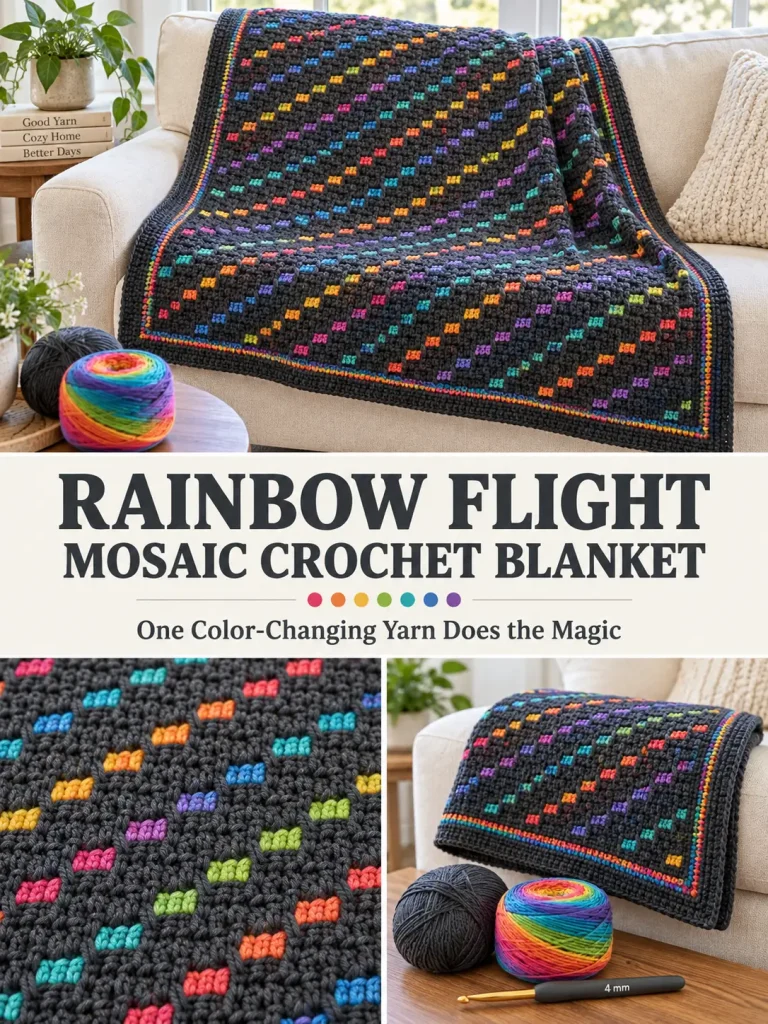
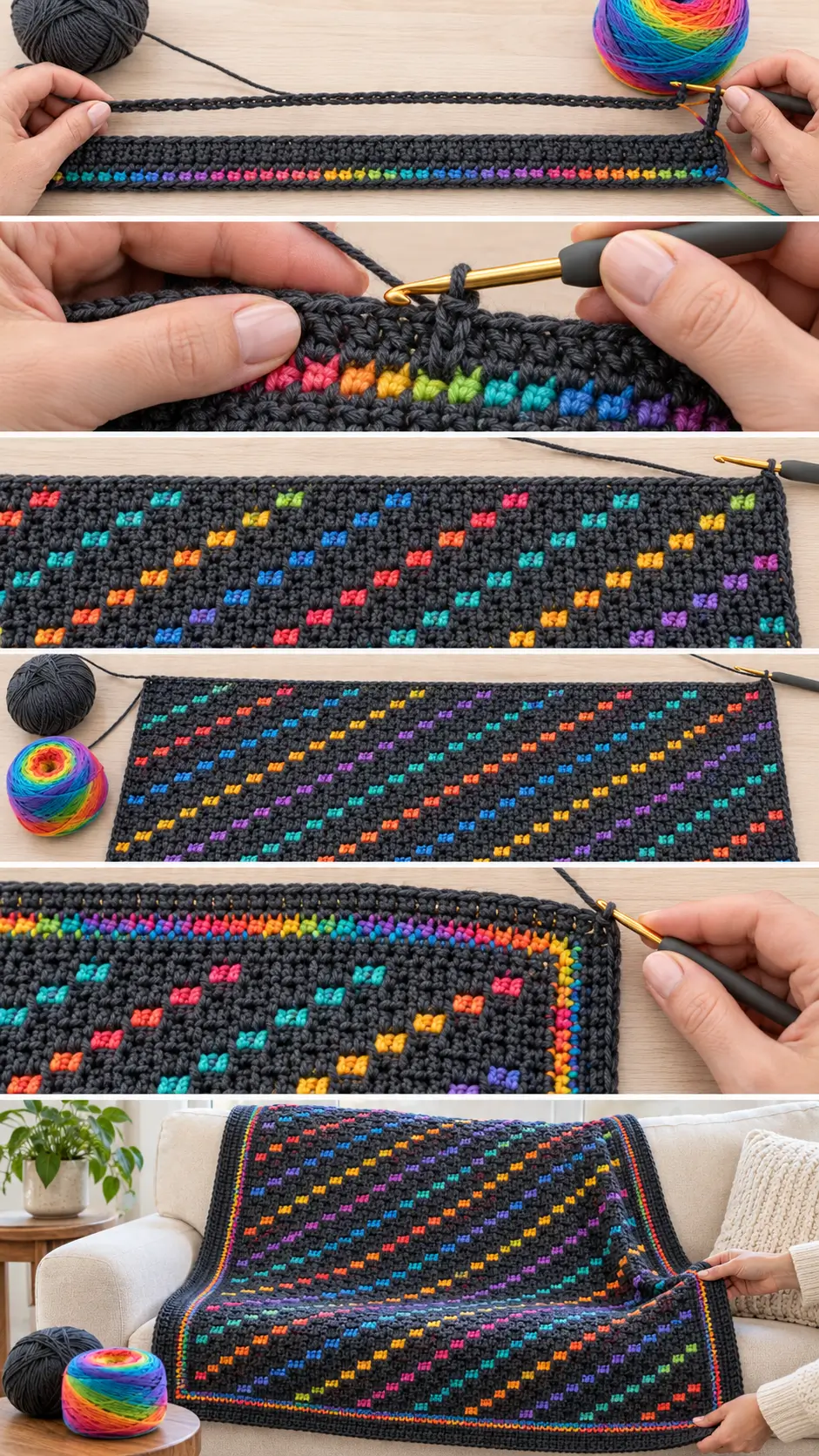
This blanket uses a deep charcoal background with bright rainbow “flight” dashes moving diagonally across the fabric. A self-striping or variegated yarn does most of the color work, so you get dozens of colors without changing yarn for every little motif.
The colorful diagonal effect was inspired by the broad visual style of the Flying South mosaic blanket. This version uses an original 12-stitch diagonal repeat, different stitch counts, sizing, color placement, and border to create its own crochet construction and finished look.
Pattern at a Glance
Skill level: Advanced beginner / intermediate
Terminology: US crochet terms
Technique: Overlay mosaic crochet
Construction: Worked flat, one right-side row at a time
Finished size: Approximately 40 × 48 inches
Yarn weight: DK / Category 3
Hook: 4 mm
Pattern multiple: 12 + 2 stitches
The sample uses:
- Color A: deep charcoal gray
- Color B: bright self-striping rainbow
The dark yarn creates the graphic structure while the rainbow yarn appears as little shifting windows.
Materials
- approximately 1,400–1,600 yards DK charcoal yarn
- approximately 750–900 yards DK rainbow/self-striping yarn
- 4 mm crochet hook
- yarn needle
- scissors
- stitch markers
- blocking mats, optional
Choose two yarns with similar thickness.
A long-color-change rainbow yarn works especially well.
Suggested Yarn Look
For the strongest visual effect:
Color A
Use one solid dark neutral:
- charcoal
- graphite
- black
- midnight navy
- deep espresso
Color B
Use a highly contrasting variegated yarn containing colors such as:
- turquoise
- magenta
- orange
- violet
- lime
- red
- blue
- gold
You do not need to control where each rainbow color lands.
That randomness is part of the finished look.
Gauge
Approximately:
18 stitches × 17 rows = 4 inches
in the finished mosaic fabric.
Gauge is not critical for a blanket, but it affects finished size and yarn usage.
Finished Size
Using the written counts:
approximately 40 inches wide × 48 inches long
before a wider decorative border.
Abbreviations
- ch = chain
- sc = single crochet
- st = stitch
- sts = stitches
- BLO = back loop only
- FL = front loop
- mdc = mosaic double crochet
- rep = repeat
- RS = right side
Special Stitch
BLO Single Crochet
Insert hook through the back loop only of the next stitch.
Complete a normal single crochet.
This leaves the front loop free for later mosaic stitches.
Mosaic Double Crochet — mdc
The mosaic double crochet is worked into the unused front loop of the stitch two rows below.
Yarn over.
Insert hook into the unused front loop directly below the next stitch.
Pull the loop up to the height of the current row.
Complete a double crochet.
The mdc sits in front of the stitch from the previous row.
Important
Do not also crochet into the current-row stitch behind the mdc.
The mdc replaces that stitch.
Therefore:
1 mdc = 1 stitch
and your stitch count remains unchanged.
Important Mosaic Rule
Every row is worked with the right side facing.
Do not turn.
At the end of every row:
- fasten off
- return to the beginning edge
- attach the next color
Leave approximately 4–5 inches of yarn at the beginning and end of each row.
We will deal with those ends after the body is finished.
Edge Stitches
The first and last stitch of every row are ordinary single crochet worked through both loops.
These two edge stitches are not part of the 12-stitch mosaic repeat.
So the blanket contains:
1 edge stitch + 180 pattern stitches + 1 edge stitch
for:
182 stitches total
PART 1 — FOUNDATION
Using Color A — charcoal:
Ch 183.
Row 1 — Charcoal Setup
Starting in the second chain from the hook:
Sc across.
182 sc
Fasten off.
Do not turn.
Row 2 — Rainbow Setup
Return to the beginning of Row 1.
Join Color B.
Sc through both loops in first stitch.
BLO sc across the next:
180 sts
Sc through both loops in final stitch.
182 sts
Fasten off.
PART 2 — DIAGONAL FLIGHT PATTERN
The colorful windows move two stitches sideways every charcoal mosaic row.
That is what creates the repeating diagonal movement.
Row 3 — Charcoal
Join Color A at beginning edge.
Sc in first stitch.
Across the next 180 stitches repeat:
10 mdc, 2 BLO sc
Repeat that sequence:
15 times
Sc in final stitch.
182 sts
Fasten off.
Row 4 — Rainbow
Join Color B.
Sc in first stitch.
BLO sc across next:
180 sts
Sc in final stitch.
Fasten off.
Row 5 — Charcoal
Sc in first stitch.
Across the 180 pattern stitches repeat:
8 mdc, 2 BLO sc, 2 mdc
Repeat 15 times.
Sc in final stitch.
Fasten off.
Row 6 — Rainbow
Sc first stitch.
BLO sc across 180 pattern stitches.
Sc final stitch.
Fasten off.
Row 7 — Charcoal
Sc first stitch.
Repeat across:
6 mdc, 2 BLO sc, 4 mdc
Repeat 15 times.
Sc final stitch.
Fasten off.
Row 8 — Rainbow
Sc first stitch.
BLO sc across 180 pattern stitches.
Sc final stitch.
Fasten off.
Row 9 — Charcoal
Sc first stitch.
Repeat:
4 mdc, 2 BLO sc, 6 mdc
across the 180 pattern stitches.
Repeat 15 times.
Sc final stitch.
Fasten off.
Row 10 — Rainbow
Sc first stitch.
BLO sc across 180 pattern stitches.
Sc final stitch.
Fasten off.
Row 11 — Charcoal
Sc first stitch.
Repeat:
2 mdc, 2 BLO sc, 8 mdc
across.
Repeat 15 times.
Sc final stitch.
Fasten off.
Row 12 — Rainbow
Sc first stitch.
BLO sc across 180 pattern stitches.
Sc final stitch.
Fasten off.
Row 13 — Charcoal
Sc first stitch.
Repeat:
2 BLO sc, 10 mdc
across.
Repeat 15 times.
Sc final stitch.
Fasten off.
You Have Completed One Flight Repeat
Look at the front of the blanket.
You should see small rainbow blocks moving diagonally across the charcoal surface.
Each rainbow dash is:
2 stitches wide
and each charcoal mosaic row moves it:
2 stitches sideways
until the sequence begins again.
This creates repeated diagonal streams rather than ordinary horizontal stripes.
PART 3 — CONTINUE THE BLANKET
Repeat:
Rows 2–13
until the blanket reaches your preferred length.
For the approximately 40 × 48-inch sample, work the 12-row sequence about:
17 times
after the initial foundation row.
You can stop sooner for a baby blanket or continue much longer for a throw.
Important Color Rule
Always use:
Rainbow
for Rows:
2, 4, 6, 8, 10 and 12
Charcoal
for Rows:
3, 5, 7, 9, 11 and 13
Then repeat.
This consistency is what keeps the dark background dominant.
What the Finished Fabric Should Look Like
You should see:
- strong charcoal background
- tiny rainbow windows
- repeated diagonal movement
- no long floats on the back
- raised mosaic double crochets on the front
- different rainbow colors appearing naturally throughout
The variegated yarn means no two areas of the blanket will look exactly alike.
PART 4 — FINISH THE FINAL BODY ROW
Try to finish after a charcoal mosaic row.
That gives the upper edge a stronger dark finish.
Fasten off.
PART 5 — DEALING WITH THE MOSAIC ENDS
Because every mosaic row begins with fresh yarn, you will have yarn tails along both side edges.
Do not weave hundreds of ends individually unless you want to.
There are two good options.
Option 1 — Fringe Edge
This is the easiest.
Pair neighboring tails at each side.
Tie them securely close to the fabric.
Trim evenly to approximately:
3–4 inches
This creates intentional side fringe.
For a casual colorful blanket, it can look very attractive.
Option 2 — Hide the Ends Under the Border
For a cleaner blanket:
Lay the yarn tails along the side edges.
As you crochet the first border round, crochet over several inches of each tail.
After the second border round, trim any small ends still visible.
For extra security, tie neighboring tails together first before crocheting over them.
PART 6 — BORDER
Use charcoal.
Join yarn at any corner.
Border Round 1
Across the top and bottom:
Work:
1 sc in each stitch
Along each long side:
Work approximately:
1 sc into each row end
Try to keep the side edge flat.
At each corner work:
3 sc
Join with sl st.
Border Round 2 — Charcoal
Ch 1.
Sc in every stitch around.
Work:
3 sc in the center corner stitch
at each corner.
Join.
Border Round 3 — Rainbow
Join the rainbow yarn.
Work:
1 hdc in each stitch around
At each corner work:
3 hdc
Join.
Fasten off.
This thin rainbow round connects the border visually with the little rainbow dashes inside the blanket.
Border Round 4 — Charcoal
Join charcoal.
Sc in every stitch around.
At each corner:
3 sc
Join.
Border Round 5 — Charcoal
Work one final round of:
reverse single crochet / crab stitch
around the blanket.
Keep your tension relaxed.
Join and fasten off.
Optional Ribbed Border
If you want the stronger striped edge seen in the visual inspiration, add a separate ribbed edging instead of Border Round 5.
Using charcoal:
Ch 7.
Sc in second chain and across.
6 sc
Attach the strip to the blanket edge with a slip stitch.
Turn.
Work:
6 BLO sc
Turn.
Continue working the 6-stitch BLO ribbing while attaching every second row to the blanket border.
This produces a narrow raised ribbed frame.
You can alternate occasional rows of rainbow yarn if you want a more colorful edge.
Resizing the Blanket
The pattern is:
multiple of 12 + 2
The extra 2 stitches are the edge stitches.
Smaller Baby Blanket
Try:
134 stitches
because:
11 × 12 = 132
132 + 2 = 134
Chain:
135
At gauge, this gives approximately a 30-inch-wide blanket.
Larger Throw
Try:
206 stitches
because:
17 × 12 = 204
204 + 2 = 206
Chain:
207
This gives approximately a 46-inch width at the listed gauge.
Large Couch Blanket
Try:
230 stitches
because:
19 × 12 = 228
228 + 2 = 230
Chain:
231
Then simply continue repeating Rows 2–13 until you reach the desired length.
How Much Yarn Will I Need?
Approximate amounts depend heavily on size and gauge.
Baby Blanket
Approximately 1,500–1,800 total yards
Written Throw Size
Approximately 2,200–2,500 total yards
Large Couch Blanket
Approximately 3,000–3,500 total yards
Expect to use considerably more charcoal than rainbow because the mosaic double crochets consume extra yarn.
Why Self-Striping Yarn Works So Well
Normally, creating this many colors would mean:
changing yarn constantly.
With a self-striping cake or variegated yarn, you attach the same Color B every second row and simply let the yarn determine the color.
One area might become:
purple and turquoise.
Another:
orange and pink.
Another:
lime and blue.
Against charcoal, all of them remain visible.
What If My Mosaic Double Crochets Look Too Short?
Make sure you pull the initial loop up to the height of the current row before completing the double crochet.
Do not crochet the long stitch tightly.
It needs enough length to lie smoothly across the row underneath.
What If the Blanket Starts Curling?
The most common reason is tight mosaic double crochets.
Try:
- loosening the mdc slightly
- going up 0.5 mm in hook size
- blocking the finished fabric
The border will also help flatten the blanket.
What If I Lose the Pattern?
Look at the position of the 2 BLO sc stitches in each charcoal row.
They are the rainbow windows.
Their position moves like this inside every 12-stitch repeat:
11–12
then:
9–10
then:
7–8
then:
5–6
then:
3–4
then:
1–2
Then the sequence starts again.
That is the entire design.
Can I Use Solid Colors Instead?
Yes.
Instead of rainbow yarn, try:
- charcoal + mustard
- navy + cream
- black + hot pink
- espresso + rust
- forest green + gold
The graphic movement becomes even easier to see when both yarns are solid.
Can I Use Scrap Yarn?
Absolutely.
Keep charcoal as Color A.
For every Color B row, choose a different scrap color.
This is a great way to use:
- leftover DK yarn
- small balls
- partial skeins
- coordinating scraps
The dark background will help unrelated colors look intentional.
Can I Use Worsted Weight Yarn?
Yes.
Use an appropriate hook, usually around:
5–5.5 mm
and make fewer repeats across because the stitches will be larger.
Use the same:
12 + 2
formula.
Final Thoughts
The trick that makes this blanket look far more complicated than it really is is surprisingly simple:
only two rainbow stitches stay visible in each 12-stitch section.
On the next charcoal row, those two stitches move sideways.
Then they move again.
Once that small sequence repeats across the blanket, hundreds of colorful diagonal dashes appear against the dark background.
And because the rainbow yarn changes color by itself, every section develops a slightly different combination.
The result is a dramatic mosaic-style blanket without having to manage a separate ball of yarn for every color.