Rust Petal Beginner Granny Square
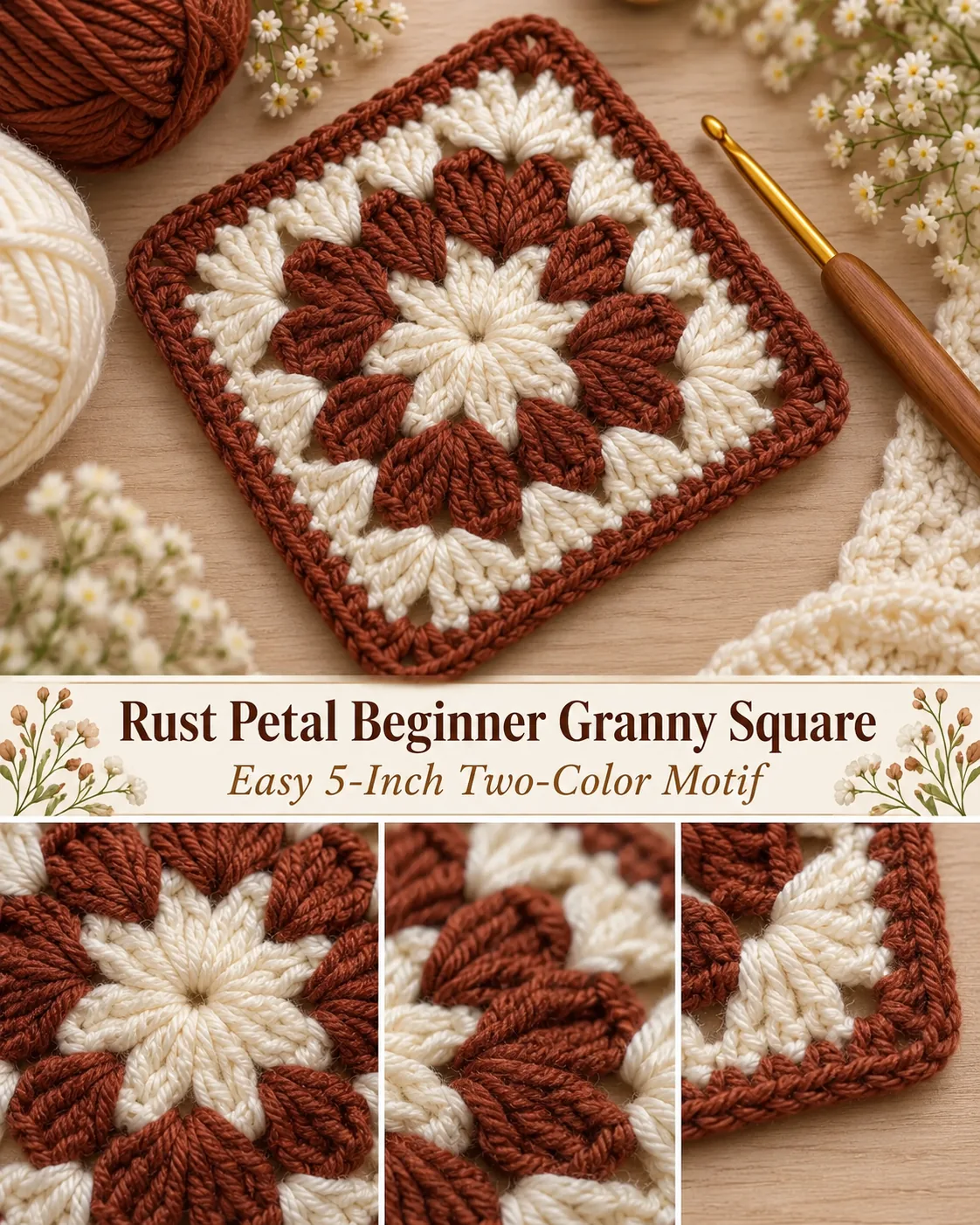
The Rust Petal Beginner Granny Square is a compact two-color crochet motif with a soft cream flower center, a raised rust-brown petal ring, a cream round that turns the flower into a square, and a tidy rust border. This Yarnimals version is written as one complete 5-inch motif with fixed colors, stitch counts, round counts, and corner placement so you can make the square from this article alone without needing to guess where any part belongs.
The construction is deliberately simple: the first two rounds stay circular and create the layered floral center, the third round uses the eight spaces around the flower to establish four corners and four side groups, and the fourth round frames the finished square in single crochet. The result has enough texture to look decorative while remaining manageable for a confident beginner.
Finished Size and Project Specification
- Finished size after blocking: approximately 5 x 5 inches / 12.5 x 12.5 cm
- Yarn: #4 worsted-weight
- Hook: 5.0 mm H-8
- Color A: warm cream
- Color B: rust brown
- Total rounds: 4
- Center petals: exactly 8 cream clusters
- Outer petals: exactly 8 rust clusters
- Square corners: exactly 4
- Round 3 stitch count: 36 dc plus four ch-2 corner spaces
- Round 4 stitch count: 48 sc total
- Construction: worked in joined rounds from the center outward
Materials
- Approximately 18-22 yd / 16-20 m of #4 worsted-weight yarn in warm cream
- Approximately 14-18 yd / 13-16 m of #4 worsted-weight yarn in rust brown
- 5.0 mm crochet hook
- Tapestry needle
- Scissors
- Optional stitch marker
- Blocking mat and rust-proof pins, optional but useful
Yarn and Color Notes
A smooth worsted-weight yarn gives the petal clusters enough body to stand out without hiding the stitch structure. Acrylic, wool blend, or cotton-blend yarn can all work, but use the same yarn family for both colors so the two rounds have similar thickness and elasticity.
This pattern is locked to warm cream and rust brown. Cream is used for the center flower and the squaring round. Rust brown is used for the second petal ring and the final border. Keeping the same color placement helps the raised petals remain the focal point.
Skill Level
Confident beginner. You should be comfortable making a magic ring, working double crochet, changing colors between rounds, finding chain spaces, joining rounds with a slip stitch, and following a repeated cluster sequence.
Abbreviations — US Crochet Terms
- ch = chain
- sc = single crochet
- dc = double crochet
- sl st = slip stitch
- sp = space
- st(s) = stitch(es)
- MR = magic ring
- 4dc-cl = 4-double-crochet cluster
- 5dc-cl = 5-double-crochet cluster
Special Stitch: 4-dc Cluster
Yarn over, insert the hook into the indicated ring or space, yarn over and pull up a loop, yarn over and pull through 2 loops. Leave the remaining loops on the hook. Repeat this partial-double-crochet sequence three more times in the same ring or space. You will have 5 loops on the hook. Yarn over and pull through all 5 loops. The cluster is complete. Do not add a chain unless the pattern specifically tells you to.
Special Stitch: 5-dc Cluster
Yarn over, insert the hook into the indicated space, yarn over and pull up a loop, yarn over and pull through 2 loops. Leave the remaining loops on the hook. Repeat this partial-double-crochet sequence four more times in the same space. You will have 6 loops on the hook. Yarn over and pull through all 6 loops. The cluster is complete.
Special Stitch: Corner Shell
Work 3 dc, ch 2, 3 dc into the same chain space. The ch-2 space becomes the corner for the next round.
Gauge and Finished Measurement
One completed four-round motif should block to approximately 5 inches square. Exact gauge is less important than achieving that finished measurement with a square that lies flat. If your motif is noticeably smaller, try a 5.5 mm hook. If it is much larger or loose and floppy, try a 4.5 mm hook.
Do not add another decorative round to change the size for this version. The Yarnimals project lock is one four-round, 5-inch motif.
Round-by-Round Structure
- Round 1: 8 cream 4dc clusters + 8 ch-2 spaces
- Round 2: 8 rust 5dc clusters + 8 ch-3 spaces
- Round 3: 4 cream corner shells + 4 cream side groups = 36 dc total
- Round 4: rust sc border = 48 sc total
Construction Overview
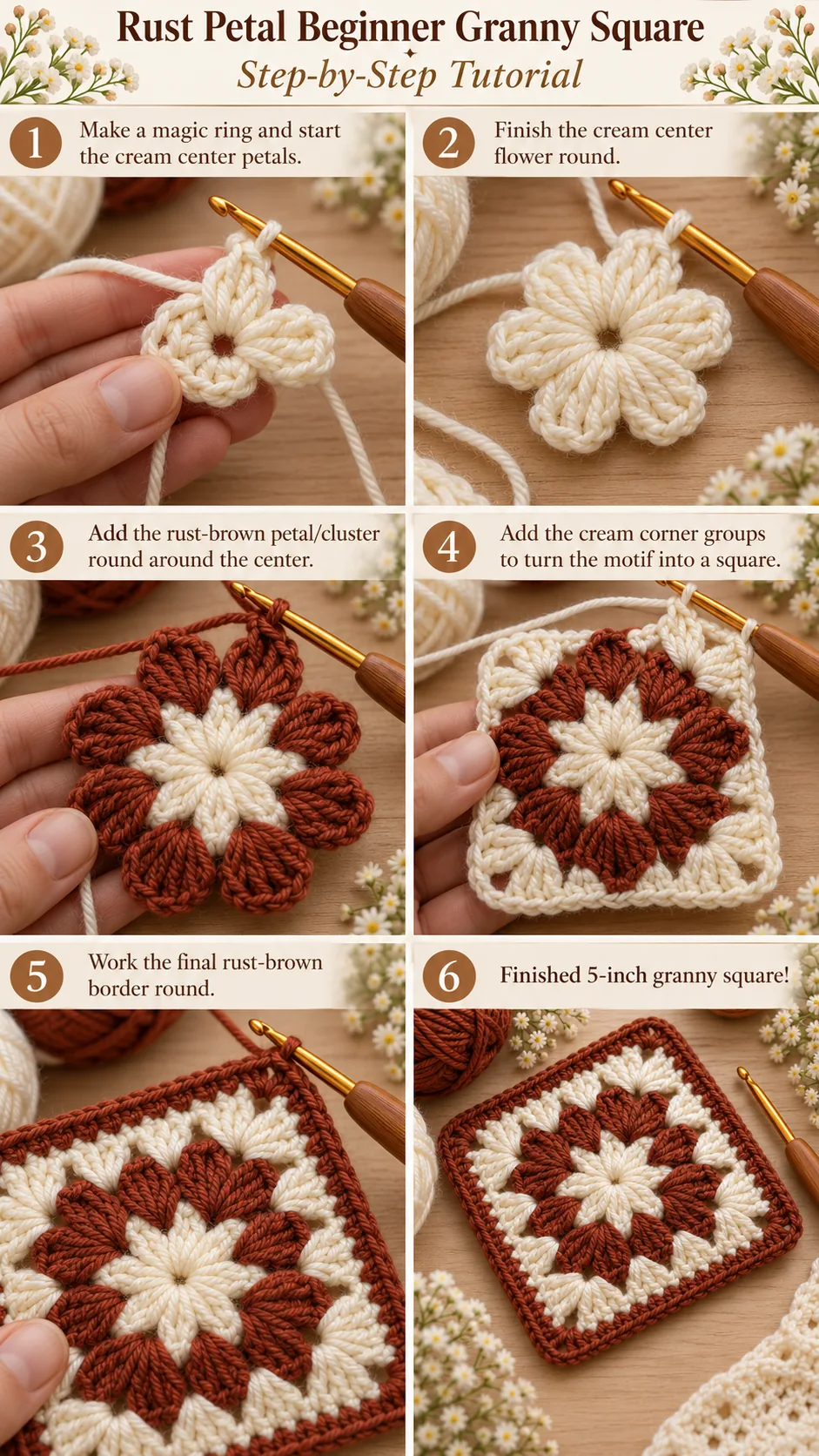
Start with a cream magic ring and build eight compact center petals. Change to rust and place one larger rust petal in each cream chain space, leaving eight new chain spaces around the outside. On the cream squaring round, use every other outer space as a corner and the alternating spaces as side groups. That converts the circle into a square with four equal sides. Finish with rust single crochet around the entire perimeter, working three single crochets into every corner space.
Detailed Pattern
Round 1 — Cream Center Flower
With cream, make a magic ring.
Round 1: Ch 1. Work 4dc-cl in the ring, ch 2. Repeat this sequence 8 times total. Pull the magic-ring tail until the center hole is small and neat. Join with sl st to the top of the first cluster. Fasten off cream.
Round 1 count: 8 cream 4dc clusters and 8 ch-2 spaces.
Round 1 Checkpoint
Spread the motif gently with your fingers. You should see eight cream petal-like clusters arranged evenly around the center. Count the eight ch-2 spaces as well. If you have seven or nine, correct the round before changing color because Round 2 depends on exactly eight spaces.
Round 2 — Rust Petal Ring
Join rust brown with a sl st in any Round 1 ch-2 space.
Round 2: Ch 1. In the same ch-2 space work 5dc-cl, ch 3. In each of the remaining seven ch-2 spaces work 5dc-cl, ch 3. Join with sl st to the top of the first rust cluster. Fasten off rust.
Round 2 count: 8 rust 5dc clusters and 8 ch-3 spaces.
Round 2 Checkpoint
The motif is still circular at this stage. Each rust cluster should sit in one cream ch-2 space, and there should be eight rust petals total. The ch-3 spaces form the working spaces for the cream squaring round.
Round 3 — Cream Squaring Round
Join cream in any Round 2 ch-3 space.
Round 3: In the same space work ch 3, 2 dc, ch 2, 3 dc. The beginning ch 3 counts as the first dc, so this is the first corner shell.
In the next ch-3 space work 3 dc.
*In the next ch-3 space work 3 dc, ch 2, 3 dc for a corner. In the next ch-3 space work 3 dc.* Repeat from * to * two more times.
Join with sl st to the top of the beginning ch 3. Fasten off cream.
Round 3 count: 4 corner shells, 4 side groups, 36 dc total, and 4 ch-2 corner spaces.
Understanding the Round 3 Math
There are eight Round 2 chain spaces. Four alternating spaces become corners and the other four become side groups. Each corner contains six dc, so the four corners contribute 24 dc. Each of the four side groups contains three dc, adding 12 more. That gives 36 dc total.
Between one corner space and the next, there are exactly 9 dc: three from the outgoing half of the first corner, three from the side group, and three from the incoming half of the next corner.
Round 3 Checkpoint
Lay the motif flat. It should now clearly have four corners. Each corner must have one ch-2 space. There should be one 3-dc side group centered between adjacent corners. If the motif still looks round, check whether you accidentally worked a corner in every chain space instead of every other space.
Round 4 — Rust Single-Crochet Border
Join rust brown in any Round 3 ch-2 corner space.
Round 4: Ch 1. Work 3 sc in the corner space. Sc in each of the next 9 dc across the side.
*Work 3 sc in the next ch-2 corner space. Sc in each of the next 9 dc across the next side.* Repeat from * to * around the remaining three sides. Join with sl st to the first sc. Fasten off.
Round 4 count: 36 sc worked into dc stitches + 12 sc worked into the four corner spaces = 48 sc total.
Final Shape Check
After Round 4, the motif should lie flat with four clearly defined corners and straight sides. The rust border should frame the cream squaring round without covering the raised rust petals in the center.
Measure the motif before blocking. It should be close to 5 inches. A small difference can usually be corrected by gentle blocking, but a large difference indicates that your hook size or tension is not matching the pattern.
Blocking
Weave in all ends before blocking. Dampen the square according to the yarn-care instructions, then place it on a blocking mat or folded towel.
Pin the four corners first to a 5-inch square. Measure diagonally from corner to corner in both directions and adjust until the diagonals match. Then smooth the sides without stretching the center flower flat. Allow the square to dry completely before removing the pins.
Weaving in Ends
Use a tapestry needle to weave each tail through stitches of the same color whenever possible. Change direction at least once. Avoid dragging a rust tail through the cream center or a cream tail through the rust border because contrasting yarn can show through the front.
Visual Checkpoints
After Round 1: 8 cream petals and 8 ch-2 spaces.
After Round 2: 8 raised rust petals and 8 ch-3 spaces. The motif is still round.
After the first half of Round 3: you should already see two corners forming with one simple 3-dc side group between them.
After Round 3: 4 corners, 4 side groups, 36 dc total.
After Round 4: 48 sc total and a clean rust frame around the square.
Troubleshooting
The center will not close
Make sure all eight cream clusters are worked over the magic ring itself. After finishing Round 1, pull the ring tail before weaving it in. If the yarn is slippery, secure the tail by weaving it around the center in two directions.
The petals look flat
Do not make the partial double crochets too short. Pull each loop up to a consistent height before closing the cluster. Smooth yarn also gives better petal definition than fuzzy yarn.
I have the wrong number of rust petals
Round 2 uses exactly one rust 5dc cluster in each Round 1 ch-2 space. Count eight cream spaces before beginning and eight rust clusters before fastening off.
The square has too many corners
Round 3 alternates corner space, side-group space, corner space, side-group space. Only four of the eight Round 2 spaces receive corner shells.
The cream square round cups inward
Your corner chains or double crochets may be too tight. Keep each ch-2 corner relaxed. If the motif still cups after the counts are confirmed, move up 0.5 mm in hook size for Round 3 only.
The final rust border ruffles
Round 4 has no increases except the three single crochets in each of the four corner spaces. Work one sc in every Round 3 dc and do not add extra stitches between groups.
My final count is not 48
Round 3 contains 36 dc. Round 4 works one sc into each of those 36 stitches plus three sc in each of four corner spaces. That is 36 + 12 = 48.
Using Multiple Squares
This article is intentionally one motif pattern, but the same finished square can be repeated for larger projects. If you plan to join multiples, block every square to the same 5-inch measurement before assembly. Keep the same yarn, hook, tension, and color placement so the corners align cleanly.
For joining, the 48-stitch outer border gives a stable edge. Each side has a consistent group of border stitches between corner centers, making the motif suitable for whipstitch, slip-stitch, or single-crochet joining in a future project.
Pattern at a Glance
- Use #4 worsted yarn and a 5.0 mm hook.
- Round 1 cream: 8 4dc clusters + 8 ch-2 spaces.
- Round 2 rust: 8 5dc clusters + 8 ch-3 spaces.
- Round 3 cream: 4 corner shells + 4 side groups = 36 dc.
- Round 4 rust: 3 sc in each corner, 1 sc in each dc = 48 sc.
- Weave in ends and block to approximately 5 x 5 inches.
The completed Rust Petal Beginner Granny Square has one consistent construction from center to border: eight cream petals, eight larger rust petals, four cream corners, and a 48-stitch rust frame. Once the first motif is blocked to 5 inches, the same four-round sequence can be repeated whenever you need another matching square.